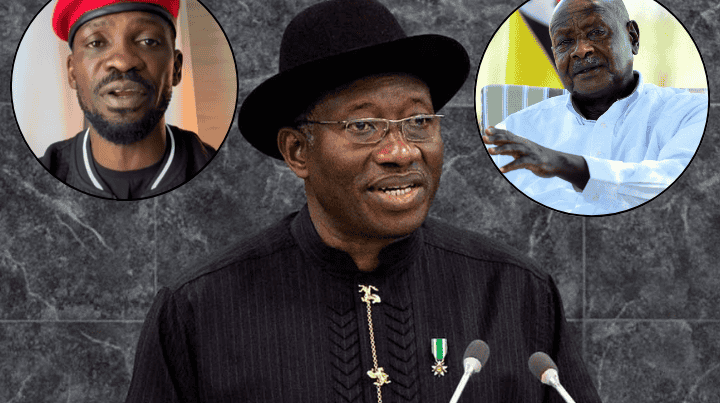
Former Nigerian President Goodluck Ebele Jonathan arrived in Kampala this week to lead a joint election observation mission organised by the African Union (AU), the Common Market for Eastern and Southern Africa (COMESA) and the Inter‑Governmental Authority on Development (IGAD) ahead of Uganda’s general elections on 15 January 2026, according to a report by P.M. News Nigeria.
An official statement from the regional blocs said the mission was invited by Uganda’s government and the Electoral Commission of Uganda to monitor voting across the country.
The multi‑organisation mission is composed of 84 short‑term observers drawn from ambassadors accredited to the AU, election management officials, civil society representatives, human‑rights specialists, and gender and media experts.
Jonathan is supported by Ambassador Shemsudin Ahmed Roble, a member of the COMESA Committee of Elders, and Commander Abebe Muluneh Beyene from IGAD. Observers have been sourced from 27 African countries including Algeria, Botswana, Burundi, Cameroon, Côte d’Ivoire, Ghana, Kenya, Nigeria, South Africa, Tanzania and Zimbabwe ensuring a broad regional representation.
According to the mission’s arrival statement, teams will be deployed to polling stations nationwide to monitor the opening of polls, voting, closing procedures and vote counting. The observers will assess the polls based on Uganda’s electoral laws as well as continental and international frameworks such as the OAU/AU Declaration on the Principles Governing Democratic Elections, the African Charter on Democracy, Elections and Governance and the International Declaration of Principles for International Election Observation.
The mission said its engagement will extend beyond polling stations to interactions with state authorities, political parties, media, civil society organisations and other observer teams.
The AU‑COMESA‑IGAD mission plans to issue a preliminary statement on 17 January 2026 in Kampala and follow up with a comprehensive report within a month of the final results. Officials underscored that the joint mission aims to promote transparency and adherence to democratic norms, echoing similar statements from regional bodies.
Uganda’s general elections will determine the president, members of parliament and local government leaders. The country has registered about 21 million voters, and the presidential race features eight candidates, including incumbent President Yoweri Museveni, who has led the nation since 1986, and opposition figures such as Robert Kyagulanyi Ssentamu (popularly known as Bobi Wine), Nathan Nandala Mafabi, Gregory Mugisha Muntu, Mubarak Munyagwa Sserunga, Frank Bulira Kabinga, Robert Kasibante and Joseph Mabirizi.
Museveni’s long tenure and the competitive field have drawn regional and international attention to the credibility of the upcoming vote. Observers and rights groups have emphasised the importance of a transparent process to bolster democratic consolidation in Uganda.
Source: PM news Nigeria
OPPOSITION POLITICS
Jonathan Leads AU‑COMESA‑IGAD Mission to Observe Uganda Elections

Jan 12, 2026
May 15, 2026
3 min read
Published
Updated:
Former Nigerian President Goodluck Ebele Jonathan arrived in Kampala this week to lead a joint election observation mission organised by the African Union (AU), the Common Market for Eastern and Southern Africa (COMESA) and the Inter‑Governmental Authority on Development (IGAD) ahead of Uganda’s general elections on 15 January 2026, according to a report by P.M. News Nigeria.
An official statement from the regional blocs said the mission was invited by Uganda’s government and the Electoral Commission of Uganda to monitor voting across the country.
The multi‑organisation mission is composed of 84 short‑term observers drawn from ambassadors accredited to the AU, election management officials, civil society representatives, human‑rights specialists, and gender and media experts.
ADVERTISEMENT
Jonathan is supported by Ambassador Shemsudin Ahmed Roble, a member of the COMESA Committee of Elders, and Commander Abebe Muluneh Beyene from IGAD. Observers have been sourced from 27 African countries including Algeria, Botswana, Burundi, Cameroon, Côte d’Ivoire, Ghana, Kenya, Nigeria, South Africa, Tanzania and Zimbabwe ensuring a broad regional representation.
According to the mission’s arrival statement, teams will be deployed to polling stations nationwide to monitor the opening of polls, voting, closing procedures and vote counting. The observers will assess the polls based on Uganda’s electoral laws as well as continental and international frameworks such as the OAU/AU Declaration on the Principles Governing Democratic Elections, the African Charter on Democracy, Elections and Governance and the International Declaration of Principles for International Election Observation.
ADVERTISEMENT
The mission said its engagement will extend beyond polling stations to interactions with state authorities, political parties, media, civil society organisations and other observer teams.
The AU‑COMESA‑IGAD mission plans to issue a preliminary statement on 17 January 2026 in Kampala and follow up with a comprehensive report within a month of the final results. Officials underscored that the joint mission aims to promote transparency and adherence to democratic norms, echoing similar statements from regional bodies.
Uganda’s general elections will determine the president, members of parliament and local government leaders. The country has registered about 21 million voters, and the presidential race features eight candidates, including incumbent President Yoweri Museveni, who has led the nation since 1986, and opposition figures such as Robert Kyagulanyi Ssentamu (popularly known as Bobi Wine), Nathan Nandala Mafabi, Gregory Mugisha Muntu, Mubarak Munyagwa Sserunga, Frank Bulira Kabinga, Robert Kasibante and Joseph Mabirizi.
TRENDING NOW


POPULAR TODAY


ADVERTISEMENT
Museveni’s long tenure and the competitive field have drawn regional and international attention to the credibility of the upcoming vote. Observers and rights groups have emphasised the importance of a transparent process to bolster democratic consolidation in Uganda.
Source: PM news Nigeria
ADVERTISEMENT
RELATED ARTICLE