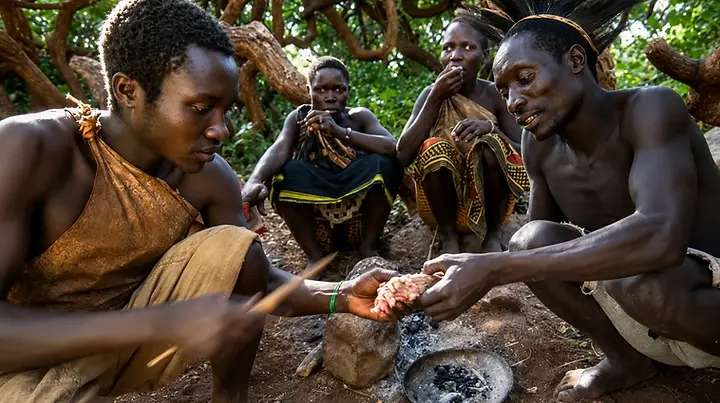
Food sharing is one of the most important parts of Hadza life. But it is often misunderstood.
The Hadza, who live around Lake Eyasi in northern Tanzania, are widely known as hunter-gatherers. They hunt, gather tubers, collect berries and baobab, and search for honey. In many descriptions, their food sharing sounds simple: someone gets food, then gives some to others.
The research shows something more complex.
Hadza food sharing is about survival, but it is also about morality, equality, reputation, and social life. It helps people eat in an uncertain environment. It also prevents one person from turning food into power over others.
Quick Facts
The Hadza live in northern Tanzania, especially around the Lake Eyasi region.
Food sharing is central to Hadza camp life.
Large game meat is widely shared, but not simply as direct repayment.
Hunters often do not fully control who receives meat from a large carcass.
Sharing helps limit hoarding, inequality, and dependency.
AFRICAN CULTURE
Why the Hadza Share Food: Morality, Survival, and Social Life

Jun 23, 2026
Jun 23, 2026
10 min read
Published
Updated:
Food sharing is one of the most important parts of Hadza life. But it is often misunderstood.
The Hadza, who live around Lake Eyasi in northern Tanzania, are widely known as hunter-gatherers. They hunt, gather tubers, collect berries and baobab, and search for honey. In many descriptions, their food sharing sounds simple: someone gets food, then gives some to others.
The research shows something more complex.
Hadza food sharing is about survival, but it is also about morality, equality, reputation, and social life. It helps people eat in an uncertain environment. It also prevents one person from turning food into power over others.
Quick Facts
The Hadza live in northern Tanzania, especially around the Lake Eyasi region.
Food sharing is central to Hadza camp life.
Large game meat is widely shared, but not simply as direct repayment.
Hunters often do not fully control who receives meat from a large carcass.
Sharing helps limit hoarding, inequality, and dependency.
Hadza men may gain reputation from hunting, even when most meat goes to others.
Men also eat while away from camp, especially honey, so returning empty-handed does not always mean they failed to find food.
The Hadza live in northern Tanzania, especially around the Lake Eyasi region
Lake Eyasi, northern Tanzania — the ancestral homeland of the Hadza people
Who Are the Hadza?
The Hadza are a hunter-gatherer people of northern Tanzania. In a major study of Hadza meat sharing, Kristen Hawkes, James O’Connell, and Nicholas Blurton Jones describe them as “about 750 hunter-gatherers” living in the arid savanna woodlands southeast of Lake Eyasi (Hawkes, O’Connell & Blurton Jones, 2001, p. 116).
Their camps are mobile and flexible. Hawkes and colleagues observed that camps could vary by season, often becoming larger in the dry season and smaller in the wet season. This matters because food sharing happens inside real camp life, where people move, visit, claim food, help carry meat, and eat together.
For language context, Hadza is listed by Glottolog as a distinct language, often discussed for its click consonants.
Sharing Is Not Just Kindness
It is tempting to describe Hadza food sharing as pure generosity. That is too simple.Sharing is generous, but it is also expected. It is part of how Hadza social life works. In James Woodburn’s classic study of egalitarian societies, he argues that immediate-return hunter-gatherer societies use practices that “impose sharing” and prevent accumulation (Woodburn, 1982, p. 431).That phrase is important. It means sharing is not only a private moral choice. It is also a social rule.
Among the Hadza, food should not become a tool for making other people dependent. A person who hoards food while others are hungry risks violating a deep expectation of camp life. Sharing helps keep people socially close without allowing one household or hunter to dominate others.
Survival in an Uncertain Environment
Food sharing also helps people survive.
Hunting large animals is unpredictable. A hunter may succeed one day and fail many other days. Gathered foods, honey, and meat also vary by season and place. In that kind of environment, sharing can reduce the danger of one person or household going without.

But the Hadza evidence does not support the simple idea that meat sharing is only direct repayment.
Hawkes, O’Connell, and Blurton Jones tested whether Hadza meat sharing worked like risk-reduction reciprocity. In that model, a hunter shares today so others will repay him with meat later. Their conclusion was clear: Hadza meat sharing “does not fit” that simple model (Hawkes et al., 2001, p. 113).
The reason is that better hunters did not simply receive more meat back from others. Poorer hunters were not excluded in the way a strict repayment system would predict. So survival matters, but Hadza sharing is not just a food insurance contract.
ADVERTISEMENT
Who Owns the Meat?
One of the most important findings is that a successful hunter does not fully own the meat in the way outsiders might expect.

Hawkes and colleagues write that the “hunter does not control” the distribution of his kill (Hawkes et al., 2001, p. 113). Once a large animal is killed, news spreads quickly. People may come to the kill site. Others help butcher and carry the meat. Large carcasses attract claims.
This changes the meaning of sharing. The question is not simply, “Why does a hunter give away his meat?” The better question is, “Why is a large carcass treated as something many people can claim?”
Woodburn gives a strong moral explanation. Large game is exactly the kind of food that could create inequality if one person controlled it. So sharing works as a levelling force.
Food, Equality, and Morality
Hadza food sharing is closely tied to equality.
Woodburn describes Hadza society as strongly egalitarian. In his analysis, people have direct access to food and resources, and this weakens formal authority. He even writes that, among the Hadza, “there are no household heads” in the usual authoritarian sense (Woodburn, 1982, p. 439).
This does not mean everyone is identical. Some people are better hunters. Some are older, stronger, more skilled, or more knowledgeable. But food sharing helps stop these differences from becoming permanent power.
Woodburn also notes that certain valued meat portions cannot be privately eaten by the hunter. He describes such an act as a “heinous offence” in Hadza terms (Woodburn, 1982, p. 441). That detail shows that sharing is not just practical. It has moral weight.
Food belongs inside a social world. A person who tries to remove it from that world can be judged harshly.
Reputation and the Successful Hunter
If hunters do not keep most of the meat, why hunt large animals?
One answer is reputation.

Hawkes and colleagues suggest that a successful hunter may gain status as a desirable neighbor. People know who brought in the animal. Even if the hunter does not control all the meat, his success matters socially.
This means hunting can be both economic and social. A hunter creates a food event that benefits many people. In return, he may gain respect, attention, and a stronger place in camp life.
ADVERTISEMENT
But this is not the same as becoming a chief or owner. The hunter’s reputation grows, while the meat still circulates.
Eating Before Sharing
Another misconception is that all food found by Hadza men is carried back to camp.
A study by J. Colette Berbesque and colleagues is useful here. Its title says the point clearly: “Eat first, share later” (Berbesque et al., 2016, p. 281). The researchers followed Hadza men during foraging trips and found that men often ate substantial food while away from camp, especially honey.
This matters because a man who comes back empty-handed may not have failed to find food. He may have eaten while out.Berbesque and colleagues warn that studies based only on what returns to camp can miss part of the picture. Sharing is real, but so is on-the-spot eating. Both need to be understood together.
Food Sharing and Camp Life
Hadza sharing happens in a living social setting.
O’Connell, Hawkes, and Blurton Jones describe Hadza foraging as a “central-based foraging strategy” in which people move out from camp and return with food when possible (O’Connell, Hawkes & Blurton Jones, 1988, p. 116).
Large animal carcasses may be butchered away from camp. Meat is transported back. Some is eaten at the kill site. Some is assigned to household areas. Some may be dried or traded. The process is not a neat private transaction between one hunter and one recipient.
It is social, visible, and often public.
Common Misconceptions
The Hadza Share Because They Are Naturally Generous
This is too simple. Sharing includes generosity, but it is also shaped by social expectation, moral pressure, and the need to prevent hoarding.
Hadza Sharing Is Just Direct Reciprocity
The strongest meat-sharing evidence does not support this. Hawkes and colleagues found that Hadza meat sharing did not match a simple meat-for-meat repayment model.
The Hunter Owns the Carcass Completely
The evidence suggests otherwise. Once a large carcass is known, the hunter does not fully control distribution.
Empty-Handed Means Unsuccessful
Not always. Berbesque and colleagues show that Hadza men may eat a large amount while foraging away from camp.
Why Hadza Food Sharing Matters
Hadza food sharing matters because it shows how food can hold a society together.


POPULAR TODAY


ADVERTISEMENT
It is about calories, but not only calories. It is about who can claim food, who can refuse, who gains respect, and who is prevented from becoming too powerful. It helps people survive uncertainty while also protecting equality.
For the Hadza, sharing is not a soft extra added after survival. It is part of survival itself.
The Hadza share food because sharing helps people live together in a difficult and uncertain environment. But survival is only part of the answer.
Sharing also expresses a moral system. It limits hoarding. It protects equality. It makes reputation visible without allowing one person to turn food into lasting authority.
That is why Hadza food sharing is so powerful. It is not only about who eats today. It is about what kind of society people are able to keep alive.
Sources and Further Reading
Hawkes, Kristen; O’Connell, James F.; Blurton Jones, Nicholas G. (2001). “Hadza Meat Sharing.” Evolution and Human Behavior, 22(2), 113–142.
Woodburn, James (1982). “Egalitarian Societies.” Man, New Series, 17(3), 431–451
Berbesque, J. Colette; Wood, Brian M.; Crittenden, Alyssa N.; Mabulla, Audax; Marlowe, Frank W. (2016). “Eat First, Share Later: Hadza Hunter-Gatherer Men Consume More While Foraging Than in Central Places.” Evolution and Human Behavior, 37(4), 281–286.
O’Connell, James F.; Hawkes, Kristen; Blurton Jones, Nicholas G. (1988). “Hadza Hunting, Butchering, and Bone Transport and Their Archaeological Implications.” Journal of Anthropological Research, 44(2), 113–161.
UNESCO. “Empowering Indigenous Knowledge: UNESCO Launches Intersectoral Project with Hadzabe Community in Tanzania.”
ADVERTISEMENT
RELATED ARTICLE