The Hadza, also called the Hadzabe, are an Indigenous people of northern Tanzania. They are best known as one of the few communities in Africa where hunting and gathering remains a living part of daily life.
But the Hadza are not people frozen in the past. They are modern Tanzanians facing land pressure, schooling debates, tourism, market contact, conservation projects, and changing livelihoods.
The better question is not only “Who are the Hadza tribe?” It is also: how have the Hadza kept their culture alive while the world around Lake Eyasi keeps changing?
Quick Facts
Name: Hadza or Hadzabe
Location: Lake Eyasi region, northern Tanzania
Language: Hadzane, a click language of uncertain affiliation
Traditional livelihood: Hunting, honey collecting, gathering tubers, berries, baobab, and other wild foods
Social structure: Highly mobile and strongly egalitarian
AFRICAN CULTURE
Who Are the Hadza?

Jun 22, 2026
Jun 22, 2026
16 min read
Published
Updated:
The Hadza, also called the Hadzabe, are an Indigenous people of northern Tanzania. They are best known as one of the few communities in Africa where hunting and gathering remains a living part of daily life.
But the Hadza are not people frozen in the past. They are modern Tanzanians facing land pressure, schooling debates, tourism, market contact, conservation projects, and changing livelihoods.
Daily life in Hadzaland near Lake Eyasi, where traditional knowledge, cultural heritage, and a close Daily life in Hadzaland near Lake Eyasi, where traditional knowledge, cultural heritage, and a close Daily life in Hadzaland near Lake Eyasi, where traditional knowledge, cultural heritage, and a close The rugged environment of the Lake Eyasi basin. Source: Ivan Grabilin / Getty Images
The better question is not only “Who are the Hadza tribe?” It is also: how have the Hadza kept their culture alive while the world around Lake Eyasi keeps changing?
Quick Facts
Name: Hadza or Hadzabe
Location: Lake Eyasi region, northern Tanzania
Language: Hadzane, a click language of uncertain affiliation
Traditional livelihood: Hunting, honey collecting, gathering tubers, berries, baobab, and other wild foods
Social structure: Highly mobile and strongly egalitarian
Modern issues: Land rights, tourism, education, markets, conservation, and carbon projects
Who Are the Hadza People?
The Hadza live around Lake Eyasi in northern Tanzania. In her University of Cambridge thesis, Katherine Fitzpatrick describes them as a hunter-gatherer population living “near Lake Eyasi in northern Tanzania” (Fitzpatrick, 2018, PDF p. 21). She also notes that Hadzaland covers about 4,000 km² around the lake (Fitzpatrick, 2018, PDF p. 23).
The two famous media hadza hunters
Chabba, the famous and great hunter(Left) and The famous Dudukwe from Hadzabe Tribe
The Hadza are often called a “tribe” in popular writing, but “Hadza people” or “Hadzabe people” is more accurate and respectful. They are not a tourist image or a survival from another age. They are a living Indigenous community with their own language, food knowledge, family life, rituals, and political struggles.
Further Reading
Katherine K. Fitzpatrick (2018)
Foraging and Menstruation in the Hadza of Tanzania
Relevant pages: PDF pp. 21-28
University of Cambridge repository
History and Origins
The Hadza live in a region with a very long archaeological record of hunting and gathering. Cambridge University Press summarizes Nicholas Blurton Jones’s book by noting that archaeology shows 130,000 years of hunting and gathering in Hadza land.
That does not mean modern Hadza people are unchanged from prehistoric times. A careful article should avoid saying the Hadza are “Stone Age” or “untouched.” The safer point is that the Lake Eyasi region has a deep history of foraging, and the Hadza remain one of the best-documented hunter-gatherer peoples in Africa.
Language
The Hadza speak Hadzane. Linguists Bonny Sands, Ian Maddieson, and Peter Ladefoged describe Hadza as a “language of uncertain genetic affiliation” (Sands, Maddieson & Ladefoged, 1996, PDF p. 1).
They also note that it is “one of three East African languages with clicks” (Sands, Maddieson & Ladefoged, 1996, PDF p. 1).
ADVERTISEMENT
Hadza has sometimes been linked to Khoisan languages, but the evidence is debated. The safest wording is that Hadzane is a click language often treated as a language isolate or a language of uncertain classification.
Further Reading
Sands, Maddieson & Ladefoged (1996)
The Phonetic Structures of Hadza
Relevant pages: PDF pp. 1-4
Traditional Lifestyle
Hadza life has long been shaped by movement, foraging, and deep knowledge of the local environment. Fitzpatrick identifies five major Hadza food categories: “meat, tubers, berries, honey, and baobab” (Fitzpatrick, 2018, PDF p. 25).
Men often hunt and collect honey. Women often gather tubers, berries, and baobab. But this division should not be made too rigid. The research shows patterns, not absolute rules. Men may gather plant foods, and women’s food production is central to camp life.
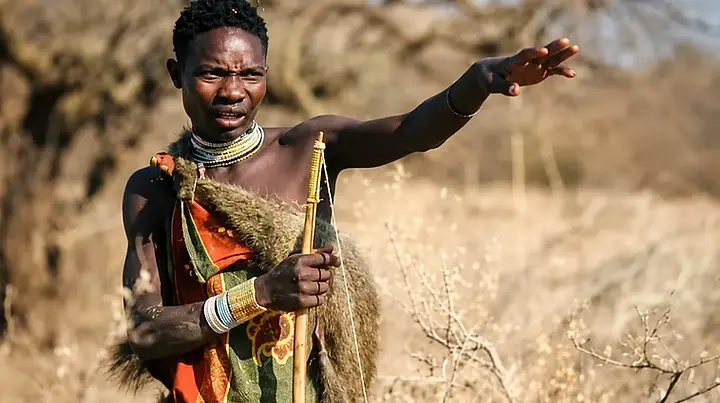
The hunters
The Hadza people, one of Africa’s best-known hunter-gatherer communities, maintain deep connections
A study by Berbesque and colleagues also warns against a simple picture of men returning to camp either successful or empty-handed. Hadza men in that study consumed an average of “2,405 kilocalories per foray” while away from camp, much of it from honey (Berbesque et al., 2016, p. 281). In other words, a man may return without food to share but still have found food for himself.
Further Reading
Berbesque et al. (2016)
Eat First, Share Later
Relevant pages: 281-282
Family and Leadership
Hadza society is famous in anthropology for being egalitarian. James Woodburn, one of the most important scholars of Hadza social life, wrote that some societies have “no real authority over each other” (Woodburn, 1982, p. 431). He later described the Hadza and similar immediate-return hunter-gatherer societies as “profoundly egalitarian” (Woodburn, 1982, p. 434).
Hadza men and women at a communal camp in the Lake Eyasi region, illustrating traditional shelter co
This does not mean there are no rules. It means power is not usually organized through chiefs, inherited offices, or strong property hierarchies. Decisions are often shaped by discussion, personal autonomy, mobility, and social pressure.
The Hadza are also known for flexible camp life. People may move between camps, and social life is not locked into one permanent settlement.
Further Reading
James Woodburn (1982)
Egalitarian Societies
Relevant pages: 431-438
Marriage and Family Traditions
A Note on Hadza Marriage: In Hadza society, marriage is a beautifully minimalist and fluid union. Because they practice a highly egalitarian courtship system, there are no institutionalized wedding ceremonies, complex dowries, or rigid bridal contracts. Instead, a union is socially recognized simply when a couple chooses to cohabit and share a hearth.
ADVERTISEMENT

To fully capture the nuances of their serial monogamy and domestic dynamics, a dedicated feature exploring the field research of anthropologists like Frank Marlowe and Nicholas Blurton Jones is currently in development.
Religion and Beliefs
Hadza belief and ritual life should be handled carefully. Older sources often described the Hadza as having little or no religion. Later researchers have challenged that view.
Thea Skaanes argues that Hadza ritual and cosmology have been underexamined. She writes of “deep cosmological complexity” in Hadza life (Skaanes, 2015, PDF p. 2). Her work focuses on epeme, ritual objects, names, spirits, women’s objects, and night dance.
The safe conclusion is not that the Hadza have one fixed religion with a single doctrine. It is that Hadza ritual life exists, varies, and has often been oversimplified by outsiders.
Further Reading
Thea Skaanes (2015)
Notes on Hadza Cosmology: Epeme, Objects and Rituals
Relevant pages: PDF pp. 2-5
Clothing and Appearance
The Evolution of Hadza Adornment: The daily attire of the Hadza reflects their practical, minimalist lifestyle and their fluid relationship with neighboring groups. Rather than wearing elaborate, static ceremonial costumes, modern Hadza look primarily to comfort and utility often blending handcrafted elements like leather pieces and intricate glass beadwork with lightweight, western-style secondhand clothing acquired through local trade.

Because their material culture is constantly adapting, a specialized visual feature examining their historical dress transitions and contemporary aesthetics is currently in development.
Food and Cuisine
Food is one of the best-documented parts of Hadza life. Meat, honey, tubers, berries, baobab, and regional foods such as marula nuts all appear in the research.
Hadza food is not only about survival. It is part of social life, movement, gendered work, sharing, and knowledge of the land. Honey is especially important in several studies, including men’s out-of-camp foraging.
The important journalistic caution is this: do not reduce Hadza cuisine to “men hunt, women gather.” The real picture is more flexible, seasonal, and socially complex.
Ceremonies and Rituals
The strongest preserved evidence concerns epeme, a ritual complex often linked to night dancing, meat, spirits, and gendered ritual knowledge. Skaanes’s work suggests that ritual objects and naming practices can carry deep meaning in Hadza cosmology.
However, the dossier does not support a broad summary of all Hadza ceremonies, songs, and arts. More research is needed before making wider claims.
Role of Women
Fitzpatrick’s thesis was designed partly to correct the way women’s work had been underexamined in hunter-gatherer studies. Her research found that Hadza women eat and share food outside camp and that women’s foraging cannot be treated as a minor background activity.


POPULAR TODAY


ADVERTISEMENT

Women commonly gather tubers, berries, baobab, and other plant foods. They often forage in groups, while men more often hunt alone or in pairs. This division of labour is important, but it should not be written as if women simply wait for men to provide food.
Music, Dance, and Arts
For a tribe that travels light, art isn't something you hang on a wall it’s something you live. The Hadza don't carry heavy musical instruments or build complex statues because they are always moving. Instead, their art comes alive at night through the power of voice, dance, and storytelling around the fire.

To do justice to this incredible auditory and spiritual world, we are putting together a standalone deep dive into the songs, stories, and sacred dances of the Hadza for an upcoming feature.
Modern Life
Modern Hadza life is changing. Land pressure from farming, grazing, tourism, conservation rules, and market contact has affected Hadza communities in different ways.
A Namati/UCRT case study reports that in 2011 Hadzabe communities gained Certificates of Customary Right of Occupancy, or CCROs, for land in northern Tanzania. The case study describes this as the first legal certification of land granted to a hunter-gatherer community in Tanzania.
The Equator Initiative Yaeda Valley Project case study also links Hadza land rights to forest conservation and carbon finance. It reports that the Hadza gained legal tenure over more than 20,000 hectares and that carbon revenue helped fund community wildlife scouts and local needs.
These projects show a major point: modern Hadza life is not only about preserving tradition. It is also about legal rights, environmental politics, and decisions about the future.
Common Misconceptions
The Hadza are Stone Age people.
This is misleading. The Hadza are contemporary people. Some continue to forage; others engage with schools, markets, tourism, conservation work, and nearby towns.
All Hadza live only by hunting and gathering.
If you think every single Hadza person lives 100% off the land by tracking game and digging tubers, it’s time to bust a major myth. While they are famous for keeping the ancient hunter-gatherer lifestyle alive, modern life has brought major changes to Lake Eyasi. Today, fewer Hadza live strictly by the old ways.
Due to shrinking wild spaces and outside contact, many families now balance traditional foraging trips with farming, trading, or working alongside local tourism groups. It's a fascinating look at how a highly resilient society adapts to the modern world without completely losing its identity.
Hadza society has no rules.
This False, Hadza society is egalitarian, but egalitarian does not mean ruleless. Sharing, mobility, autonomy, and social expectations all matter.
The Hadza have no religion.
Too simple, Earlier sources often minimized Hadza religion, but later work documents ritual and cosmological life.Skaanes documents Hadza ritual objects, naming practices, epeme night dance, spirits, death, and cosmological ideas, arguing that Hadza ritual life has been underexamined rather than absent.
Source: Skaanes (2015), pp. 248-251.
The Hadza are one of Africa’s most studied hunter-gatherer peoples, but they are often misunderstood. Their culture is not a museum piece. It is a living, changing way of life rooted in Lake Eyasi, Hadzane language, foraging knowledge, egalitarian social values, ritual practice, and modern struggles over land and identity.
To ask “Who are the Hadza tribe?” is to ask about much more than hunting and gathering. It is to ask how an Indigenous people continues to defend land, language, food knowledge, and cultural freedom in modern Tanzania.
Reference
Fitzpatrick, Katherine K. (2018). Foraging and Menstruation in the Hadza of Tanzania. University of Cambridge.
Blurton Jones, Nicholas (2016). Demography and Evolutionary Ecology of Hadza Hunter-Gatherers. Cambridge University Press.
Sands, Bonny, Ian Maddieson & Peter Ladefoged (1996). “The Phonetic Structures of Hadza.”
Skaanes, Thea (2015). “Notes on Hadza Cosmology: Epeme, Objects and Rituals.”
Berbesque et al. (2016). “Eat First, Share Later.”
Namati/UCRT. “Securing Collective Land Tenure for Hunter-Gatherers in Tanzania.”
Equator Initiative. “Yaeda Valley Project Case Study.”
ADVERTISEMENT
RELATED ARTICLE