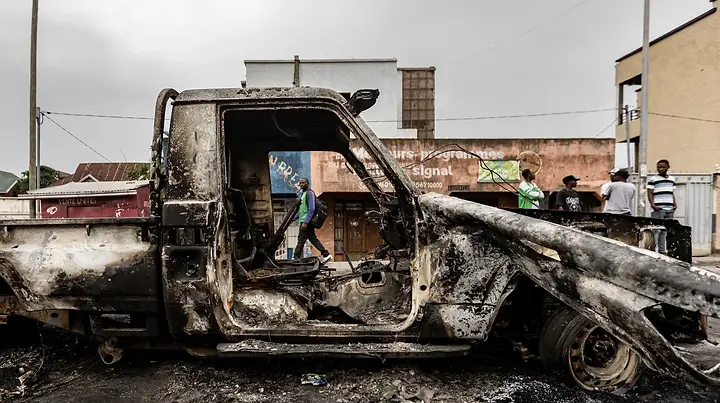
The midnight assault on 3 June in the Congolese town of Mbau, Beni Territory, underscores how vulnerable civilians remain despite years of joint military operations against the Allied Democratic Forces (ADF). According to survivors interviewed by Actualité.CD, at least sixteen people were killed when ADF fighters attacked three neighbourhoods Matete, Kithoho and Mamuli simultaneously.
Homes and motorcycles were set ablaze, and five people remain missing, heightening fear and causing another wave of displacement. Witnesses say the attack unfolded during a wake and in private houses, catching residents off guard.
The victims’ profiles highlight the brutality of the raid. Among those killed were a Kimbanguist pastor, his wife and daughter; two police officers’ wives; a baby and two schoolchildren.
Survivors lamented that local authorities failed to respond promptly to warnings, complaining that civilian alerts are often ignored. The raid came only days after coordinated ADF attacks in Beni and nearby Vemba left at least twenty‑one dead, bringing the toll in a 20‑km radius to around forty civilians.
Why does this incident matter?
First, it illustrates the ADF’s capacity to strike repeatedly despite heavy military pressure. Earlier this year, It was previously reported that at least forty people were killed when militants attacked villages near the Uganda border; local sources said twenty‑five died in Beni Territory and fifteen in Ituri Province.
The killings underscore the group’s resilience and its affiliation to the Islamic State’s Central Africa Province.
Mbau’s attack also mirrors the late‑March assault in Ituri’s Mambasa Territory, where forty‑three people were killed and forty‑four houses burned; authorities vowed to reinforce operations but acknowledged that prior measures had not prevented the tragedy. By linking the recent attack with these earlier incidents, it becomes clear that the ADF remains capable of mass‑casualty operations across multiple provinces.
Second, the Mbau killings highlight the wider humanitarian crisis in eastern Congo. A civil‑society coalition in North Kivu said at least sixty‑two civilians have been killed since January in Beni and Lubero territories, alongside the destruction of shops, homes and community infrastructure.
Thousands have been displaced, and leaders are urging the government to reassess military cooperation with Uganda and increase humanitarian aid.
WAR IN DR CONGO
Why the Mbau ADF Attack Reveals Persistent Security Gaps in North Kivu

Jun 3, 2026
Jun 3, 2026
3 min read
Published
Updated:
The midnight assault on 3 June in the Congolese town of Mbau, Beni Territory, underscores how vulnerable civilians remain despite years of joint military operations against the Allied Democratic Forces (ADF). According to survivors interviewed by Actualité.CD, at least sixteen people were killed when ADF fighters attacked three neighbourhoods Matete, Kithoho and Mamuli simultaneously.
Homes and motorcycles were set ablaze, and five people remain missing, heightening fear and causing another wave of displacement. Witnesses say the attack unfolded during a wake and in private houses, catching residents off guard.
The victims’ profiles highlight the brutality of the raid. Among those killed were a Kimbanguist pastor, his wife and daughter; two police officers’ wives; a baby and two schoolchildren.
ADVERTISEMENT
Survivors lamented that local authorities failed to respond promptly to warnings, complaining that civilian alerts are often ignored. The raid came only days after coordinated ADF attacks in Beni and nearby Vemba left at least twenty‑one dead, bringing the toll in a 20‑km radius to around forty civilians.
Why does this incident matter?
First, it illustrates the ADF’s capacity to strike repeatedly despite heavy military pressure. Earlier this year, It was previously reported that at least forty people were killed when militants attacked villages near the Uganda border; local sources said twenty‑five died in Beni Territory and fifteen in Ituri Province.
The killings underscore the group’s resilience and its affiliation to the Islamic State’s Central Africa Province.
ADVERTISEMENT
Mbau’s attack also mirrors the late‑March assault in Ituri’s Mambasa Territory, where forty‑three people were killed and forty‑four houses burned; authorities vowed to reinforce operations but acknowledged that prior measures had not prevented the tragedy. By linking the recent attack with these earlier incidents, it becomes clear that the ADF remains capable of mass‑casualty operations across multiple provinces.
Second, the Mbau killings highlight the wider humanitarian crisis in eastern Congo. A civil‑society coalition in North Kivu said at least sixty‑two civilians have been killed since January in Beni and Lubero territories, alongside the destruction of shops, homes and community infrastructure.


POPULAR TODAY


ADVERTISEMENT
Thousands have been displaced, and leaders are urging the government to reassess military cooperation with Uganda and increase humanitarian aid.
The Mbau attack amplifies calls for a dual‑track response: strengthening intelligence and rapid‑response capabilities, while addressing the humanitarian needs of displaced families. Unless authorities heed these warnings, eastern Congo is likely to witness more tragedies like Mbau.
ADVERTISEMENT
RELATED ARTICLE


