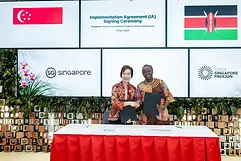
ANTALYA, Türkiye — 16 November 2026 (TRT, UTC+3). Kenya and Singapore signed an implementation agreement at the COP31 climate summit on Monday, establishing a legally binding framework for qualifying carbon credits to be authorised and transferred between the countries under Article 6 of the Paris Agreement.
Kenya's Environment Cabinet Secretary Deborah Mlongo Barasa and Singapore's Minister for Sustainability and the Environment Grace Fu attended the signing at the Singapore Pavilion.
The agreement provides the rules for future transactions; it is not evidence that the two governments have already bought or sold a specified number of credits. Singapore's government says applications for projects under the framework are expected to open in 2027. That is the central distinction for Kenyan project developers, communities and investors planning around the announcement.
What did Kenya and Singapore agree at COP31?
They signed an Article 6 implementation agreement that sets a bilateral route for approving eligible emissions-reduction projects and transferring authorised carbon credits without double counting. It may attract investment, but the signing did not itself announce completed credit purchases, funded projects or guaranteed payments to communities.
Singapore's official account of Grace Fu's signing remarks confirms the agreement and describes it as the next stage of a partnership that began with a memorandum of understanding in 2023. A memorandum expresses an intention to cooperate; an implementation agreement creates the bilateral procedures through which properly authorised carbon credits can eventually move.
The Singapore Ministry of Energy, Trade and Industry's guide explains the distinction: implementation agreements address authorisation, reporting and the adjustments required when one country transfers a mitigation outcome to another. Private developers can then design projects that satisfy both national rules and international accounting requirements.
At the signing, Barasa said the arrangement built on a memorandum signed in Nairobi on 18 May 2023, according to Kenyan reporting by Switch Media. Kenya's government presented the framework as a way to mobilise climate investment while protecting national climate targets and the interests of local communities. Those are commitments for implementation, not measured results from newly financed projects.
How a credit could move from a Kenyan project to Singapore
SCIENCE AND ENVIRONMENT
Kenya–Singapore Carbon Credit Deal at COP31: What Changes?

16 nov. 2026
16 nov. 2026
6 min read
Publié
Mis à jour:
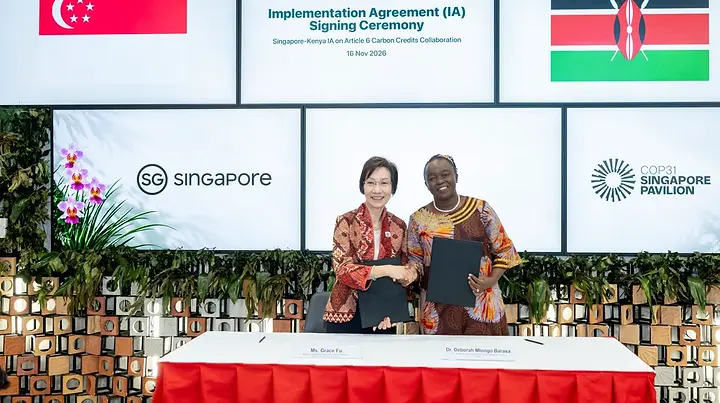
ANTALYA, Türkiye — 16 November 2026 (TRT, UTC+3). Kenya and Singapore signed an implementation agreement at the COP31 climate summit on Monday, establishing a legally binding framework for qualifying carbon credits to be authorised and transferred between the countries under Article 6 of the Paris Agreement.
Kenya's Environment Cabinet Secretary Deborah Mlongo Barasa and Singapore's Minister for Sustainability and the Environment Grace Fu attended the signing at the Singapore Pavilion.
The agreement provides the rules for future transactions; it is not evidence that the two governments have already bought or sold a specified number of credits. Singapore's government says applications for projects under the framework are expected to open in 2027. That is the central distinction for Kenyan project developers, communities and investors planning around the announcement.
What did Kenya and Singapore agree at COP31?
They signed an Article 6 implementation agreement that sets a bilateral route for approving eligible emissions-reduction projects and transferring authorised carbon credits without double counting. It may attract investment, but the signing did not itself announce completed credit purchases, funded projects or guaranteed payments to communities.
Singapore's official account of Grace Fu's signing remarks confirms the agreement and describes it as the next stage of a partnership that began with a memorandum of understanding in 2023. A memorandum expresses an intention to cooperate; an implementation agreement creates the bilateral procedures through which properly authorised carbon credits can eventually move.
The Singapore Ministry of Energy, Trade and Industry's guide explains the distinction: implementation agreements address authorisation, reporting and the adjustments required when one country transfers a mitigation outcome to another. Private developers can then design projects that satisfy both national rules and international accounting requirements.
At the signing, Barasa said the arrangement built on a memorandum signed in Nairobi on 18 May 2023, according to Kenyan reporting by Switch Media. Kenya's government presented the framework as a way to mobilise climate investment while protecting national climate targets and the interests of local communities. Those are commitments for implementation, not measured results from newly financed projects.
PUBLICITÉ
How a credit could move from a Kenyan project to Singapore
An eligible Kenyan project would first need to show that it reduces or removes greenhouse-gas emissions under an accepted methodology.
The relevant authorities would have to approve the activity, authorise any international transfer, and record it through the required accounting and registry systems. Only after those steps could an eligible mitigation outcome be used by an approved buyer under the bilateral framework.
The UN Climate Change explanation of Article 6 distinguishes Article 6.2, which governs accounting and reporting for internationally transferred mitigation outcomes, from Article 6.4, which establishes a separate UN crediting mechanism. The Kenya–Singapore agreement concerns bilateral cooperation under Article 6.2.
One accounting safeguard is especially important. If Singapore counts a transferred reduction towards its climate target, Kenya must make a corresponding adjustment in its own accounting, instead of having the same reduction counted towards both countries' targets. The idea is to keep one tonne of mitigation from becoming two political claims.
Singapore's carbon-market cooperation portal explains that its bilateral model includes project authorisation, reporting and corresponding adjustments. It also describes mechanisms intended to support adaptation finance and the overall mitigation of global emissions. Those general mechanisms do not by themselves disclose the value of any future Kenyan transaction.
PUBLICITÉ
Tendances actuelles


Which projects and Kenyan communities could benefit?
Potential applicants may look to renewable energy, cleaner cooking, transport, waste management, restoration or other genuine emissions-reduction activities, depending on the approved methods and eligibility rules that are subsequently published. The signing does not identify a final list of Kenyan sites or companies with approved credits.
The legal context matters. Kenya adopted the Climate Change (Carbon Markets) Regulations, 2024, setting out procedures for project approvals, record-keeping and community arrangements. The National Environment Management Authority's regulations page provides the government framework, while Kenya Law's published regulations address community development agreements for qualifying projects on public and community land.
Those safeguards do not mean every project automatically pays every community. The benefits depend on the project's legal category, the specific agreement, actual earnings, accountability and enforcement. A credible investment announcement should eventually identify which communities are involved, what consent and consultation occurred, how revenue will be calculated, and who will publish payment records.
Fu told the summit that more than 90% of Kenya's electricity generation in 2024 came from renewables and that Kenyan projects represented roughly one-fifth of African voluntary-carbon-market revenues that year. Those figures were presented by Singapore's government to describe market potential, rather than the economic value already delivered by the new agreement.
Why Singapore is interested and what Kenya must protect
Singapore is a carbon services and financial centre with significant climate commitments and limited land for domestic mitigation projects. Kenya is seeking investment for its climate and development priorities. Bilateral trade could connect investors to qualifying projects, but only if the reductions are real, verifiable and properly accounted for.
PUBLICITÉ
The deal is reportedly Singapore's 13th implementation agreement and its third with an African partner after Ghana and Rwanda, according to Lianhe Zaobao's reporting from Antalya. That establishes the agreement's place in Singapore's network; it does not assign any purchase obligation to Singapore or a fixed revenue target to Kenya.
Two pitfalls remain. Weak methodologies could overstate climate impact, while unclear community agreements could concentrate benefits away from the people whose land or livelihoods make a project possible. A carbon agreement should therefore be judged not only by the number of developers attracted, but by verified emissions outcomes, public accounting and benefits that communities can inspect.
There is a useful distinction between this cross-border financing framework and Kenya's other development ambitions, including the industrial expansion described in XTRAfrica's report on the planned Dangote refinery in Lamu. They are separate initiatives with different funding structures and environmental questions. Neither should be presented as delivered economic benefit merely because a launch or agreement occurred.
What happens in 2027?
The immediate milestone is the project application process expected in 2027, which Singapore's minister explicitly referenced. Before applications can be assessed effectively, authorities need to settle eligible methodologies, registration arrangements, authorisation procedures and the roles of any joint oversight bodies. Project developers will also need to show how their proposals comply with Kenyan law.
The most useful future disclosures will be a public application timetable, the approved crediting programmes, any authorised project list, the first confirmed international transfer, and data showing investment and local benefit distribution. No overall contract value, initial credit volume or guaranteed farmer payout was announced at the signing. The new framework is significant precisely because its performance can now be tested against those measurable steps.
PUBLICITÉ
Articles connexes