LAGOS, Nigeria — 16 November 2026 (WAT, UTC+1). Dangote Sinotruk West Africa Limited has unveiled electric commercial vehicles at its Lagos assembly operation, with a rollout held on Sunday, 15 November. The joint venture between the Dangote Group and China's Sinotruk is extending its Nigerian assembly business from conventional commercial vehicles and compressed-natural-gas options into battery-electric trucks.
The event is an observable product unveiling, not evidence that a large electric fleet has entered commercial service. Reports identify different types of electric truck shown at the event. Neither a confirmed total of customer deliveries nor a published Nigerian price list has been established from the company's rollout information.
The company presented battery-electric commercial vehicles assembled through its Lagos operation, including trucks intended for cargo transport and heavier haulage. The unveiling demonstrates an expanded product line, but the public announcement does not prove mass production, customer deliveries or a nationwide charging network. Those are still separate commercial milestones.
The Lagos plant has moved beyond a single type of truck
The International Centre for Investigative Reporting's account, carrying News Agency of Nigeria reporting, describes the ceremony and comments made by Dangote Group vice-president Devakumar Edwin. The company's earlier line-up included heavy trucks, tippers, light trucks, pickups and buses. Electric vehicles have now joined that line-up.
Nigeria's Independent newspaper photographed and named executives at the ceremony, including Sinotruk president Liu Wei and Edwin, and placed the unveiling at the company's Ikeja facility. The participation of company leaders and Lagos State representatives supports the occurrence of the launch; it should not be mistaken for an independent certification of every performance claim made on stage.
The distinction between assembled in Nigeria and manufactured entirely in Nigeria matters. Assembly is meaningful industrial activity, especially when local processes and technical skills expand. It does not establish the Nigerian origin of batteries, motors, electronics or every vehicle component. A proper local-content assessment would require component sourcing data and production records beyond a launch ceremony.
Electric tractor and cargo truck specifications need to be kept separate
A detailed report in The Sun describes the new electric range as including a 6×4 tractor head with a stated 600 kWh battery capacity and 350 km driving range, alongside lighter commercial vehicles. These are specifications reported from the event, not independently measured results from Nigerian long-haul operations.
Separately, Naira Energies, citing Daily Trust, describes a smaller 4×2 electric cargo truck. The two configurations have different intended work. A tractor head is designed to pull a trailer, while a cargo truck commonly carries a body or box on its own chassis. Figures for one should never be assigned to the other without a verified model sheet.
TRANSPORT AND LOGISTICS
Dangote–Sinotruk Electric Trucks Launch in Lagos: Key Facts

16 nov. 2026
16 nov. 2026
6 min read
Publié
Mis à jour:
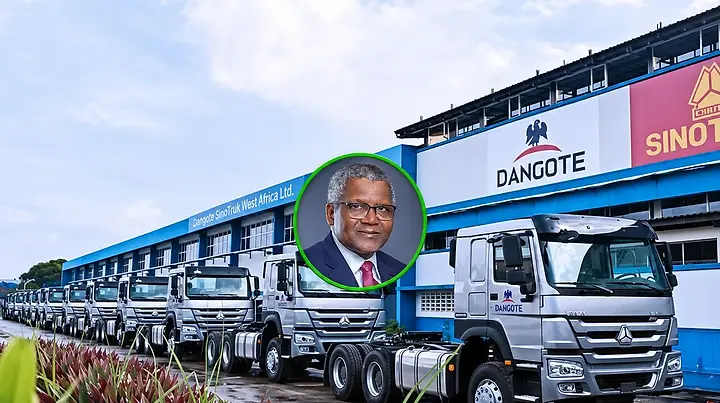
LAGOS, Nigeria — 16 November 2026 (WAT, UTC+1). Dangote Sinotruk West Africa Limited has unveiled electric commercial vehicles at its Lagos assembly operation, with a rollout held on Sunday, 15 November. The joint venture between the Dangote Group and China's Sinotruk is extending its Nigerian assembly business from conventional commercial vehicles and compressed-natural-gas options into battery-electric trucks.
The event is an observable product unveiling, not evidence that a large electric fleet has entered commercial service. Reports identify different types of electric truck shown at the event. Neither a confirmed total of customer deliveries nor a published Nigerian price list has been established from the company's rollout information.
The company presented battery-electric commercial vehicles assembled through its Lagos operation, including trucks intended for cargo transport and heavier haulage. The unveiling demonstrates an expanded product line, but the public announcement does not prove mass production, customer deliveries or a nationwide charging network. Those are still separate commercial milestones.
The Lagos plant has moved beyond a single type of truck
The International Centre for Investigative Reporting's account, carrying News Agency of Nigeria reporting, describes the ceremony and comments made by Dangote Group vice-president Devakumar Edwin. The company's earlier line-up included heavy trucks, tippers, light trucks, pickups and buses. Electric vehicles have now joined that line-up.
Nigeria's Independent newspaper photographed and named executives at the ceremony, including Sinotruk president Liu Wei and Edwin, and placed the unveiling at the company's Ikeja facility. The participation of company leaders and Lagos State representatives supports the occurrence of the launch; it should not be mistaken for an independent certification of every performance claim made on stage.
The distinction between assembled in Nigeria and manufactured entirely in Nigeria matters. Assembly is meaningful industrial activity, especially when local processes and technical skills expand. It does not establish the Nigerian origin of batteries, motors, electronics or every vehicle component. A proper local-content assessment would require component sourcing data and production records beyond a launch ceremony.
PUBLICITÉ
Electric tractor and cargo truck specifications need to be kept separate
A detailed report in The Sun describes the new electric range as including a 6×4 tractor head with a stated 600 kWh battery capacity and 350 km driving range, alongside lighter commercial vehicles. These are specifications reported from the event, not independently measured results from Nigerian long-haul operations.
Separately, Naira Energies, citing Daily Trust, describes a smaller 4×2 electric cargo truck. The two configurations have different intended work. A tractor head is designed to pull a trailer, while a cargo truck commonly carries a body or box on its own chassis. Figures for one should never be assigned to the other without a verified model sheet.
The launch material cited in THISDAY's coverage emphasises the heavy-duty electric unveiling, training and technical support but does not establish a full public catalogue of Nigerian prices, independently measured ranges, payloads or battery warranties. Operators comparing an electric vehicle with a diesel truck would still need those details.
Several headlines call the product Nigeria's first locally assembled electric heavy-duty truck. Liu Wei went further, calling it the first such new-energy truck assembled on the African continent, according to The Government and Business Journal's coverage of his remarks. Those are attributable company claims; they should not be represented as a verified historical first across all African electric-vehicle manufacturers without a comprehensive comparison.
PUBLICITÉ
Tendances actuelles


How the joint venture reached the electric rollout
Sinotruk and the Dangote business have a partnership history predating the current electric programme. The chronology presented at the launch traced cooperation to 2010, the establishment of the joint venture to 2014, and its first heavy-truck assembly to 2017. The group said welding and e-coating paint facilities became operational in 2024.
According to THISDAY's detailed account, Liu Wei said the venture had assembled more than 8,000 vehicles over its operating history. That is a cumulative company figure, not a claim that 8,000 electric trucks have been produced. The business also plans additional training for engineers and technicians, including exposure to Sinotruk facilities in China.
A useful industrial benchmark is whether the local operation adds more welding, painting, quality-control and engineering capacity as it moves into electrification. If electric trucks arrive mainly as imported kits with limited local work, the employment and supplier benefits will differ from those of a much deeper manufacturing programme. Public breakdowns of local sourcing would allow those claims to be assessed.
Charging, cost and after-sales support may decide the market
In independent reporting on the launch, Edwin acknowledged that practical adoption requires reliable charging facilities, spare parts, trained technicians and after-sales support. He argued that electric trucks could reduce tailpipe emissions and operating expenses, while accepting that electricity prices and the intended use would influence the economics.
For a logistics operator, the questions are straightforward. How far can a loaded truck travel on the route it will actually serve? How often will it charge, where will that happen, and how long will it be off the road? What happens if a battery fails, and where will repairs take place? An advertised driving range alone does not answer those questions.
PUBLICITÉ
Nigeria's Energy Transition Plan transport section includes a future role for electric and hydrogen freight vehicles, while recognising that the necessary infrastructure and technology will develop over time. A single truck launch is therefore consistent with a direction of travel, but it cannot demonstrate an immediate shift of the national haulage fleet away from diesel.
More broadly, the Dangote Group has other, separate projects in African industry, including the planned Lamu refinery investment in Kenya previously reported by XTRAfrica. The electric-truck operation is a distinct partnership and should be assessed on its own manufacturing and transport evidence rather than on the scale of the group's refinery ambitions.
The next proof will come from customers and production records
The event demonstrates that Dangote–Sinotruk can present electric commercial vehicles through a Nigerian assembly business. The next evidence should be a model-by-model specification sheet, the first documented paid deliveries, pricing and financing terms, local assembly and parts content, and the location of working charging and service support.
Independent route trials under Nigerian conditions would add a more meaningful measure of performance than launch-day claims.
The development-first question is no longer whether an electric truck appeared in Lagos. It is how many are built, who can operate them economically and what production, skills and supplier benefits remain in Nigeria. Those answers will determine whether the November unveiling becomes a durable industrial advance.
PUBLICITÉ
Articles connexes