The World Health Organization has expanded its Ebola emergency declaration to include Uganda as health officials race to contain a growing outbreak centered in eastern Democratic Republic of Congo. The outbreak, linked to the rare Bundibugyo strain of Ebola, has raised concern because no approved vaccine or targeted treatment currently exists for the variant, according to a Reuters report.
WHO declared the outbreak a Public Health Emergency of International Concern on Sunday, warning that countries bordering Congo face a high risk of further spread. Authorities in Uganda confirmed imported Ebola cases connected to cross-border movement from Congo, including a Congolese citizen who later died in Kampala.
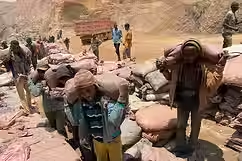
According to the WHO, at least eight laboratory-confirmed Ebola cases have been recorded alongside hundreds of suspected infections and dozens of suspected deaths concentrated in Ituri province. The outbreak has heavily affected Bunia, Mongwalu and Rwampara, areas already struggling with insecurity, displacement and intense mining activity.
The BBC reported that health officials fear the actual scale of infections could be much larger than current confirmed figures suggest because surveillance remains difficult in conflict-affected areas.
The Bundibugyo strain has only caused two previous outbreaks since it was first identified in Uganda in 2007. Unlike the more common Ebola-Zaire strain, there are currently no approved vaccines or therapeutics specifically designed for Bundibugyo, increasing pressure on containment measures and community surveillance.
In response, WHO and Congolese authorities have intensified emergency operations in Ituri province. Nearly seven tons of medical supplies, including protective equipment, medical kits, tents and hospital beds, arrived in Bunia on Sunday to support frontline response teams. Congolese health officials said new treatment centres are also being prepared in Rwampara and Mongwalu as contact tracing and awareness campaigns expand.
Regional governments are also tightening border screening and surveillance systems as fears grow over further transmission across East Africa. South Sudan and Rwanda have both increased monitoring measures while the Africa CDC warned that population movement and insecurity could complicate efforts to contain the virus.
Health experts continue urging communities to follow strict hygiene measures and immediately report suspected symptoms including fever, vomiting, diarrhea and bleeding.
PUBLIC HEALTH ALERTS
WHO Adds Uganda to Congo Ebola Emergency Alert

May 18, 2026
May 18, 2026
3 min read

Published
Updated:
The World Health Organization has expanded its Ebola emergency declaration to include Uganda as health officials race to contain a growing outbreak centered in eastern Democratic Republic of Congo. The outbreak, linked to the rare Bundibugyo strain of Ebola, has raised concern because no approved vaccine or targeted treatment currently exists for the variant, according to a Reuters report.
WHO declared the outbreak a Public Health Emergency of International Concern on Sunday, warning that countries bordering Congo face a high risk of further spread. Authorities in Uganda confirmed imported Ebola cases connected to cross-border movement from Congo, including a Congolese citizen who later died in Kampala.
According to the WHO, at least eight laboratory-confirmed Ebola cases have been recorded alongside hundreds of suspected infections and dozens of suspected deaths concentrated in Ituri province. The outbreak has heavily affected Bunia, Mongwalu and Rwampara, areas already struggling with insecurity, displacement and intense mining activity.
ADVERTISEMENT
The BBC reported that health officials fear the actual scale of infections could be much larger than current confirmed figures suggest because surveillance remains difficult in conflict-affected areas.
The Bundibugyo strain has only caused two previous outbreaks since it was first identified in Uganda in 2007. Unlike the more common Ebola-Zaire strain, there are currently no approved vaccines or therapeutics specifically designed for Bundibugyo, increasing pressure on containment measures and community surveillance.
ADVERTISEMENT
In response, WHO and Congolese authorities have intensified emergency operations in Ituri province. Nearly seven tons of medical supplies, including protective equipment, medical kits, tents and hospital beds, arrived in Bunia on Sunday to support frontline response teams. Congolese health officials said new treatment centres are also being prepared in Rwampara and Mongwalu as contact tracing and awareness campaigns expand.
Regional governments are also tightening border screening and surveillance systems as fears grow over further transmission across East Africa. South Sudan and Rwanda have both increased monitoring measures while the Africa CDC warned that population movement and insecurity could complicate efforts to contain the virus.
Trending Now


Popular Today


ADVERTISEMENT
Health experts continue urging communities to follow strict hygiene measures and immediately report suspected symptoms including fever, vomiting, diarrhea and bleeding.
ADVERTISEMENT
Related Articles