ECONOMIC POLICIES
🕒 4 min read
Explained: What the Washington Agreements Mean for the DRC
The Washington Agreements aim to transform Congo’s mineral wealth into local processing, job creation, and stronger governance.

Published:
February 17, 2026 at 5:46:05 PM
Modified:
May 15, 2026 at 7:03:32 PM
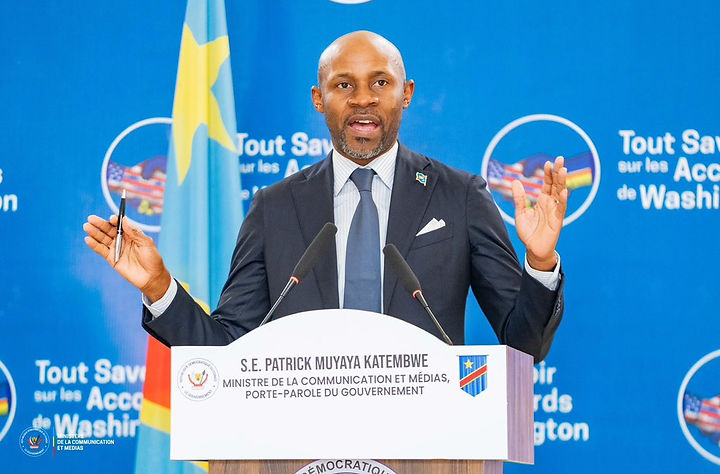
DRC Government Spokesperson Patrick Muyaya
The Washington Agreements signed between the Democratic Republic of the Congo and the United States represent more than a diplomatic development. Congolese government spokesperson Patrick Muyaya describes them as part of a long-term strategy to turn mineral wealth into sustainable growth, while reinforcing sovereignty and security.
Here is what the framework is intended to deliver.
Moving Beyond Raw Exports
At the center of the U.S.–DRC strategic partnership is a shift away from exporting unprocessed minerals.
Congo holds major reserves of cobalt, copper, lithium, and other resources essential to electric vehicles, batteries, and advanced technologies. For decades, much of this output left the country in raw form, limiting domestic economic returns.
Under the Washington framework, Kinshasa plans to expand local processing and refining before export, strengthen industries linked to battery supply chains, and increase domestic value addition.
The aim is to secure a larger share of the economic benefits generated by Congo’s strategic resources.
Job Creation and Skills Development
Employment is a key element of the agreements.
Investment in processing facilities and industrial infrastructure is expected to create direct jobs in mining and transformation, as well as indirect employment in logistics, services, and supply chains.
Officials have placed particular emphasis on training Congolese geologists and technical specialists. The intention is to ensure that national expertise develops alongside foreign investment.
Capacity building is presented as a structural component of the partnership, aimed at strengthening institutions and reducing long-term dependency.
Regulated Resource Governance
Authorities describe the agreements as part of a broader effort to manage mineral exploitation in a more regulated and transparent way.
This includes reinforcing governance frameworks, improving oversight of extraction and exports, and aligning practices with international standards.
Government representatives have repeatedly stated that the agreements do not involve selling national resources or compromising sovereignty. During public engagements in Kolwezi, officials stressed that there has been no question of mortgaging the country’s strategic assets.
Linking Economic Reform to Peace
The agreements also intersect with the wider peace process.
According to Kinshasa, the security dimension of the partnership supports commitments made under the Washington Peace Accords. The stated goal is to contribute to stabilizing eastern Congo by reinforcing ceasefire mechanisms, improving security cooperation, and strengthening monitoring processes.
Congolese authorities argue that economic reform and security stabilization cannot be separated. Investment and industrial growth, they say, depend on lasting peace.
Dialogue Within a Sovereign Framework
On the question of national dialogue, officials have clarified that any political consultations will be organized by state institutions and held on Congolese territory, in a context that respects sovereignty and territorial integrity.
They have also stressed that accountability remains central, particularly regarding armed activity and violations linked to the conflict in the east.
The Broader Strategy
Taken together, the Washington Agreements are presented as a long-term national project built around three pillars: economic transformation, human capital development, and security stabilization.
Whether these ambitions produce measurable results will depend on implementation, governance standards, and sustained investment.
For now, Kinshasa is framing the agreements as an effort to reposition the DRC — not simply as a supplier of critical minerals, but as a country seeking a greater role in shaping the value chains built around them.
Tags
Keep Reading


