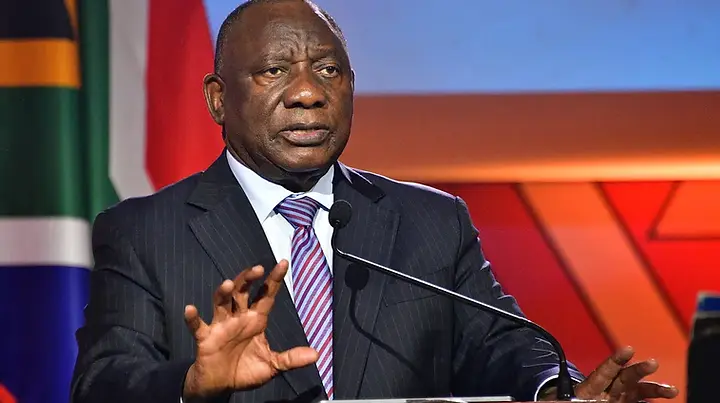
President Cyril Ramaphosa says South Africa will deploy the army to support police operations against organised crime and criminal syndicates, while also directing that municipal officials who fail to supply water to communities should face criminal charges. He made the pledge in his State of the Nation Address to parliament in Cape Town on Thursday.
Ramaphosa framed organised crime as an urgent national risk, arguing it now poses an immediate threat to democracy, social stability and economic development. In his address, he said the initial troop deployment would focus on Gauteng and the Western Cape two provinces facing acute pressure from gang-related violence while the minister of police and the defence leadership finalise operational details within days.
The announcement lands as public anxiety over safety intensifies. South Africa continues to grapple with high levels of violent crime, and security concerns have become a defining issue for voters. Ramaphosa’s government, which has been operating as a coalition since June 2024 after the governing African National Congress (ANC) lost its parliamentary majority, faces mounting pressure to show measurable improvements in day-to-day security and basic services.
Why the army deployment matters
The planned deployment signals a more forceful, visible state response to organised crime networks that authorities say have expanded their reach from localised gang activity to broader criminal syndicates that undermine policing, commerce, and community safety.
Ramaphosa’s emphasis was not simply on crime volumes, but on organised structures: syndicates, coordination, and entrenched criminal economies.
That framing suggests the government is preparing a strategy that goes beyond arrests and patrols, leaning on intelligence, coordination between agencies, and concentrated operations in hotspots.
At the same time, the move raises expectations. Military support can provide surge capacity and reinforce overwhelmed policing in targeted areas, but it also places a spotlight on whether deployments translate into sustained reductions in violence especially in communities where residents often complain that enforcement is episodic, and crime quickly resurges once pressure eases.
Alongside the security push, Ramaphosa devoted significant attention to worsening water outages, describing them as a sign of local governance breakdown. He said communities cannot be left without water due to neglected infrastructure and poor municipal management, and he pledged consequences for officials who do not meet their responsibilities.
CRIME PREVENTION
Ramaphosa orders army deployment to curb crime, fix water outages

Feb 13, 2026
May 15, 2026
5 min read
Published
Updated:
President Cyril Ramaphosa says South Africa will deploy the army to support police operations against organised crime and criminal syndicates, while also directing that municipal officials who fail to supply water to communities should face criminal charges. He made the pledge in his State of the Nation Address to parliament in Cape Town on Thursday.
Ramaphosa framed organised crime as an urgent national risk, arguing it now poses an immediate threat to democracy, social stability and economic development. In his address, he said the initial troop deployment would focus on Gauteng and the Western Cape two provinces facing acute pressure from gang-related violence while the minister of police and the defence leadership finalise operational details within days.
The announcement lands as public anxiety over safety intensifies. South Africa continues to grapple with high levels of violent crime, and security concerns have become a defining issue for voters. Ramaphosa’s government, which has been operating as a coalition since June 2024 after the governing African National Congress (ANC) lost its parliamentary majority, faces mounting pressure to show measurable improvements in day-to-day security and basic services.
Why the army deployment matters
The planned deployment signals a more forceful, visible state response to organised crime networks that authorities say have expanded their reach from localised gang activity to broader criminal syndicates that undermine policing, commerce, and community safety.
Ramaphosa’s emphasis was not simply on crime volumes, but on organised structures: syndicates, coordination, and entrenched criminal economies.
ADVERTISEMENT
That framing suggests the government is preparing a strategy that goes beyond arrests and patrols, leaning on intelligence, coordination between agencies, and concentrated operations in hotspots.
At the same time, the move raises expectations. Military support can provide surge capacity and reinforce overwhelmed policing in targeted areas, but it also places a spotlight on whether deployments translate into sustained reductions in violence especially in communities where residents often complain that enforcement is episodic, and crime quickly resurges once pressure eases.
Alongside the security push, Ramaphosa devoted significant attention to worsening water outages, describing them as a sign of local governance breakdown. He said communities cannot be left without water due to neglected infrastructure and poor municipal management, and he pledged consequences for officials who do not meet their responsibilities.
“Water outages” were described as a symptom of a system that is failing residents. The president’s call for criminal charges is a sharper posture than the usual administrative reprimands, and it is likely aimed at restoring a sense of consequence management particularly in areas where repeated breakdowns have become routine.
Nationally, responsibility for water governance is shared across institutions, but the Department of Water and Sanitation is the central custodian of policy and oversight under South Africa’s water legislation. That broader context matters because Ramaphosa’s intervention implicitly acknowledges two problems at once: the physical constraints of a drying climate and the persistent, well-documented failures in maintenance and municipal delivery systems.
ADVERTISEMENT
Protests sharpen the political stakes
The address comes amid growing public frustration. In Johannesburg, residents have held protests after some neighbourhoods experienced dry taps for more than 20 days. While water disruptions are not new, their duration and spread have increased political pressure particularly in an election year.
Municipal elections later in 2026 are expected to test the coalition’s credibility at the local level, where service delivery failures are most visible. Crime and water shortages are among the issues that consistently generate anger and protest, and both now sit at the heart of the president’s stated priorities for the year.
Ramaphosa also spoke to the wider state of governance: service delivery, municipal performance, and the state’s ability to carry out its basic functions. The coalition has helped stabilise confidence in parts of the economy, with chronic power cuts easing and markets showing improved sentiment in recent periods. But persistent unemployment remains a major stressor, and communities continue to judge government performance through everyday realities safety, water, and working infrastructure.
On the security side, the government has pointed to ongoing policing initiatives and inter-agency coordination. Publicly available government briefings and notices around policing performance including periodic crime-statistics processes reflect the state’s effort to demonstrate measurement and accountability. However, Ramaphosa’s decision to put an army deployment on the agenda suggests the administration believes it must visibly escalate its response, especially in areas where communities feel abandoned or unsafe.


POPULAR TODAY


ADVERTISEMENT
What to watch next
Three signals will matter in the days ahead:
Deployment details: The scope, timeline, and legal framework governing how soldiers will support police—especially rules of engagement and oversight.
Target outcomes: Whether government sets measurable goals (for example, reductions in specific violent-crime categories or dismantling of named syndicates).
Water enforcement: Whether criminal investigations and prosecutions follow, or whether the threat of charges remains largely rhetorical.
For now, Ramaphosa has placed two of South Africa’s most immediate and politically sensitive crises violent organised crime and water outages at the center of his governing agenda for 2026, with the promise of stronger enforcement and accountability to match.
ADVERTISEMENT
RELATED ARTICLE