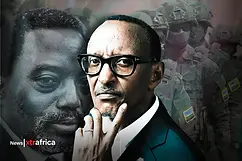
The rebellion that brought Laurent-Désiré Kabila to power in 1997 relied on a collapsing state, foreign armies and a particular political moment. Joseph Kabila's new alliance inherits a different Congo—and faces a much more visible record of Rwanda's involvement.
In 1997, Laurent-Désiré Kabila's Alliance of Democratic Forces for the Liberation of Congo-Zaire (AFDL) entered Kinshasa as Mobutu Sese Seko's long rule came to an end. In October 2026, his son Joseph Kabila emerged at the head of a new political-military coalition, the Front for the Refoundation of the Nation (FRN), incorporating leaders of AFC/M23.
The parallel makes a dramatic political story: two Kabilas, two armed movements, and Rwanda appearing in both histories. But the differences matter more than the family name. Mobutu's weakened institutions, the collapse of his army and an unusual alliance of foreign militaries made the AFDL's advance possible. None of those conditions can simply be assumed in 2026.
That is why the question is not whether another rebellion can adopt the symbolism of 1997. It is whether it can reproduce the circumstances that made that outcome possible. On the available evidence, the answer is far from straightforward.
1. The AFDL defeated a collapsing Mobutu state
To understand 1997, start with the state the AFDL confronted. Decades of authoritarian rule, economic deterioration, unpaid soldiers and deteriorating institutions had hollowed out Mobutu's Zaire. Its armed forces, the Forces Armées Zaïroises (FAZ), often retreated rather than mount sustained resistance.
The AFDL's offensive was also not a purely domestic uprising. Human Rights Watch's 1997 assessment describes significant military support from Rwanda, Uganda, Angola and other regional actors. Rwanda's contribution was especially important.
In a July 1997 interview reported by The Washington Post, Paul Kagame, then Rwanda's defence minister, acknowledged that Rwanda had planned and directed key aspects of the campaign that overthrew Mobutu.
Many Congolese were exhausted by Mobutu's government. Yet public frustration alone did not topple him. Foreign military intervention, the FAZ's weakness and shifting regional alliances were essential. Nor was the AFDL campaign free of abuses: historical human rights reports documented killings of refugees and civilians amid the war.
The lesson is important. AFDL's victory was the product of a specific state crisis and regional military intervention—not a formula any new rebellion can automatically repeat.
JUSTICE & CRIME
How FRN Cannot Repeat AFDL's Success | XTRAfrica

Oct 19, 2026
Oct 19, 2026
13 min read

Published
Updated:
The rebellion that brought Laurent-Désiré Kabila to power in 1997 relied on a collapsing state, foreign armies and a particular political moment. Joseph Kabila's new alliance inherits a different Congo—and faces a much more visible record of Rwanda's involvement.
In 1997, Laurent-Désiré Kabila's Alliance of Democratic Forces for the Liberation of Congo-Zaire (AFDL) entered Kinshasa as Mobutu Sese Seko's long rule came to an end. In October 2026, his son Joseph Kabila emerged at the head of a new political-military coalition, the Front for the Refoundation of the Nation (FRN), incorporating leaders of AFC/M23.
The parallel makes a dramatic political story: two Kabilas, two armed movements, and Rwanda appearing in both histories. But the differences matter more than the family name. Mobutu's weakened institutions, the collapse of his army and an unusual alliance of foreign militaries made the AFDL's advance possible. None of those conditions can simply be assumed in 2026.
That is why the question is not whether another rebellion can adopt the symbolism of 1997. It is whether it can reproduce the circumstances that made that outcome possible. On the available evidence, the answer is far from straightforward.
1. The AFDL defeated a collapsing Mobutu state
To understand 1997, start with the state the AFDL confronted. Decades of authoritarian rule, economic deterioration, unpaid soldiers and deteriorating institutions had hollowed out Mobutu's Zaire. Its armed forces, the Forces Armées Zaïroises (FAZ), often retreated rather than mount sustained resistance.
The AFDL's offensive was also not a purely domestic uprising. Human Rights Watch's 1997 assessment describes significant military support from Rwanda, Uganda, Angola and other regional actors. Rwanda's contribution was especially important.
In a July 1997 interview reported by The Washington Post, Paul Kagame, then Rwanda's defence minister, acknowledged that Rwanda had planned and directed key aspects of the campaign that overthrew Mobutu.
Many Congolese were exhausted by Mobutu's government. Yet public frustration alone did not topple him. Foreign military intervention, the FAZ's weakness and shifting regional alliances were essential. Nor was the AFDL campaign free of abuses: historical human rights reports documented killings of refugees and civilians amid the war.
The lesson is important. AFDL's victory was the product of a specific state crisis and regional military intervention—not a formula any new rebellion can automatically repeat.
2. Joseph Kabila is not entering politics as his father did
Laurent-Désiré Kabila had spent years opposing Mobutu before emerging as the AFDL's public leader. Joseph Kabila is not an unknown challenger: he governed the DRC from 2001 to 2019. His years in power and the controversies surrounding his administration form part of how Congolese citizens will judge his latest decision.
On October 12, 2026, Joseph Kabila appeared as leader of the FRN in rebel-held Goma. the new coalition includes groups previously united under AFC and involves M23, whose fighters hold extensive areas in eastern Congo. Reuters identified veteran rebel figures among the new leadership.
Kabila and his allies present their movement as a response to governance failures under President Félix Tshisekedi. Those grievances deserve scrutiny. But joining an armed coalition raises a separate question: whether the political dispute can legitimately be pursued through forces that have seized Congolese territory and contributed to a devastating civilian crisis.
ADVERTISEMENT
In April 2026, the U.S. Treasury sanctioned Joseph Kabila, alleging that he had supported M23 and AFC. A Congolese military court had also sentenced him to death in absentia in 2025; Kabila rejects the charges and says the proceedings were politically motivated. The sanctions and conviction are significant developments, but they should not be confused with independent proof of every accusation made against him.
Unlike the first Kabila in 1996, the second carries the record of a former president—and the political liabilities that come with it.
3. The Rwanda connection is no longer hidden in historical hindsight
The strongest historical parallel is Rwanda's involvement. The evidence, however, must be described precisely.
During the AFDL campaign, Rwanda's military role became unmistakable and was later publicly acknowledged by Kagame. Today, the United Nations has documented Rwandan military support and operational involvement alongside AFC/M23. The UN Group of Experts' June 2026 final report, S/2026/466, addresses RDF involvement, military coordination and conditions in eastern DRC. Human Rights Watch's June 2026 investigation also reports serious abuses and describes Rwandan involvement in M23 operations.
The issue is not merely a verbal accusation from Kinshasa. On February 21, 2025, the UN Security Council unanimously adopted Resolution 2773, demanding that M23 end hostilities and withdraw from the areas it controlled, while calling on the Rwanda Defence Force to stop supporting M23 and withdraw from DRC territory without preconditions.
Rwanda denies controlling M23 and cites threats from the FDLR and other armed groups as security concerns. Its position should be reported, but those denials do not erase the Security Council's demands or the evidence set out by UN investigators.
Congolese government spokesperson Patrick Muyaya argues that FRN's emergence gives an existing Rwanda-backed rebellion a new Congolese political face. The coalition disputes that interpretation. What can be established directly is the continuity of central figures and the documented record of RDF involvement with the preceding AFC/M23 structure. It would go beyond the evidence to assert that every individual FRN decision is directed personally from Kigali.
4. Tshisekedi's Political Support: A Difference From Mobutu's Final Years
Unlike Mobutu during the final years of his rule, President Félix Tshisekedi leads a government with an electoral mandate, functioning national institutions and an established base of political support. Congo's electoral commission declared him the winner of the December 2023 presidential election with approximately 73% of the vote.
His supporters have also rallied around the defense of Congolese sovereignty amid the conflict in eastern DRC. This presents a different political environment from 1997, when the AFDL advanced against a weakened Mobutu government whose army and institutions were disintegrating.
Joseph Kabila's FRN cannot simply assume that dissatisfaction with the government will translate into public acceptance of an armed rebellion. The UN Security Council's Resolution 2773, which demands an end to M23 hostilities and Rwandan military support, further illustrates the international framework surrounding Congo's territorial sovereignty.
While Tshisekedi's current nationwide popularity cannot be established from election results or public demonstrations alone, FRN faces a government with organized political supporters and institutions that remain in place—conditions substantially different from those preceding Mobutu's fall.
ADVERTISEMENT
5. A new acronym does not create a new army
FRN's central challenge is that a change in political branding does not automatically create fresh military strength, national legitimacy or a broader social base.
The October announcement elevated Joseph Kabila while retaining familiar leaders from AFC/M23. Contemporary reporting named Corneille Nangaa, Bertrand Bisimwa and Sultani Makenga among the figures associated with the coalition. Al Jazeera reported that FRN said it would inherit AFC's commitments under the Doha negotiations.
That explicit continuity matters. It strengthens Muyaya's argument that the organization's identity has changed more than the underlying armed confrontation. Yet the FRN may still seek to attract additional politicians, recruits or supporters. Whether it succeeds is an empirical question that cannot be answered by the founding ceremony alone.
The comparison with 1997 therefore breaks down at a crucial point: the AFDL emerged during the rapid disintegration of a national regime; FRN inherits a years-long territorial rebellion that the world is already watching.
6. What people in Kinshasa and Goma are actually saying
It would be irresponsible to declare that every Congolese citizen backs the government or that every resident of rebel-held territory supports FRN. The available reactions are more varied—and more revealing.
In an October 19 report based on interviews in Kinshasa, Actualité.cd described residents who condemned Kabila's entry into armed politics, questioned his motives and expressed concern over another round of conflict. Their objections focused not only on party loyalty but on the suffering that armed confrontation could bring.
The concern reaches eastern Congo. In Al Jazeera's October 18 reporting from Goma, resident Basa Juhudi expressed fear that the former president's involvement could make the war last longer. He also recalled his hope for Congo's first peaceful presidential transfer of power in 2019.
Others see the development differently. In the same report, Goma resident Willo Riziki warned that Kabila continues to have loyalists and that Kinshasa should take his participation seriously. Deutsche Welle also reported divided public responses, including frustration with governance and hopes that the crisis might end.
These interviews offer a genuine window into competing views. They are not a nationwide poll. They do, however, challenge the claim that FRN's leadership announcement is synonymous with broad public endorsement.
7. Congo in 2026 is not Mobutu's Zaire
The Congolese state faces enormous security and governance challenges. M23 captured Goma and Bukavu, civilians have endured repeated displacement, and government forces have suffered major setbacks. A serious comparison cannot pretend otherwise.
But setbacks are not the same as the nationwide institutional collapse that marked Mobutu's final months. The FARDC continues to operate, the central government retains internationally recognized institutions, and Congo is the subject of sustained regional and global diplomatic engagement.
Trending Now


Popular Today


ADVERTISEMENT
That distinction matter, because It means that a straight replay of 1997 cannot be assumed. Any claim that Kabila can simply retrace his father's march to Kinshasa ignores the military and political differences of the present conflict.
The responsibilities of the Congolese government are correspondingly substantial: civilian protection, accountable security institutions, open political participation and credible implementation of peace commitments remain essential. Defending sovereignty is not a substitute for addressing legitimate public grievances.
8. The international environment has changed
AFDL's victory came at a moment when regional intervention and international calculations operated very differently from today. FRN emerges amid unusually close scrutiny of Rwanda's role and active negotiations intended to stop the fighting.
The UN Security Council's Resolution 2773 sets out demands for M23's withdrawal and the cessation of RDF support. Washington has pursued commitments between Rwanda and the DRC, while Doha has hosted talks with AFC/M23. Their implementation remains incomplete, and fighting has continued.
These initiatives show how the conflict is being monitored, documented and contested internationally in ways that differ from the military campaign against Mobutu.
The U.S. sanctions against Kabila have also made the former president's relationship to the insurgency a matter of explicit international policy—not simply a dispute between rival Congolese political parties.
9. Patrick Muyaya's central argument—and its limits
In remarks supplied to XTRAfrica, government spokesperson Patrick Muyaya said Kabila's decision to embrace an armed movement amounted to a challenge against the Republic and the right of Congolese citizens to choose their leaders peacefully. He argued that the new coalition had not fundamentally changed the rebel structure and criticized attempts to present it as a new political project.
Muyaya's central contention is understandable in the context of the FRN leadership announcement: a former president's public association with an armed coalition cannot be treated as an ordinary electoral comeback.
10. Why 1997 is not a blueprint for FRN
Set side by side, the differences are striking.
Mobutu's Zaire: institutions nearing collapse, an army prone to retreat, a broad regional coalition backing the AFDL and a foreign role that became fully evident over time.
The DRC in 2026: a functioning central state despite serious security failures, an existing but internationally scrutinized AFC/M23 military network, sanctions against key actors, formal demands for foreign troop withdrawal and diplomatic talks whose effectiveness remains contested.
Laurent-Désiré Kabila: an opposition figure taking the leadership of a newly formed foreign-backed campaign against a regime many citizens wanted to see end.
Joseph Kabila: A former president who has joined a coalition of familiar rebel leaders, bringing with him his 18-year record in power. The coalition is linked to Rwanda, a country long accused of involvement in conflicts on Congolese soil. Kabila also faces sanctions and serious legal accusations, which he rejects.
The evidence does not establish that FRN has acquired a national political constituency comparable to the anti-Mobutu sentiment of the 1990s. It also does not establish that FRN's failure is inevitable. Armed actors control territory, civilians remain at risk, and the consequences of new recruitment or shifting alliances are uncertain.
That is the central distinction: FRN may invoke the memory of AFDL, but it cannot inherit AFDL's historical circumstances merely by invoking the Kabila name.
ADVERTISEMENT
Related Articles