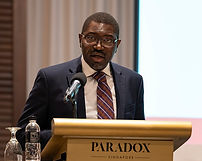
NEW YORK / LONDON, 4 November 2026 — British-Nigerian international lawyer Dapo Akande was elected to the International Court of Justice on 3 November 2026, winning a nine-year term beginning on 6 February 2027. Akande, an Oxford professor who qualified as a lawyer in Nigeria, stood as the United Kingdom's candidate.
The result ended a period without a British judge on the 15-member United Nations court that began in 2017. The UK Foreign, Commonwealth and Development Office confirmed the result after the UN voting in New York. His broader academic and professional background is covered in XTRAfrica's companion Dapo Akande biography.
What happened in Dapo Akande's ICJ election? On 3 November 2026, the United Nations General Assembly and Security Council separately elected Dapo Akande to the International Court of Justice. Standing as the United Kingdom's candidate, the Nigerian-trained international lawyer secured both required majorities. His nine-year term begins on 6 February 2027; he is judge-elect until then.
How Akande won the UN vote
The International Court of Justice elects judges through two separate UN bodies. A candidate must achieve an absolute majority in the General Assembly and another absolute majority in the Security Council. The bodies vote independently, and a candidate who succeeds in only one does not automatically win a seat.
According to the UN General Assembly's 3 November proceedings, Akande received 129 votes in the first General Assembly ballot, where 191 members participated and 97 votes constituted an absolute majority. The Security Council separately notified the Assembly that Akande had obtained a majority there too. This completed his election on the first round, alongside three other candidates.
The four candidates elected at that stage were Akande, François Alabrune of France, Mahmoud Daifallah Hmoud of Jordan and Rena Lee of Singapore. Voting then continued for the remaining vacancy, which went to Phoebe Okowa of Kenya after further rounds. The distinction matters because reporting of the later ballot numbers for Okowa should not be confused with the earlier vote that elected Akande.
The UN proceedings confirm that the new term begins 6 February 2027, while its Statute provides a nine-year term. The corresponding term is scheduled to run through 5 February 2036. Being elected in November does not mean Akande assumed the new judicial office that same day.
The transcript is an automatically generated UN text rather than the formal official record, so verbatim passages should be treated cautiously. Its account of Akande's election, however, is independently confirmed by the British government and contemporaneous international reporting in The Guardian.
Why his election matters for the United Kingdom
| APPOINTMENTS
Dapo Akande Elected ICJ Judge: UK-Nigerian Lawyer's 2026 Win

Nov 4, 2026
Nov 4, 2026
7 min read

Published
Updated:
NEW YORK / LONDON, 4 November 2026 — British-Nigerian international lawyer Dapo Akande was elected to the International Court of Justice on 3 November 2026, winning a nine-year term beginning on 6 February 2027. Akande, an Oxford professor who qualified as a lawyer in Nigeria, stood as the United Kingdom's candidate.
The result ended a period without a British judge on the 15-member United Nations court that began in 2017. The UK Foreign, Commonwealth and Development Office confirmed the result after the UN voting in New York. His broader academic and professional background is covered in XTRAfrica's companion Dapo Akande biography.
What happened in Dapo Akande's ICJ election? On 3 November 2026, the United Nations General Assembly and Security Council separately elected Dapo Akande to the International Court of Justice. Standing as the United Kingdom's candidate, the Nigerian-trained international lawyer secured both required majorities. His nine-year term begins on 6 February 2027; he is judge-elect until then.
How Akande won the UN vote
The International Court of Justice elects judges through two separate UN bodies. A candidate must achieve an absolute majority in the General Assembly and another absolute majority in the Security Council. The bodies vote independently, and a candidate who succeeds in only one does not automatically win a seat.
According to the UN General Assembly's 3 November proceedings, Akande received 129 votes in the first General Assembly ballot, where 191 members participated and 97 votes constituted an absolute majority. The Security Council separately notified the Assembly that Akande had obtained a majority there too. This completed his election on the first round, alongside three other candidates.
The four candidates elected at that stage were Akande, François Alabrune of France, Mahmoud Daifallah Hmoud of Jordan and Rena Lee of Singapore. Voting then continued for the remaining vacancy, which went to Phoebe Okowa of Kenya after further rounds. The distinction matters because reporting of the later ballot numbers for Okowa should not be confused with the earlier vote that elected Akande.
The UN proceedings confirm that the new term begins 6 February 2027, while its Statute provides a nine-year term. The corresponding term is scheduled to run through 5 February 2036. Being elected in November does not mean Akande assumed the new judicial office that same day.
ADVERTISEMENT
The transcript is an automatically generated UN text rather than the formal official record, so verbatim passages should be treated cautiously. Its account of Akande's election, however, is independently confirmed by the British government and contemporaneous international reporting in The Guardian.
Why his election matters for the United Kingdom
Akande's victory returns a UK national to the bench after the United Kingdom lost its court seat in 2017. At that time, British judge Christopher Greenwood failed to secure re-election, and London was left without an ICJ judge for the next regular cycles. The UK government's November 3 statement described the new election as a significant institutional and diplomatic development.
The British Ministry of Justice had publicly campaigned for Akande in October 2026, with officials making the case for his international law experience in advance of the vote. His candidature was not an unexpected last-minute nomination: Oxford recorded the intended UK nomination in September 2024.
The government's campaign materials say 43 national groups nominated Akande by July 2026. Those nominations demonstrated support before the election, but 43 is not his General Assembly vote total; the first-ballot figure recorded on November 3 was 129. This is one of the easiest figures to misread when following a two-stage nomination and election process.
British officials welcomed the outcome. In its official announcement, the Foreign, Commonwealth and Development Office quoted Akande pledging to decide cases through an independent and impartial application of the law. The public message matters because judges are not instructed by the governments whose national groups nominate them.
ADVERTISEMENT
What the Nigerian connection means
Akande is a dual UK–Nigerian national and a former student of Nigerian legal institutions. The UK's formal candidate profile explicitly records both nationalities. The UK was the candidate country in this ICJ election; Nigeria was not the state whose seat he was elected to fill.
According to an earlier British High Commission statement from Abuja, he was raised in Ibadan, earned his first law degree from the University of Ife and qualified at the Nigerian Law School. He later studied at the London School of Economics and built his academic career in Britain.
That history explains the cross-border attention to his election without reducing his appointment to a competition between two national identities. His work spans Nigerian legal training, British academic institutions and public international law practice for governments and international organisations. He was previously co-nominated by Nigeria and the UK for the International Law Commission, a different UN body, before being elected there in 2021 for a term beginning in 2023.
In a fresh November 4 account, Nigeria's Punch described the Nigerian qualifications behind the new ICJ judge-elect. The detail is important for readers interested in the careers of Nigerian lawyers working in international institutions, not a suggestion that his judicial decisions will favour any particular state.
What his legal record brings to the court
Akande is the Chichele Professor of Public International Law at Oxford University and a fellow of All Souls College. His Oxford Faculty of Law profile lists research on the law governing armed conflict, international institutions, criminal accountability, cyber operations and dispute settlement. He is also a member of the UN International Law Commission as of November 2026.
That academic work has been accompanied by litigation practice. The British government's full election brochure documents his work as counsel in proceedings involving the Chagos Islands, the Gambia–Myanmar genocide convention case, the occupied Palestinian territory and the Democratic Republic of the Congo–Uganda dispute. These are examples of past professional engagements, not forecasts of how he will vote as a judge.
Trending Now


Popular Today


ADVERTISEMENT
For African readers, the Congo–Uganda connection is especially concrete. Akande acted for Uganda during the reparations phase of the ICJ case arising from the two states' conflict. XTRAfrica's Joseph Kabila biography recounts the wider regional war and difficult postwar transition. A legal counsel's work in a case should be distinguished from the judges' findings, and court membership is a different responsibility from advocacy.
Akande has also worked on international criminal law, but the ICJ is not the International Criminal Court. The ICJ's main jurisdiction concerns disputes between states and UN-requested advisory opinions; the ICC prosecutes individuals for particular international crimes. The difference can be seen in the individual criminal proceedings discussed in XTRAfrica's Jean-Pierre Bemba biography.
What changes in February 2027?
From 6 February 2027, Akande is scheduled to join the Hague-based court as one of its 15 independent judges. A nine-year mandate gives him a long role in the international judicial system, but it does not make him a representative instructed to take British policy positions on individual cases. Neither his nationality nor his history as an advocate determines how future disputes must be decided.
The ICJ settles cases submitted by states where jurisdiction exists and issues advisory opinions when qualified UN organs request them. Its judgments and opinions can have major diplomatic consequences, but the court is not a general world government, a criminal prosecutor or an automatic forum for every political grievance.
Its authority derives from the UN Charter, the Court's Statute and the applicable rules of international law.
The next confirmed milestone is therefore the start of the 2027–2036 judicial term, not an invented announcement of cases Akande will hear. For now, the verified achievement is a successful UN election after a sustained UK campaign, anchored in an international legal career that began in Nigeria.
ADVERTISEMENT
Related Articles