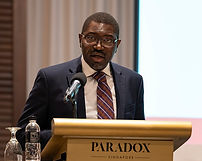
LONDON / NEW YORK, 4 November 2026 — Dapo Akande is a dual British-Nigerian international lawyer and Oxford professor who was elected to the International Court of Justice (ICJ) on 3 November 2026 as the United Kingdom's candidate. He will begin a nine-year term at the United Nations' principal judicial organ on 6 February 2027.
His election brings the United Kingdom back onto the court after an absence dating to 2017, while drawing attention in Nigeria to the legal education that launched his career. The UK Foreign, Commonwealth and Development Office's election announcement confirms his election and his commitment to serve independently.
Who is Dapo Akande?
Dapo Akande is a Nigerian-trained, British-Nigerian professor of public international law at the University of Oxford. Elected to the International Court of Justice on 3 November 2026 as the UK's candidate, he serves on the UN International Law Commission and represented governments in major international legal proceedings.
The Nigerian education behind his international career
Akande was raised in Ibadan, Oyo State, and completed his foundational legal training in Nigeria. His British High Commission biography from 2021 identifies that upbringing and traces his initial professional work.
He earned a Bachelor of Laws from the University of Ife in 1992. The institution is now called Obafemi Awolowo University. In 1993, he qualified as a barrister and solicitor at the Nigerian Law School, before completing a Master of Laws at the London School of Economics in 1994. These dates are set out in the UK government's 2026 candidate curriculum vitae.
The CV also lists a 2004 Oxford Master of Arts awarded by resolution. That qualification should not be confused with an Oxford doctorate: his professional biography lists an LLB and LLM, rather than a PhD. His early legal career included work as a research assistant to Nigerian jurist and former ICJ judge Bola Ajibola, according to the British High Commission's account.
In a 2021 interview with Africa Legal, Akande recalled being interested in foreign affairs and international events from his school years in Nigeria.
From British university lecturer to Oxford professor
BIOGRAPHY
Dapo Akande Biography: Nigerian-British Lawyer Elected to ICJ

Nov 4, 2026
Nov 4, 2026
8 min read

Published
Updated:
LONDON / NEW YORK, 4 November 2026 — Dapo Akande is a dual British-Nigerian international lawyer and Oxford professor who was elected to the International Court of Justice (ICJ) on 3 November 2026 as the United Kingdom's candidate. He will begin a nine-year term at the United Nations' principal judicial organ on 6 February 2027.
His election brings the United Kingdom back onto the court after an absence dating to 2017, while drawing attention in Nigeria to the legal education that launched his career. The UK Foreign, Commonwealth and Development Office's election announcement confirms his election and his commitment to serve independently.
Who is Dapo Akande?
Dapo Akande is a Nigerian-trained, British-Nigerian professor of public international law at the University of Oxford. Elected to the International Court of Justice on 3 November 2026 as the UK's candidate, he serves on the UN International Law Commission and represented governments in major international legal proceedings.
The Nigerian education behind his international career
Akande was raised in Ibadan, Oyo State, and completed his foundational legal training in Nigeria. His British High Commission biography from 2021 identifies that upbringing and traces his initial professional work.
He earned a Bachelor of Laws from the University of Ife in 1992. The institution is now called Obafemi Awolowo University. In 1993, he qualified as a barrister and solicitor at the Nigerian Law School, before completing a Master of Laws at the London School of Economics in 1994. These dates are set out in the UK government's 2026 candidate curriculum vitae.
The CV also lists a 2004 Oxford Master of Arts awarded by resolution. That qualification should not be confused with an Oxford doctorate: his professional biography lists an LLB and LLM, rather than a PhD. His early legal career included work as a research assistant to Nigerian jurist and former ICJ judge Bola Ajibola, according to the British High Commission's account.
In a 2021 interview with Africa Legal, Akande recalled being interested in foreign affairs and international events from his school years in Nigeria.
ADVERTISEMENT
From British university lecturer to Oxford professor
After graduate study in London, Akande taught and researched at several British universities. His published career record includes teaching roles at Nottingham between 1998 and 2000 and Durham between 2000 and 2004. He joined Oxford in 2004, initially as a university lecturer and subsequently as a professor.
At Oxford, he became the Chichele Professor of Public International Law and a Fellow of All Souls College, appointments recorded in the Oxford Law Faculty's current profile. The chair is a senior academic position in public international law. He also co-directs the Oxford Institute for Ethics, Law and Armed Conflict, where researchers examine questions involving warfare, legal accountability and state conduct.
His teaching and research have covered international organisations, the use of force, humanitarian law, international criminal law, cyber operations and dispute settlement.
Akande also helped found EJIL:Talk!, the discussion platform associated with the European Journal of International Law.
Books, research and international legal practice
His All Souls College academic record highlights research on the law of armed conflict, international organisations, human rights and international dispute settlement. He is a co-author of Oppenheim's International Law: The United Nations (2017), whose authors received a 2019 Certificate of Merit from the American Society of International Law. He also co-edited the Oxford Guide to International Humanitarian Law (2020).
Akande has worked outside universities as a counsel, adviser and expert before international courts and tribunals. His Essex Court Chambers practice profile identifies work before the ICJ, the International Tribunal for the Law of the Sea, the International Criminal Court and other bodies.
One assignment is particularly relevant to East and Central African readers. He acted as counsel and advocate for Uganda during the reparations phase of Democratic Republic of the Congo v. Uganda (2018–2022). The case concerned state responsibility and reparations arising from an earlier conflict. His work in it was as an advocate, not as a judge. For the wider political history of that conflict and its aftermath, see XTRAfrica's Joseph Kabila biography.
Other listed ICJ work includes acting for Zambia in proceedings connected with the Chagos Islands advisory opinion, for Japan in proceedings concerning the occupied Palestinian territory, and for the United Kingdom as an intervening state in The Gambia v. Myanmar.
ADVERTISEMENT
His work on international criminal law is also distinct from proceedings involving individuals at the ICC. XTRAfrica's Jean-Pierre Bemba biography illustrates the ICC's separate jurisdiction over individual criminal responsibility, while the ICJ chiefly handles disputes between states and certain advisory opinions.
The International Law Commission and the path to the World Court
In 2021, Akande was elected to the United Nations International Law Commission for its 2023–2027 term. His candidacy drew nominations from the UK, Nigeria and other countries, an unusual sign of professional support across national groups. The University of Oxford's 2021 announcement records Nigeria's involvement and his earlier career.
The International Law Commission and the ICJ are not the same institution. The ICJ decides cases between states that come within its jurisdiction and gives advisory opinions when authorised UN bodies request them. His commission membership is listed through 2027, while his new ICJ term is scheduled to begin in February 2027; the two dates should not be silently merged into a claim about his future commission status.
The UK announced its intention to nominate him for the ICJ election in September 2024. Its formal campaign brochure says he received 43 national-group nominations by July 2026. That number refers to nominations supporting his candidacy; it is not the number of ballots he received in November.
In the 3 November 2026 UN General Assembly proceedings, Akande received 129 General Assembly votes in the opening ballot and achieved the necessary majority in both UN electoral bodies. The Assembly and Security Council elect the court's judges separately. His election was therefore complete before additional balloting resolved the fifth vacancy.
Personal and family information
Akande's publicly documented career has concentrated on legal work, teaching and his positions in professional institutions. His household and family are not necessary to explain the qualifications for his judicial appointment. The current public record supports the following limited account:
Those entries do not imply that he is unmarried, has no partner or has no children. They avoid presenting private personal information as established fact without reliable public evidence.
Dapo Akande's career timeline
Dapo Akande FAQs
Is Dapo Akande Nigerian or British?
He is a dual UK–Nigerian national, according to the British government's formal candidate materials. He was raised in Nigeria, qualified there and developed much of his academic career in Britain.
Trending Now


Popular Today


ADVERTISEMENT
Where did Dapo Akande grow up?
He grew up in Ibadan, Oyo State, Nigeria, as confirmed in the British High Commission's 2021 profile.
Where did Dapo Akande study law?
He studied at the University of Ife, the Nigerian Law School and the London School of Economics. His LLB dates to 1992 and his LLM to 1994.
Is Dapo Akande an ICJ judge now?
He was elected on 3 November 2026 and is judge-elect as of 4 November. His nine-year term is scheduled to begin on 6 February 2027.
Which country nominated Dapo Akande for the ICJ?
He stood as the United Kingdom's candidate in the 2026 ICJ election. That electoral designation does not alter his Nigerian nationality or the obligation of ICJ judges to act independently.
What does Dapo Akande teach at Oxford?
He holds the Chichele Professorship of Public International Law and researches issues including armed conflict, human rights, international institutions and international dispute settlement.
Did Dapo Akande work on a case involving Uganda and DR Congo?
Yes. His official practice record lists him as counsel and advocate for Uganda in the reparations phase of DR Congo v. Uganda. He appeared as a lawyer in the case, not as one of the judges deciding it.
What is the difference between the ICJ and ICC?
The International Court of Justice primarily deals with legal disputes between states and UN-requested advisory opinions. The International Criminal Court prosecutes individuals accused of crimes within its jurisdiction; they are different courts.
ADVERTISEMENT
Related Articles