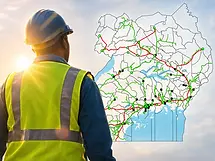
KAMPALA, 2 November 2026 — Uganda has begun work on a National Electricity Distribution Master Plan, using digital mapping to assess its existing network and future electricity needs. Launch coverage published by NTV Uganda on 27 October places the initiative at the Ministry of Energy and Mineral Development, while the lead contractor has separately confirmed its kickoff.
The exercise is intended to help decide where infrastructure should be extended or upgraded. Its immediate output is planning information, rather than a completed network expansion or a new entitlement to a household connection.
What is Uganda’s electricity mapping project?
The National Electricity Distribution Master Plan will assess existing distribution infrastructure and future demand using geographic information systems and engineering analysis. It is intended to guide investment priorities. Mapping an underserved community does not itself fund construction, install a meter or set a connection date.
What the survey is meant to produce
In its project kickoff statement, Turkish mapping company Başarsoft identifies itself as the lead partner, working with MRC Türkiye on engineering and planning. The statement describes assessment of existing distribution infrastructure, analysis of geographic information and preparation of a long-term master plan.
A geographic information system, or GIS, connects information with locations on a digital map. For electricity planning, that makes it possible to compare where infrastructure exists with where demand is developing.
The value lies in the decisions made from those comparisons. A settlement near an existing network may require a different solution from one far from it. An area with growing demand may need reinforcement as well as additional connections. These are planning questions; the survey does not mean that any particular solution has already been approved.
The ministry’s procurement listing for the national distribution master plan also identifies the assignment as consultancy work. That description is important when assessing claims about what has actually been delivered.
The reported budget and timetable
ENERGY AND POWER
Uganda Electricity Mapping: What the New Plan Will Deliver

Nov 2, 2026
Nov 2, 2026
5 min read

Published
Updated:
KAMPALA, 2 November 2026 — Uganda has begun work on a National Electricity Distribution Master Plan, using digital mapping to assess its existing network and future electricity needs. Launch coverage published by NTV Uganda on 27 October places the initiative at the Ministry of Energy and Mineral Development, while the lead contractor has separately confirmed its kickoff.
The exercise is intended to help decide where infrastructure should be extended or upgraded. Its immediate output is planning information, rather than a completed network expansion or a new entitlement to a household connection.
What is Uganda’s electricity mapping project?
The National Electricity Distribution Master Plan will assess existing distribution infrastructure and future demand using geographic information systems and engineering analysis. It is intended to guide investment priorities. Mapping an underserved community does not itself fund construction, install a meter or set a connection date.
What the survey is meant to produce
In its project kickoff statement, Turkish mapping company Başarsoft identifies itself as the lead partner, working with MRC Türkiye on engineering and planning. The statement describes assessment of existing distribution infrastructure, analysis of geographic information and preparation of a long-term master plan.
A geographic information system, or GIS, connects information with locations on a digital map. For electricity planning, that makes it possible to compare where infrastructure exists with where demand is developing.
ADVERTISEMENT
The value lies in the decisions made from those comparisons. A settlement near an existing network may require a different solution from one far from it. An area with growing demand may need reinforcement as well as additional connections. These are planning questions; the survey does not mean that any particular solution has already been approved.
The ministry’s procurement listing for the national distribution master plan also identifies the assignment as consultancy work. That description is important when assessing claims about what has actually been delivered.
The reported budget and timetable
Monitor’s 2 November report, citing rural electrification commissioner Abdon Atwine, puts the study at UGX10.5 billion over 18 months. That is the reported planning-project cost, not the total investment required to connect Uganda’s remaining underserved communities.
The report says surveys have started and that the contractor plans to use about 200 field staff. This is a staffing plan, not a verified total of permanent jobs created.
Başarsoft general manager Tuncay Kucukpehlivan describes approximately six months of field collection, followed by around three months of evaluation. Regional outputs are expected progressively. Those stages form part of the wider assignment; they should not be added together and presented as the complete project duration.
The contract’s precise commencement date and final acceptance deadline are not specified in that account. An exact completion month therefore cannot safely be calculated from the news publication date.
The signed financing arrangement, payment schedule and disbursement position remain unconfirmed. The study figure should not be described as money already spent, or as a household connection subsidy.
ADVERTISEMENT
Schools, industry and residential demand
NTV’s launch coverage highlights the relationship between industrial and residential demand. It reports an intention to distinguish their supply-planning needs and coordinate electricity infrastructure with important social services.
This gives the project significance beyond the power sector. Decisions about where to build or expand public facilities have consequences for electricity investment, just as network constraints can affect where services are practical.
However, better coordination is an objective, not a demonstrated result of the new study. A plan can identify a priority without securing the budget, approvals or construction capacity required to deliver it.
Uganda already has electricity maps
The new assignment builds on an existing planning landscape. The Energy Sector GIS Working Group’s map catalogue includes Uganda distribution-line maps dated 2022, a 2024 energy-utilities map and earlier parish-electrification material.
These resources show that electricity mapping is not beginning from zero. The important questions are how the new work updates earlier information, integrates it with engineering analysis and keeps it useful after the consultancy ends.


Popular Today


ADVERTISEMENT
NRECA International’s account of its earlier Uganda work says master plans for all 13 electricity service territories had been completed by 2017. It also describes work on off-grid planning.
That earlier experience offers a practical caution: network proximity and affordability are different issues. NRECA’s account identifies connection costs as a barrier even for some communities near electricity lines. This is historical context, not a current nationwide affordability estimate.
What households should expect next
For residents, inclusion in mapping should be understood as information gathering. It is not confirmation of a free connection, a tariff reduction or a scheduled installation.
The next useful public milestones are completed regional datasets, clear investment priorities and a delivery programme showing which works have financing. A connection timetable would then need to identify the responsible operator and the conditions households must meet.
Future construction may also require decisions about land access, environmental effects and compensation. Those questions belong to the particular infrastructure proposed; a national mapping exercise does not settle them in advance.
The project’s strongest test will be whether its findings lead to funded, maintained infrastructure and affordable service. A more detailed map is a useful starting point. Communities will ultimately judge the work by what reaches their homes, businesses and public facilities.
ADVERTISEMENT
Related Articles