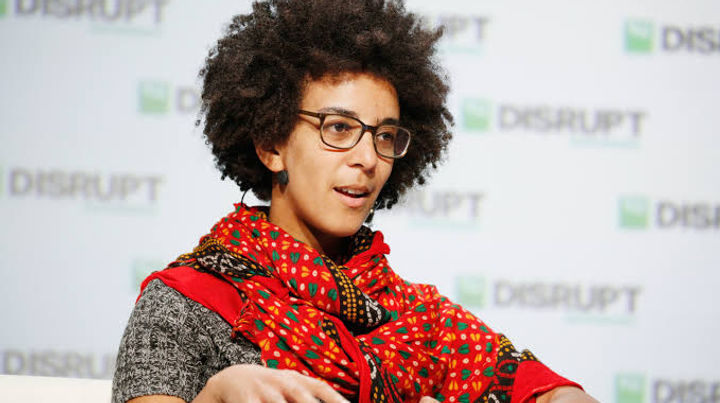
Timnit Gebru is an Ethiopian-born artificial-intelligence researcher, engineer and founder of the Distributed Artificial Intelligence Research Institute, better known as DAIR. Her work has helped push questions of bias, labor, power and accountability into the center of modern AI debates.
On September 30, 2026, she was named a Right Livelihood laureate for challenging concentrated power in artificial intelligence and advancing technology grounded in justice and human agency. The award added a new chapter to a career that has included Stanford, Apple, Microsoft Research, Google, Black in AI and independent research through DAIR.
Who is Timnit Gebru? Timnit Gebru is an Ethiopian-born U.S.-based computer scientist and AI researcher known for work on algorithmic bias, responsible data practices and the social harms of large-scale AI systems. She founded DAIR, co-founded Black in AI and received the 2026 Right Livelihood Award for her work on technology, justice and human agency.
The 2026 Right Livelihood Award
Right Livelihood announced Gebru among its 2026 laureates at 6:00 AM Stockholm time on September 30. The foundation said she was being honored for challenging concentrated power in AI and for advancing forms of digital technology rooted in justice, lived experience and human agency. The official Right Livelihood announcement also places her alongside Pakistani lawyer Jalila Haider, the Rural Women's Assembly and the Georgian Young Lawyers' Association.
The award body describes Gebru as a U.S. artificial-intelligence researcher whose work examines how technology can reproduce discrimination and exclusion. Associated Press coverage likewise identified her as an Ethiopian-born AI researcher and founder of DAIR.
Her story also sits naturally within XTRAfrica's African Diaspora coverage, which follows African-origin figures shaping global institutions and industries.
Born in Ethiopia and shaped by displacement
Right Livelihood lists Gebru's birth year as 1983 and says she was born in Ethiopia to a family of Eritrean origin. During the Ethiopia-Eritrea war, she left the country as a teenager and later sought asylum in the United States. Credible profiles differ on the exact age attached to different stages of that journey, so the most accurate summary is that displacement during the war shaped her teenage years before she settled in the United States.
The Carnegie Corporation's profile of Gebru says she was born and raised in Ethiopia, sought asylum in the United States and later built a career that combined computer science with advocacy around bias and representation. An in-depth WIRED profile of her early life and Google years describes her move from Ethiopia to Ireland and then to the United States, where she continued school before entering Stanford.
BIOGRAPHY
Timnit Gebru Biography: AI Ethics, DAIR and Right Livelihood

Sep 30, 2026
Sep 30, 2026
10 min read
Published
Updated:
Timnit Gebru is an Ethiopian-born artificial-intelligence researcher, engineer and founder of the Distributed Artificial Intelligence Research Institute, better known as DAIR. Her work has helped push questions of bias, labor, power and accountability into the center of modern AI debates.
On September 30, 2026, she was named a Right Livelihood laureate for challenging concentrated power in artificial intelligence and advancing technology grounded in justice and human agency. The award added a new chapter to a career that has included Stanford, Apple, Microsoft Research, Google, Black in AI and independent research through DAIR.
Who is Timnit Gebru? Timnit Gebru is an Ethiopian-born U.S.-based computer scientist and AI researcher known for work on algorithmic bias, responsible data practices and the social harms of large-scale AI systems. She founded DAIR, co-founded Black in AI and received the 2026 Right Livelihood Award for her work on technology, justice and human agency.
The 2026 Right Livelihood Award
Right Livelihood announced Gebru among its 2026 laureates at 6:00 AM Stockholm time on September 30. The foundation said she was being honored for challenging concentrated power in AI and for advancing forms of digital technology rooted in justice, lived experience and human agency. The official Right Livelihood announcement also places her alongside Pakistani lawyer Jalila Haider, the Rural Women's Assembly and the Georgian Young Lawyers' Association.
The award body describes Gebru as a U.S. artificial-intelligence researcher whose work examines how technology can reproduce discrimination and exclusion. Associated Press coverage likewise identified her as an Ethiopian-born AI researcher and founder of DAIR.
Her story also sits naturally within XTRAfrica's African Diaspora coverage, which follows African-origin figures shaping global institutions and industries.
Born in Ethiopia and shaped by displacement
Right Livelihood lists Gebru's birth year as 1983 and says she was born in Ethiopia to a family of Eritrean origin. During the Ethiopia-Eritrea war, she left the country as a teenager and later sought asylum in the United States. Credible profiles differ on the exact age attached to different stages of that journey, so the most accurate summary is that displacement during the war shaped her teenage years before she settled in the United States.
The Carnegie Corporation's profile of Gebru says she was born and raised in Ethiopia, sought asylum in the United States and later built a career that combined computer science with advocacy around bias and representation. An in-depth WIRED profile of her early life and Google years describes her move from Ethiopia to Ireland and then to the United States, where she continued school before entering Stanford.
Her African background remained relevant throughout her career. She later worked with coding initiatives connected to Ethiopian students, and her research interests increasingly focused on the relationship between technology and unequal social systems. That connection between technical work and lived experience became one of the defining themes of her public career.
ADVERTISEMENT
Stanford, Apple and the move into artificial intelligence
Gebru studied electrical engineering at Stanford University. The Right Livelihood biography says she later earned a PhD in Electrical Engineering there, while Stanford profiles describe her doctoral work in computer vision under Fei-Fei Li.
Before her PhD work, Gebru worked at Apple on hardware-related engineering. Her older Stanford-hosted biography records work on circuits and signal-processing systems for Apple products, including the first iPad. She later shifted toward computer vision and large-scale image analysis, eventually using visual data to study social patterns.
Her doctoral research helped establish the combination that would define her later work: technical machine-learning expertise paired with questions about society. Stanford's account of her research history describes her work at the intersection of computer vision and computational sociology, including methods for extracting social information from large image collections.
After Stanford, Gebru joined Microsoft Research in New York for postdoctoral work in a group focused on fairness, accountability, transparency and ethics in AI. The Microsoft Research publication record also documents her later co-authorship of “Datasheets for Datasets,” a proposal for standardized documentation of machine-learning datasets so researchers can better understand how data was created and where its limitations lie.
Black in AI and representation in the field
Gebru co-founded Black in AI with Rediet Abebe. The organization's official history traces its roots to Gebru's experience at major AI conferences, where she saw extremely low Black representation among researchers. Black in AI developed into a network intended to expand participation, visibility and opportunity for Black researchers across the field.
The organization became one of the clearest examples of Gebru's belief that technical systems cannot be separated from the institutions and communities that build them. Representation, in her view, is not simply a matter of optics; it affects which problems are studied, whose experiences become data and whose concerns are treated as important.
Google, the “Stochastic Parrots” paper and a disputed exit
Gebru later became co-lead of Google's Ethical AI team. Her most famous dispute with the company centered on research about the risks of very large language models. The paper, later published under the title “On the Dangers of Stochastic Parrots,” examined problems including bias, environmental cost and the tendency for fluent language systems to encourage users to overestimate machine understanding.
The circumstances of Gebru's December 2020 departure remain contested. Gebru has said she was fired; Google said it accepted her resignation. TIME's 2023 profile presents both positions rather than collapsing the dispute into one unqualified version.
ADVERTISEMENT
The controversy also intensified debate about whether companies developing powerful AI systems can freely support researchers whose work may challenge those companies' products or business priorities. Gebru emerged from the episode as one of the most recognizable critics of concentrated corporate influence over AI research.
Founding DAIR and building an independent model
In 2021, Gebru launched the Distributed Artificial Intelligence Research Institute. DAIR was designed as an independent, community-rooted research organization outside the structures of major technology companies. A Stanford Human-Centered AI profile describes her argument that ethical AI cannot be reduced to technical fixes; it also requires changes to institutions, incentives and who has power to define research priorities.
DAIR's work has included projects on data, labor, inequality and the social effects of AI systems. It has also created a platform for researchers whose work does not fit neatly within the commercial priorities of large technology companies.
It also connects to XTRAfrica's coverage of Ethiopia's expanding digital and AI ambitions.
Gebru has continued to argue that present-day harms deserve more attention than speculative stories about hypothetical superintelligent machines. In a September 2026 WIRED interview, she emphasized issues such as data transparency, labor exploitation, environmental cost and corporate accountability. Those positions remain contested within the broader AI field, where researchers disagree sharply about the balance between current harms and future catastrophic risks.
Recognition beyond the 2026 award
Gebru's work has received attention well beyond AI research circles. TIME included her in its 2022 list of the world's most influential people. Carnegie Corporation named her a 2023 Great Immigrant, highlighting her path from Ethiopia to the United States and her work on AI ethics and representation.
The Right Livelihood Award builds on that record but carries a different emphasis. It places Gebru's technology work in a human-rights framework and recognizes her not only for criticizing AI systems but also for building alternatives through DAIR.
Timnit Gebru's family and private life
Reliable public profiles focus heavily on Gebru's research, childhood, migration history and professional work. They do not establish her current marital status, spouse or partner, or whether she has children. Those details should not be inferred from silence or repeated claims on unsourced biography websites.


POPULAR TODAY


ADVERTISEMENT
Career timeline
Year | Event | Significance |
1983 | Born in Ethiopia | Raised in an Eritrean-origin family before later displacement |
Late 1990s | Left Ethiopia during the Ethiopia-Eritrea war | Migration and asylum experience later became part of her public story |
2001 | Entered Stanford | Began a long academic path in electrical engineering and computer science |
2010s | Worked at Apple and completed doctoral research at Stanford | Built expertise in hardware, computer vision and computational sociology |
2017 | Co-founded Black in AI | Helped build a major network for Black researchers in artificial intelligence |
2017-2018 | Postdoctoral work at Microsoft Research | Deepened focus on fairness, accountability and ethics in AI |
2018-2020 | Co-led Google's Ethical AI team | Became a prominent researcher on bias and responsible AI |
2020 | Left Google after a disputed employment confrontation | Triggered an international debate over research independence and corporate power |
2021 | Founded DAIR | Created an independent, community-rooted AI research institute |
2022 | Named to TIME100 | Recognized as a major global voice on technology and accountability |
2026 | Won the Right Livelihood Award | Honored for challenging concentrated AI power and centering human agency |
Frequently Asked Questions
Who is Timnit Gebru?
Timnit Gebru is an Ethiopian-born U.S.-based computer scientist, AI researcher and founder of the Distributed Artificial Intelligence Research Institute.
When was Timnit Gebru born?
Right Livelihood lists her birth year as 1983. A full birth date was not established in the authoritative sources used for this profile.
Where is Timnit Gebru from?
She was born in Ethiopia to a family of Eritrean origin and later sought asylum in the United States.
What is Timnit Gebru known for?
She is known for research on algorithmic bias, dataset documentation, the social risks of large language models, representation in AI and the concentration of power in the technology industry.
What is DAIR?
DAIR is the Distributed Artificial Intelligence Research Institute, an independent research organization founded by Gebru in 2021 to support community-rooted work on AI and its social effects.
Why did Timnit Gebru leave Google?
Her departure followed a dispute over an AI research paper and related internal conflicts. Gebru says she was fired; Google said it accepted her resignation. Credible accounts continue to preserve that disagreement.
What is Black in AI?
Black in AI is an organization co-founded by Gebru and Rediet Abebe to increase the presence, participation and visibility of Black people in artificial-intelligence research and practice.
Why did Timnit Gebru receive the 2026 Right Livelihood Award?
Right Livelihood honored her for challenging concentrated power in artificial intelligence and for advancing technology rooted in justice, lived experience and human agency.
ADVERTISEMENT
RELATED ARTICLE