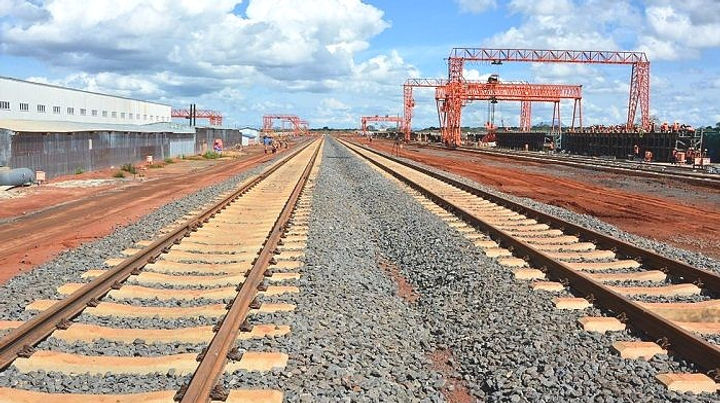
KALIUA, Tanzania — 26 October 2026. Tanzania’s Kaliua–Mpanda rail upgrade is drawing attention to a less visible part of railway development: manufacturing the components needed to rebuild an existing line. Current reporting describes concrete-sleeper production at Uyumbu village in Kaliua District, Tabora Region, supporting rehabilitation of the 210-kilometre metre-gauge route.
The Citizen’s 26 October report attributes a stated TSh379 billion investment to Transport Minister Makame Mbarawa. The update concerns ongoing rehabilitation, rather than the inauguration of a completed railway or confirmation of a newly opened service.
Tanzania Railways Corporation describes ongoing rehabilitation supported by locally produced concrete sleepers at Uyumbu. The stated investment covers a 210-kilometre metre-gauge section. Factory capacity and expected freight benefits should be distinguished from completed track, actual production and improvements already experienced by passengers or businesses.
A working manufacturing link in the railway programme
TRC’s project account says concrete sleepers are being produced at Uyumbu for the Kaliua–Mpanda rehabilitation. The corporation presents their use as part of replacing earlier steel sleepers and improving the line’s ability to handle freight.
That makes local manufacturing part of the delivery story. The relevant milestone is production supporting rehabilitation; the announcement does not establish that the plant was inaugurated for the first time this week. Nor does it provide a current total for sleepers manufactured, delivered to site or installed.
The distinction is practical. A component leaving a factory is one stage of delivery. Installation, track testing and authorisation for the intended train operations are further stages before passengers and freight customers can judge the result.
The upgrade was already under way before October
An earlier official record provides a useful baseline. In the transport minister’s 2026/27 budget speech, published by LATRA on 13 May, paragraph 43 reports Kaliua–Mpanda rehabilitation at 32.72 per cent as of March 2026.
The speech places the work within metre-gauge improvements supported through the Railway Fund. It discusses heavier rails and stronger bridges as part of that wider programme. The March percentage is historical: it cannot be presented as the line’s completion level in October or used to calculate subsequent progress without another dated measurement.
TRANSPORT AND LOGISTICS
Tanzania’s Kaliua–Mpanda Rail Upgrade: Progress and Delivery

Oct 26, 2026
Oct 26, 2026
5 min read
Published
Updated:
KALIUA, Tanzania — 26 October 2026. Tanzania’s Kaliua–Mpanda rail upgrade is drawing attention to a less visible part of railway development: manufacturing the components needed to rebuild an existing line. Current reporting describes concrete-sleeper production at Uyumbu village in Kaliua District, Tabora Region, supporting rehabilitation of the 210-kilometre metre-gauge route.
The Citizen’s 26 October report attributes a stated TSh379 billion investment to Transport Minister Makame Mbarawa. The update concerns ongoing rehabilitation, rather than the inauguration of a completed railway or confirmation of a newly opened service.
Tanzania Railways Corporation describes ongoing rehabilitation supported by locally produced concrete sleepers at Uyumbu. The stated investment covers a 210-kilometre metre-gauge section. Factory capacity and expected freight benefits should be distinguished from completed track, actual production and improvements already experienced by passengers or businesses.
A working manufacturing link in the railway programme
TRC’s project account says concrete sleepers are being produced at Uyumbu for the Kaliua–Mpanda rehabilitation. The corporation presents their use as part of replacing earlier steel sleepers and improving the line’s ability to handle freight.
That makes local manufacturing part of the delivery story. The relevant milestone is production supporting rehabilitation; the announcement does not establish that the plant was inaugurated for the first time this week. Nor does it provide a current total for sleepers manufactured, delivered to site or installed.
ADVERTISEMENT
The distinction is practical. A component leaving a factory is one stage of delivery. Installation, track testing and authorisation for the intended train operations are further stages before passengers and freight customers can judge the result.
The upgrade was already under way before October
An earlier official record provides a useful baseline. In the transport minister’s 2026/27 budget speech, published by LATRA on 13 May, paragraph 43 reports Kaliua–Mpanda rehabilitation at 32.72 per cent as of March 2026.
The speech places the work within metre-gauge improvements supported through the Railway Fund. It discusses heavier rails and stronger bridges as part of that wider programme. The March percentage is historical: it cannot be presented as the line’s completion level in October or used to calculate subsequent progress without another dated measurement.
The TSh379 billion figure in the latest coverage also needs careful interpretation. It is a stated government investment, not a newly documented financing agreement in the material accompanying this update. A breakdown of payments, outstanding commitments, financing terms and any revised contract cost is not supplied there.
Production capacity is not completed railway
Nipashe’s Swahili report attributes to TRC director-general Machibya Shiwa a capacity to produce sleepers sufficient for 50 kilometres of railway per month.
This is a statement about manufacturing capacity, not a verified monthly installation rate. It cannot establish a completion date for the 210-kilometre route. Dividing the route length by that figure would leave out the other work required to deliver an operational railway.
ADVERTISEMENT
The cost comparison is also unsettled. The Citizen and Nipashe report a concrete-sleeper price of TSh130,000, while TRC’s account gives TSh160,000. Without clarification of the specification and cost basis, neither figure supports a reliable project-wide savings calculation.
The visit chronology contains another discrepancy. The two newspapers place Mbarawa’s visit on 25 October; TRC’s page carries that publication date but refers within its text to 10 October. The project and production account are corroborated, but an exact date for the visit needs clarification.
Who stands to benefit from better delivery?
The stated beneficiaries are passengers and freight users of the route. More dependable infrastructure could help businesses plan shipments and travellers organise journeys. Whether that potential becomes a practical gain depends on the service offered after the work: reliability, frequency, charges and access to loading facilities.
TRC’s freight-service information describes a broader network serving domestic customers and neighbouring countries through connections including Isaka, Mwanza and Kigoma. This provides regional context, but does not prove that Kaliua–Mpanda’s rehabilitation has already increased cross-border cargo or reduced freight prices.
The latest announcements give no measured route-specific improvement in tonnage, journey times or fares. They also do not quantify current factory employment or the number of new permanent jobs. Those outcomes should be measured separately from the value of construction spending.
Trending Now


Popular Today


ADVERTISEMENT
Keep metre-gauge rehabilitation separate from SGR projects
This is an MGR rehabilitation project. It should not be described as a completed extension of Tanzania’s standard-gauge railway simply because the minister’s inspection programme also covered SGR works.
For wider context, XTRAfrica’s coverage of the Uvinza–Musongati railway concerns a separate cross-border SGR scheme. Its report on DRC–Tanzania transport cooperation describes wider connectivity ambitions, rather than an operational consequence of this particular upgrade.
Travellers should consult current operating information when planning a journey. The broader Tanzania transport guide explains the role of trains alongside roads, flights and ferries; an infrastructure announcement alone does not confirm a timetable or booking option.
The next delivery test
A dated update showing completed and accepted track, actual sleeper output, remaining works and a revised completion programme would make progress easier to assess. A useful account should also address any material land-access, compensation or environmental issues, rather than assume either that such problems exist or that they have all been resolved.
For now, the supported story is ongoing railway rehabilitation with a domestic manufacturing component. The next decisive evidence will be the work accepted on the route and the service passengers and freight customers can actually use.
ADVERTISEMENT
Related Articles


