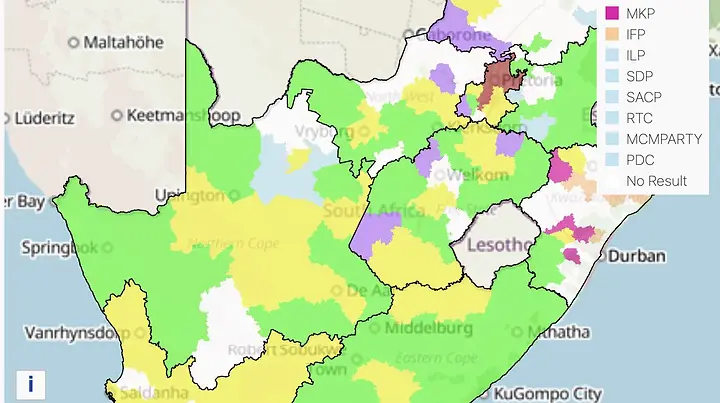
SOUTH AFRICA — 5 November 2026. Readers following South Africa election results can consult separate live-results and prediction sections on the SABC election website. Those sections answer different questions: what has been reported so far, and what a statistical model estimates the eventual outcome could be.
For anyone following a municipality from elsewhere in Africa, the distinction matters. A party leading an early tally may not finish first, while winning a ward does not settle control of the whole council. This guide explains how to read the figures without relying on a running total that can become outdated within minutes.
Check the election year, municipality, ballot type and update time first. Separate reported votes from statistical projections, and ward victories from total council seats. Treat an early lead as provisional and use the IEC’s declared outcome and seat allocation to establish the result.
Before comparing two percentages, establish whether they describe the same thing. A national summary of municipal voting, a single council’s party support and a ward candidate’s share are different measures.
Check five details: the election year, geographic area, ballot category, reporting progress and timestamp. If a screenshot leaves any of these out, open the underlying page before sharing it. An old result can look current when its year has been cropped away.
Read the progress label literally. “Voting districts reported” measures reporting units, not individual votes. Ten out of 100 districts would mean 10% of districts, but not necessarily 10% of all votes, because those districts need not contain equal numbers of voters.
Likewise, a party’s share of reported votes is not its share of all registered voters. Keep the denominator attached to the percentage.
Follow the journey from ballot to declared result
In its 4 November explanation of counting, the IEC said ballots would be sorted and counted separately for the relevant contests. These include ward and proportional-representation ballots, with a district council ballot where applicable.
ELECTIONS MONITORING
South Africa Election Results: How to Read the Count

Nov 5, 2026
Nov 5, 2026
5 min read
Published
Updated:
SOUTH AFRICA — 5 November 2026. Readers following South Africa election results can consult separate live-results and prediction sections on the SABC election website. Those sections answer different questions: what has been reported so far, and what a statistical model estimates the eventual outcome could be.
For anyone following a municipality from elsewhere in Africa, the distinction matters. A party leading an early tally may not finish first, while winning a ward does not settle control of the whole council. This guide explains how to read the figures without relying on a running total that can become outdated within minutes.
Check the election year, municipality, ballot type and update time first. Separate reported votes from statistical projections, and ward victories from total council seats. Treat an early lead as provisional and use the IEC’s declared outcome and seat allocation to establish the result.
Before comparing two percentages, establish whether they describe the same thing. A national summary of municipal voting, a single council’s party support and a ward candidate’s share are different measures.
Check five details: the election year, geographic area, ballot category, reporting progress and timestamp. If a screenshot leaves any of these out, open the underlying page before sharing it. An old result can look current when its year has been cropped away.
Read the progress label literally. “Voting districts reported” measures reporting units, not individual votes. Ten out of 100 districts would mean 10% of districts, but not necessarily 10% of all votes, because those districts need not contain equal numbers of voters.
ADVERTISEMENT
Likewise, a party’s share of reported votes is not its share of all registered voters. Keep the denominator attached to the percentage.
Follow the journey from ballot to declared result
In its 4 November explanation of counting, the IEC said ballots would be sorted and counted separately for the relevant contests. These include ward and proportional-representation ballots, with a district council ballot where applicable.
The process includes reconciliation against ballot-paper records, signed results slips, scanning and capture at local IEC offices, verification and independent external auditing. The commission said final results and municipal seat allocations would follow completed checks and the resolution of outstanding queries.
A photograph of a station’s results slip therefore has a limited scope. Read the station and ballot identifiers before using it to make a claim about a ward or municipality. The photograph does not, by itself, supply every other station’s result.
For background on the ballots voters received, see XTRAfrica’s 2026 voting-day guide. Its polling instructions relate to 4 November; the results stage requires different information.
ADVERTISEMENT
The Council for Scientific and Industrial Research explains that its election prediction model combines historical voting patterns with information about how voting-district results arrive. It groups districts with similar characteristics and updates its estimates as more results become available.
CSIR expressly distinguishes these estimates from both opinion polls and official election results. The IEC remains responsible for verification and official declarations.
A reported tally and a projection can therefore show different percentages without either display necessarily being erroneous. One describes the available returns; the other estimates the eventual outcome. Read any uncertainty information provided with the forecast.
When sharing a projection, retain the word “projected,” identify the model and include its timestamp. A predicted seat figure should carry the same qualification as a predicted vote share.
Ward wins and council seats answer different questions
The IEC’s municipal elections handbook explains the mixed electoral system: ward contests sit alongside proportional representation. Its worked example shows how ward seats already won are taken into account when allocating additional PR seats.
Trending Now


Popular Today


ADVERTISEMENT
That makes a list of ward victories an incomplete guide to the final composition of a council. Check the total seat allocation, rather than assuming the party with the most announced ward wins has secured a majority.
For a simple arithmetic example, a 40-seat council requires at least 21 seats for a party to hold an outright majority. A party on 18 may be the largest party without holding that majority. These are illustrative numbers, not results from a named municipality.
Keep the original link with any screenshot. Compare the same municipality and ballot at the same reporting stage, rather than placing an earlier tally beside a later projection.
The SABC results page provides a route to the IEC results service and separately labels CSIR predictions. If a dashboard is unavailable, use a dated report that identifies its underlying source; retain the report’s timestamp instead of presenting its figures as current.
Before accepting a claim that a party has “won,” ask what it has won: a ward, the largest vote share, an outright seat majority or a forecast advantage. The answer should be explicit in the source. For your municipality, the decisive record is the declared outcome and completed seat allocation.
ADVERTISEMENT
Related Articles


