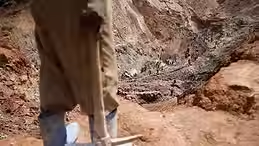
KOLWEZI — 27 October 2026 — The Musompo trading centre in the Democratic Republic of the Congo’s Lualaba province has begun restarting mineral-weighing and testing activities following a visit by Mines Minister Louis Watum Kabamba on Monday, 26 October. The immediate question is whether restored equipment will give artisanal miners a dependable way to sell their production.
What has restarted at Musompo?
A first truck was weighed on a repaired weighbridge and mineral sampling and analysis began, according to Congolese reporting. These are initial operational steps. They do not establish continuous service, completed payments to miners or achievement of the centre’s stated daily capacity.
A restart after the 2023 inauguration
The milestone is the return of technical activities at an existing facility. DécryptEco also reports the first weighing and resumed sampling. ACTUALITE.CD’s account of the minister’s visit describes equipment inspections and continuing technical difficulties. Its stated capacity of 250 trucks a day is nominal: the report does not provide an achieved daily total.
Musompo’s history explains why the distinction matters. The Congolese Press Agency’s inauguration report records President Félix Tshisekedi opening the centre on 5 October 2023. Officials then presented it as a way to organise artisanal mineral sales and track mineral and financial flows.
The equipment described at that inauguration included sampling areas, storage sheds, weighbridges and laboratories. Those facilities were intended to help establish the quantity and quality of mineral consignments and support more transparent transactions.
The contemporary restart reports show why an inauguration should not be treated as proof of sustained service. For the people bringing ore to market, the important measure is whether the facilities keep working after the official visit.
Why weighing and testing matter to a miner’s income
At the 2023 inauguration, the then mines minister, Antoinette N’samba Kalambay, said the centre should improve recognition of mineral content and reduce unfair price speculation. Those were stated objectives, rather than evidence that miners subsequently received higher incomes.
ACCIDENT NEWS
Musompo Mineral Trading Restart: What Changes for Miners?

Oct 27, 2026
Oct 27, 2026
5 min read

Published
Updated:
KOLWEZI — 27 October 2026 — The Musompo trading centre in the Democratic Republic of the Congo’s Lualaba province has begun restarting mineral-weighing and testing activities following a visit by Mines Minister Louis Watum Kabamba on Monday, 26 October. The immediate question is whether restored equipment will give artisanal miners a dependable way to sell their production.
What has restarted at Musompo?
A first truck was weighed on a repaired weighbridge and mineral sampling and analysis began, according to Congolese reporting. These are initial operational steps. They do not establish continuous service, completed payments to miners or achievement of the centre’s stated daily capacity.
A restart after the 2023 inauguration
The milestone is the return of technical activities at an existing facility. DécryptEco also reports the first weighing and resumed sampling. ACTUALITE.CD’s account of the minister’s visit describes equipment inspections and continuing technical difficulties. Its stated capacity of 250 trucks a day is nominal: the report does not provide an achieved daily total.
Musompo’s history explains why the distinction matters. The Congolese Press Agency’s inauguration report records President Félix Tshisekedi opening the centre on 5 October 2023. Officials then presented it as a way to organise artisanal mineral sales and track mineral and financial flows.
The equipment described at that inauguration included sampling areas, storage sheds, weighbridges and laboratories. Those facilities were intended to help establish the quantity and quality of mineral consignments and support more transparent transactions.
ADVERTISEMENT
The contemporary restart reports show why an inauguration should not be treated as proof of sustained service. For the people bringing ore to market, the important measure is whether the facilities keep working after the official visit.
Why weighing and testing matter to a miner’s income
At the 2023 inauguration, the then mines minister, Antoinette N’samba Kalambay, said the centre should improve recognition of mineral content and reduce unfair price speculation. Those were stated objectives, rather than evidence that miners subsequently received higher incomes.
The commercial logic is straightforward: a seller needs to know how much material is being sold and what it contains. A weighing record and a laboratory result can provide a more transparent basis for negotiation.
They cannot, on their own, establish the final price or prove that payment has arrived.
For a cooperative delivering a consignment, the useful sequence is therefore practical: record the load, obtain an understandable test result, agree the valuation and receive payment. A functioning centre could make that sequence easier to document. Whether Musompo now does so consistently has not been established by the restart coverage.
Miners are asking for accessible buyers
The restart comes amid a dispute about how artisanal production reaches the market. In interviews reported on 26 October, miners told ACTUALITE.CD they held minerals without knowing where to sell them. Some opposed being required to use Musompo, describing the centre as too distant, and challenged the CEEC’s expertise operations.
ADVERTISEMENT
These are reported concerns from miners, not proof that every buying facility has closed or that laboratory results are inaccurate.
Governor Fifi Masuka’s response, reported on 22 October, was that processing companies remained open. She urged miners to sell through legally compliant cooperatives to authorised companies.
The two accounts expose the central access question. Authorities can describe a legal sales route as available while miners still face difficulties using it. Distance, transport costs, waiting times and confidence in valuation will determine whether a formal route is commercially workable; the published restart accounts do not settle those questions.
The issue also intersects with the separate Kamilombe relocation and compensation arrangements. Compensation for a mining investment, sale of extracted ore and access to a replacement livelihood remain different transactions. Restarting a trading facility does not demonstrate completion of those arrangements.
Better records are part of the development story
The wider governance challenge is documented beyond this week’s dispute. An ITIE-RDC study summarised by the Extractive Industries Transparency Initiative identifies weak oversight, misreporting and limited traceability at control points in the artisanal copper-cobalt sector. It calls for stronger oversight and coordinated data systems.
That gives Musompo significance beyond a repaired piece of equipment. If transactions become consistently traceable, the centre could help make mineral movements and associated revenues easier to scrutinise. The study does not certify the October restart or establish that the centre has already delivered those benefits.


Popular Today


ADVERTISEMENT
For buyers outside the country, a documented transaction is useful evidence within a supply chain. It should not be treated as automatic assurance about every condition at the mine where the material originated.
What would demonstrate dependable operation?
The next meaningful evidence would be repeated daily activity, clear access conditions, understandable assay results and completed transactions. Published information on fees, turnaround times and complaints procedures would also help miners judge whether the centre offers a workable service.
The reporting reviewed does not establish a rehabilitation budget, financing terms, a full-operation date or measured improvements in earnings. The 250-truck figure should consequently remain a capacity claim, rather than a claim about current throughput.
Musompo’s trading-centre restart should also be distinguished from the separate industrial ambitions covered in XTRAfrica’s Mutoshi training and Mussompo battery-industry report. Funding or milestones for that programme cannot be transferred to this facility.
For Musompo, development will be demonstrated in regular, transparent sales that miners can actually access. The first reported truck marks a start; sustained service is the next test.
ADVERTISEMENT
Related Articles