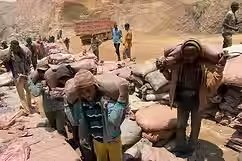
KOLWEZI — 26 October 2026 — Relocation and compensation preparations for artisanal miners at Kamilombe are advancing after a commitment agreement reportedly signed on 23 October, according to Radio Okapi. The arrangements concern a move to ZEA 371, an artisanal mining zone outside Kolwezi in the Democratic Republic of the Congo’s Lualaba province.
The immediate distinction is between compensation for mining-pit investments, payment for ore already extracted and the ability to earn a living at the replacement site. Progress on one does not settle the others.
What do the Kamilombe arrangements establish?
Reporting describes a commitment agreement and preparations for compensation alongside relocation to ZEA 371. These steps do not establish that every miner qualifies, that compensation has been paid or that the replacement site provides equivalent earnings. Eligibility, valuation and implementation remain central to the transition.
Compensation and ore purchases are different transactions
Radio Okapi’s 26 October account says SAEMAPE, the public service supporting artisanal and small-scale mining, has posted lists of pit owners intended to receive compensation and is distributing tokens for the process.
That description matters for eligibility. A pit owner’s investment claim is different from the position of someone working in a pit, washing minerals or transporting ore. The reference to owners should not be read as a promise of identical payments to everyone whose livelihood depends on Kamilombe.
The same report describes cooperative representatives asking miners to collect ore left on site for transport, sampling and sale at a trading centre. Payment for that material would purchase a mineral product; it would not, by itself, compensate for a lost pit or interrupted income.
Neither a token nor a place on a list demonstrates that a payment has cleared. A completed arrangement needs an identifiable recipient, an agreed valuation and evidence of settlement.
The provincial government presents the move as mining reorganisation
MINING AND MINERALS
Kamilombe Relocation: Compensation and ZEA 371 Explained

Oct 26, 2026
Oct 26, 2026
5 min read

Published
Updated:
KOLWEZI — 26 October 2026 — Relocation and compensation preparations for artisanal miners at Kamilombe are advancing after a commitment agreement reportedly signed on 23 October, according to Radio Okapi. The arrangements concern a move to ZEA 371, an artisanal mining zone outside Kolwezi in the Democratic Republic of the Congo’s Lualaba province.
The immediate distinction is between compensation for mining-pit investments, payment for ore already extracted and the ability to earn a living at the replacement site. Progress on one does not settle the others.
What do the Kamilombe arrangements establish?
Reporting describes a commitment agreement and preparations for compensation alongside relocation to ZEA 371. These steps do not establish that every miner qualifies, that compensation has been paid or that the replacement site provides equivalent earnings. Eligibility, valuation and implementation remain central to the transition.
Compensation and ore purchases are different transactions
Radio Okapi’s 26 October account says SAEMAPE, the public service supporting artisanal and small-scale mining, has posted lists of pit owners intended to receive compensation and is distributing tokens for the process.
That description matters for eligibility. A pit owner’s investment claim is different from the position of someone working in a pit, washing minerals or transporting ore. The reference to owners should not be read as a promise of identical payments to everyone whose livelihood depends on Kamilombe.
ADVERTISEMENT
The same report describes cooperative representatives asking miners to collect ore left on site for transport, sampling and sale at a trading centre. Payment for that material would purchase a mineral product; it would not, by itself, compensate for a lost pit or interrupted income.
Neither a token nor a place on a list demonstrates that a payment has cleared. A completed arrangement needs an identifiable recipient, an agreed valuation and evidence of settlement.
The provincial government presents the move as mining reorganisation
The transfer proposal predates the latest agreement. In its 13 October dispatch, the Congolese Press Agency, ACP, reproduced a provincial government statement calling for calm over the move from Kamilombe to ZEA 371.
The statement, signed by provincial executive secretary Jules Kabwit, described the operation as part of organising artisanal mining through the availability of viable mining zones. It urged residents to rely on official communications.
The government’s stated objective is therefore an organised transfer. Whether that produces a workable livelihood depends on conditions at the receiving site and the treatment of affected operators, rather than the announcement alone.
ADVERTISEMENT
SAEMAPE had previously presented Kamilombe as a formalisation case. Its July account of a site visit described a cooperative explaining its operating methods to a visiting delegation. That earlier institutional recognition provides context; it is not a current compensation entitlement or proof that relocation terms have been fulfilled.
Miners’ concerns extend beyond the payment amount
In La Guardia’s 14 October reporting, cooperative representatives questioned the distance to the replacement zone and its mineral potential. They placed the site roughly 60 kilometres from Kolwezi.
That distance raises practical questions about transport, equipment and access to buyers. Mineral potential is equally consequential: designation as an artisanal zone does not, on its own, demonstrate how much economically workable material miners can recover.
Mining & Business reported on 22 October that the rights organisation Action Sans Frontière had called for consultation, reasonable relocation time and fair compensation. Its concerns included valuation of pit investments and the effects on workers and small businesses connected to mining.
Those concerns were reported before the 23 October meeting. They should not be presented as proof that the later agreement failed, but they identify the issues its implementation must address. Nor does an agreement among representatives establish the individual consent of every affected person.
Trending Now


Popular Today


ADVERTISEMENT
What a workable settlement needs to clarify
The decisive questions concern the terms and their delivery:
Arrangement | Information affected people need |
Pit-investment compensation | Eligible claimant categories, valuation method, approved amount, payer and payment date |
Ore removal and sale | Transport responsibility, weighing and sampling records, price calculation and settlement receipt |
Access to ZEA 371 | Allocation rules, start date, site preparation and arrangements for equipment and transport |
Disputed or missing claims | A named office, correction process, appeal route and response timetable |
As of 26 October, the published reporting does not set out a complete compensation budget, final eligibility schedule or documented payment total. It also does not establish a finished transfer of all affected miners. No universal compensation amount can safely be read into the reported preparations.
For households dependent on mining, the test is whether an agreed transition preserves a realistic route to income. A payment can cover one defined loss while leaving transport costs, access to working ground or unpaid ore unresolved.
The next concrete milestones are disclosure of the agreed terms, transparent valuation, evidence of payments and demonstrable access to productive ground. Those would show whether the administrative arrangements are becoming a functioning settlement.
Related XTRAfrica coverage examines proposed Congolese mining ownership reforms and enforcement of local subcontracting rules. These are separate policy questions, not sources of an automatic Kamilombe compensation right. Follow further updates through DR Congo News.
ADVERTISEMENT
Related Articles