A public meeting at Kisangani’s Higher Institute of Commerce brought together civil-society groups, students, and local officials to discuss the Doha and Washington agreements. Speakers urged that the city and the wider Greater Orientale region seize these international frameworks to rebuild infrastructure and spur economic growth.
The forum’s organisers, including MP Grace Neema and University of Kisangani professor Trésor Grison Kakumbi, argued that international diplomacy should not be seen as a weakness but as a pragmatic strategy for ending violence and attracting investment. They cited infrastructure work underway in Bunia, Kisangani, Isiro, and Buta as early proof that peace can deliver tangible development.
Participants also backed a forthcoming national dialogue, saying it must be held in the DRC, focus on building a middle class, and expose those diverting public funds. Kakumbi noted that residents want to see the promised “generation of young millionaires” become reality.
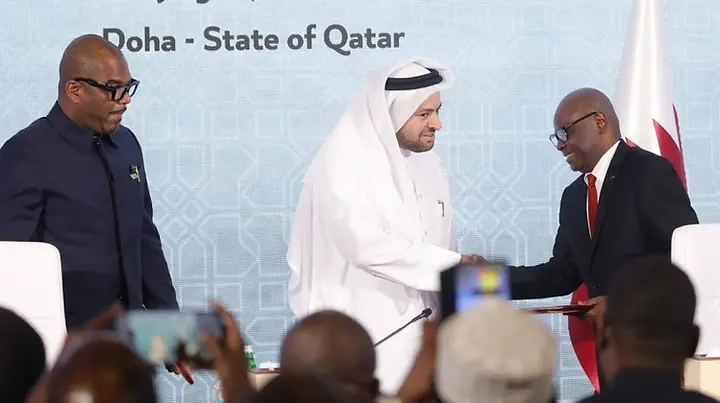
The Doha and Washington deals referenced at the meeting are part of a broader peace track between Kinshasa, Kigali, and the Rwanda‑backed M23 rebellion. In July 2025, the DRC and M23 signed a Declaration of Principles in Doha that set an August timetable for a permanent agreement but left big questions unresolved. A month later, Kigali and Kinshasa initialled a Washington peace accord that commits both states to halt support for armed groups and to establish a joint security mechanism; it also embeds a regional economic integration framework giving Rwanda legal access to Congolese minerals in partnership with the U.S. government.
The agreements were ceremonially ratified in Washington on 4 December 2025 and augmented by a regional economic integration framework and U.S.‑DRC strategic partnership, with Qatar, the African Union, and the United States forming a Joint Oversight Committee to monitor implementation.
Official statements describe the Washington and Doha agreements as complementary steps toward ending eastern Congo’s war and promoting economic cooperation. Yet analysts note that fighting has continued since the accords were signed, that the M23 is not a signatory to the Washington pact, and that key provisions such as neutralising the FDLR and withdrawing foreign troops remain unmet. Critics warn that the associated economic framework could erode Congolese sovereignty over its mineral wealth.
Despite these challenges, Kisangani’s speakers insisted that sustained diplomatic engagement is the only path toward lasting stability. By embracing the Doha and Washington accords, they said, eastern Congolese provinces hope to lock in security gains, attract regional investment and transform their cities into hubs of growth
JUSTICE & CRIME
Kisangani backs Doha and Washington agreements for regional peace

Feb 20, 2026
May 15, 2026
3 min read
Published
Updated:
A public meeting at Kisangani’s Higher Institute of Commerce brought together civil-society groups, students, and local officials to discuss the Doha and Washington agreements. Speakers urged that the city and the wider Greater Orientale region seize these international frameworks to rebuild infrastructure and spur economic growth.
The forum’s organisers, including MP Grace Neema and University of Kisangani professor Trésor Grison Kakumbi, argued that international diplomacy should not be seen as a weakness but as a pragmatic strategy for ending violence and attracting investment. They cited infrastructure work underway in Bunia, Kisangani, Isiro, and Buta as early proof that peace can deliver tangible development.
Participants also backed a forthcoming national dialogue, saying it must be held in the DRC, focus on building a middle class, and expose those diverting public funds. Kakumbi noted that residents want to see the promised “generation of young millionaires” become reality.
ADVERTISEMENT
The Doha and Washington deals referenced at the meeting are part of a broader peace track between Kinshasa, Kigali, and the Rwanda‑backed M23 rebellion. In July 2025, the DRC and M23 signed a Declaration of Principles in Doha that set an August timetable for a permanent agreement but left big questions unresolved. A month later, Kigali and Kinshasa initialled a Washington peace accord that commits both states to halt support for armed groups and to establish a joint security mechanism; it also embeds a regional economic integration framework giving Rwanda legal access to Congolese minerals in partnership with the U.S. government.
The agreements were ceremonially ratified in Washington on 4 December 2025 and augmented by a regional economic integration framework and U.S.‑DRC strategic partnership, with Qatar, the African Union, and the United States forming a Joint Oversight Committee to monitor implementation.
ADVERTISEMENT
Trending Now


Popular Today


Official statements describe the Washington and Doha agreements as complementary steps toward ending eastern Congo’s war and promoting economic cooperation. Yet analysts note that fighting has continued since the accords were signed, that the M23 is not a signatory to the Washington pact, and that key provisions such as neutralising the FDLR and withdrawing foreign troops remain unmet. Critics warn that the associated economic framework could erode Congolese sovereignty over its mineral wealth.
Despite these challenges, Kisangani’s speakers insisted that sustained diplomatic engagement is the only path toward lasting stability. By embracing the Doha and Washington accords, they said, eastern Congolese provinces hope to lock in security gains, attract regional investment and transform their cities into hubs of growth
ADVERTISEMENT
ADVERTISEMENT
Related Articles


