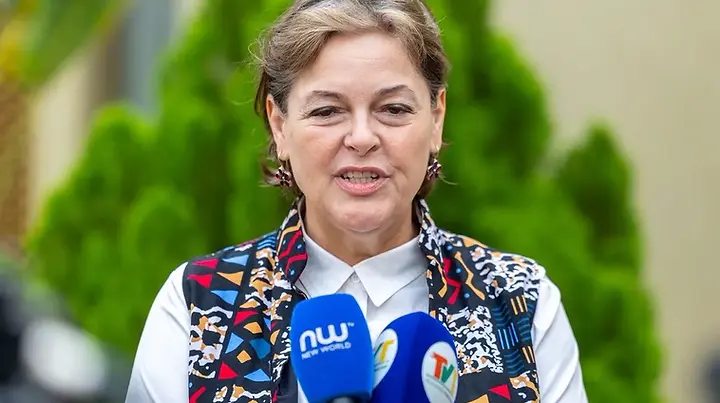
The acting head of the UN Mission in the Democratic Republic of the Congo (MONUSCO), Vivian van de Perre, arrived in Goma on Thursday, February 12, 2026, to support preparations for monitoring and verifying a ceasefire an operational step that included a rare air arrival after more than a year of disrupted air access to the city as cited in an official communication by MONUSCO.
Van de Perre told reporters her arrival could signal “the gradual reopening” of Goma International Airport “for the benefit of the population,” noting she had been on the last plane to land at the airport on January 26, 2025, and was now on the first helicopter to return.
The message is clear: MONUSCO wants to help restore a minimum level of operational access while supporting the ceasefire architecture. But the airport’s status remains politically and militarily sensitive because the site is still described as being controlled by the Rwandan-backed AFC/M23 rebellion, the same factor that has kept the airport inoperable since the occupation of Goma in late January 2025.
A reopening signal inside an unresolved security equation
In her remarks, van de Perre framed MONUSCO’s role tightly within its Security Council mandate, emphasizing sovereignty and the need for security guarantees for UN personnel and assets. That caution matters: any sustained reopening of a strategic airport in a contested environment requires more than a “first landing.”
It requires enforceable arrangements on who secures the perimeter, who controls access, and how verification teams move without becoming part of the conflict’s leverage.
MONUSCO says its support will be provided progressively, based on confirmed arrangements in the agreed architecture and security guarantees language that underscores that the Mission is not presenting the airport as “open,” but as a step-by-step process conditioned on safety and coordination.
MONUSCO’s visit is linked to preparations for a ceasefire monitoring and verification mechanism, including procedures, coordination, and communication to ensure credibility. The Mission ties this work to Security Council Resolution 2808 (2025), which renewed MONUSCO’s mandate and tasks it with supporting efforts toward a permanent ceasefire.
The article also references MONUSCO’s support to the Expanded Joint Verification Mechanism Plus (EJM+). More broadly, the region has previously used the ICGLR’s Expanded Joint Verification Mechanism (EJVM) structure to monitor and investigate cross-border security incidents an institutional backdrop that shapes how verification efforts are typically designed and staffed.
For residents and humanitarian actors, the airport’s closure has been a persistent bottleneck. Calls to reopen Goma and Kavumu airports have repeatedly emphasized humanitarian access, medical evacuations, and the movement of essential supplies.
JUSTICE & CRIME
Goma airport reopening talk raises questions as M23 still holds site

Feb 12, 2026
May 15, 2026
4 min read
Published
Updated:
The acting head of the UN Mission in the Democratic Republic of the Congo (MONUSCO), Vivian van de Perre, arrived in Goma on Thursday, February 12, 2026, to support preparations for monitoring and verifying a ceasefire an operational step that included a rare air arrival after more than a year of disrupted air access to the city as cited in an official communication by MONUSCO.
Van de Perre told reporters her arrival could signal “the gradual reopening” of Goma International Airport “for the benefit of the population,” noting she had been on the last plane to land at the airport on January 26, 2025, and was now on the first helicopter to return.
The message is clear: MONUSCO wants to help restore a minimum level of operational access while supporting the ceasefire architecture. But the airport’s status remains politically and militarily sensitive because the site is still described as being controlled by the Rwandan-backed AFC/M23 rebellion, the same factor that has kept the airport inoperable since the occupation of Goma in late January 2025.
A reopening signal inside an unresolved security equation
In her remarks, van de Perre framed MONUSCO’s role tightly within its Security Council mandate, emphasizing sovereignty and the need for security guarantees for UN personnel and assets. That caution matters: any sustained reopening of a strategic airport in a contested environment requires more than a “first landing.”
ADVERTISEMENT
It requires enforceable arrangements on who secures the perimeter, who controls access, and how verification teams move without becoming part of the conflict’s leverage.
MONUSCO says its support will be provided progressively, based on confirmed arrangements in the agreed architecture and security guarantees language that underscores that the Mission is not presenting the airport as “open,” but as a step-by-step process conditioned on safety and coordination.
MONUSCO’s visit is linked to preparations for a ceasefire monitoring and verification mechanism, including procedures, coordination, and communication to ensure credibility. The Mission ties this work to Security Council Resolution 2808 (2025), which renewed MONUSCO’s mandate and tasks it with supporting efforts toward a permanent ceasefire.
ADVERTISEMENT
The article also references MONUSCO’s support to the Expanded Joint Verification Mechanism Plus (EJM+). More broadly, the region has previously used the ICGLR’s Expanded Joint Verification Mechanism (EJVM) structure to monitor and investigate cross-border security incidents an institutional backdrop that shapes how verification efforts are typically designed and staffed.
For residents and humanitarian actors, the airport’s closure has been a persistent bottleneck. Calls to reopen Goma and Kavumu airports have repeatedly emphasized humanitarian access, medical evacuations, and the movement of essential supplies.
Yet the political reality described in the report remains: reopening is still blocked because AFC/M23 controls the site, and Rwanda’s position according to the article is that any reopening cannot happen without M23’s direct involvement.


POPULAR TODAY


ADVERTISEMENT
That is the core tension behind the “reopening” narrative. Even if international and regional actors favor restoring air access, the question is not only whether flights resume, but under what conditions and whether reopening, in practice, could normalize or entrench the de facto control of key infrastructure absent a broader settlement.
MONUSCO’s first air arrival into Goma since the disruption may be symbolically important. But until the security and access arrangements are transparently defined and accepted by relevant stakeholders the airport will remain a flashpoint where humanitarian needs, verification logistics, and conflict leverage collide.
ADVERTISEMENT
RELATED ARTICLE