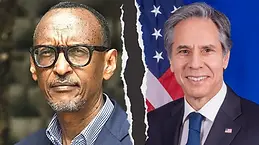
Following the Democrats' November 2026 congressional victory, speculation about Washington's future Rwanda policy overlooks a documented record: Antony Blinken defended the principle of peaceful political change in Rwanda, the Biden administration called for Rwandan troops to leave the DRC, and Democratic officials helped advance the Lobito Corridor. But Congress does not control the White House, and no party can be assumed to guarantee peace.
WASHINGTON / KINSHASA - November 6, 2026 | XTRAfrica Analysis
The Democratic Party's victory in the November 3, 2026 U.S. midterm elections has triggered renewed debate about American policy toward Rwanda and the Democratic Republic of the Congo. Some commentary assumes that Democratic control of Congress will automatically make Washington more accommodating toward President Paul Kagame's government and its activities in eastern Congo.
That assumption deserves scrutiny. The available record does not establish that Democratic lawmakers will support Rwanda's military involvement in the DRC. In fact, several public statements and initiatives from Democratic officials point in a different direction: support for peaceful political participation in Rwanda, respect for Congolese territorial integrity, and investment in economic infrastructure that could benefit the DRC.
This record does not amount to a promise of what every Democrat will do in 2027. Nor does it mean the United States has a policy of forcing a change of government in Rwanda. It does, however, provide a factual basis for assessing claims about the party's intentions.
Blinken's 2023 Statement: Political Change in Rwanda Through Peaceful Means
On March 24, 2023, U.S. Secretary of State Antony Blinken, serving under Democratic President Joe Biden, welcomed Rwanda's release of Paul Rusesabagina. In the official State Department statement, Blinken thanked Rwanda and Qatar for helping reunite Rusesabagina with his family, then added an unusually explicit principle:
"We reaffirm the principle of seeking political change in Rwanda and globally through peaceful means."
He also rejected political violence. The context matters: Blinken was discussing Rusesabagina's release, not unveiling a U.S. campaign to unseat Kagame. His language defended the legitimacy of nonviolent political change, while rejecting violence as a method of pursuing it. It was a statement by a Democratic administration in 2023.
Nevertheless, the statement challenges the idea that the Democratic administration regarded Rwanda's existing political leadership as beyond criticism or peaceful challenge. It recognized that political change in Rwanda can be pursued by peaceful means, without endorsing an armed uprising or specifying an electoral outcome.
POLICY AND REFORMS
US Democrats' Rwanda Record: Peaceful Change and Congo Sovereignty

6 nov. 2026
6 nov. 2026
10 min read

Publié
Mis à jour:
Following the Democrats' November 2026 congressional victory, speculation about Washington's future Rwanda policy overlooks a documented record: Antony Blinken defended the principle of peaceful political change in Rwanda, the Biden administration called for Rwandan troops to leave the DRC, and Democratic officials helped advance the Lobito Corridor. But Congress does not control the White House, and no party can be assumed to guarantee peace.
WASHINGTON / KINSHASA - November 6, 2026 | XTRAfrica Analysis
The Democratic Party's victory in the November 3, 2026 U.S. midterm elections has triggered renewed debate about American policy toward Rwanda and the Democratic Republic of the Congo. Some commentary assumes that Democratic control of Congress will automatically make Washington more accommodating toward President Paul Kagame's government and its activities in eastern Congo.
That assumption deserves scrutiny. The available record does not establish that Democratic lawmakers will support Rwanda's military involvement in the DRC. In fact, several public statements and initiatives from Democratic officials point in a different direction: support for peaceful political participation in Rwanda, respect for Congolese territorial integrity, and investment in economic infrastructure that could benefit the DRC.
This record does not amount to a promise of what every Democrat will do in 2027. Nor does it mean the United States has a policy of forcing a change of government in Rwanda. It does, however, provide a factual basis for assessing claims about the party's intentions.
Blinken's 2023 Statement: Political Change in Rwanda Through Peaceful Means
On March 24, 2023, U.S. Secretary of State Antony Blinken, serving under Democratic President Joe Biden, welcomed Rwanda's release of Paul Rusesabagina. In the official State Department statement, Blinken thanked Rwanda and Qatar for helping reunite Rusesabagina with his family, then added an unusually explicit principle:
"We reaffirm the principle of seeking political change in Rwanda and globally through peaceful means."
He also rejected political violence. The context matters: Blinken was discussing Rusesabagina's release, not unveiling a U.S. campaign to unseat Kagame. His language defended the legitimacy of nonviolent political change, while rejecting violence as a method of pursuing it. It was a statement by a Democratic administration in 2023.
Nevertheless, the statement challenges the idea that the Democratic administration regarded Rwanda's existing political leadership as beyond criticism or peaceful challenge. It recognized that political change in Rwanda can be pursued by peaceful means, without endorsing an armed uprising or specifying an electoral outcome.
The Biden Administration Called for Rwanda's Troops to Leave Congo
The historical record is still clearer on eastern DRC. On February 17, 2024, the Biden State Department condemned Rwanda's support for M23 and called for the withdrawal of Rwandan military personnel and air-defense systems from Congolese territory.
PUBLICITÉ
On November 8, 2024, it repeated its call for Rwanda to withdraw all Rwanda Defence Force personnel and equipment from the DRC, while condemning M23 ceasefire violations. On January 15, 2025, in the final days of the Biden administration, the State Department endorsed the findings of UN experts and condemned the unlawful presence of thousands of Rwandan troops in Congo.
Those statements also called on Congolese authorities to end cooperation with the FDLR armed group and fulfill commitments to neutralize it. That distinction is important: U.S. policy treated both Rwanda's military presence and armed-group threats as matters to be addressed, rather than granting either side unrestricted permission to use force.
Rwanda has cited the FDLR and other security concerns to explain its regional posture. But Washington's public demands under Biden did not accept those concerns as justification for an open-ended Rwandan troop presence on Congolese territory.
Lobito Corridor: A Democratic Administration's Investment in Congo's Future
The Biden administration also made the Lobito Corridor a flagship African infrastructure initiative. Its economic logic was to improve connections between the DRC, Zambia and Angola, including transport routes to the Atlantic Ocean, while encouraging regional trade, agriculture, connectivity, energy investment and private-sector development.
A State Department announcement on October 26, 2023 described a multilateral memorandum of understanding involving the United States, European Union, DRC, Angola, Zambia, African Development Bank and Africa Finance Corporation.
In September 2024, Blinken hosted a roundtable to advance the corridor. In December 2024, Biden met Congolese President Felix Tshisekedi and discussed the Lobito initiative, transparent investment and the need for a sovereign DRC to benefit from its resources.
The U.S. International Development Finance Corporation announced a loan commitment of up to $553 million for the Lobito Atlantic Railway in Angola in December 2024. This was not a $553 million cash grant to the Congolese government, nor proof that every proposed railway extension had already been built. It was a concrete financing commitment to a transport network intended to improve DRC access to international markets.
The corridor also serves U.S. commercial and strategic interests, particularly diversified access to critical-mineral supply chains. Those interests should not be confused with altruism. Still, the initiative demonstrates that a Democratic administration saw value in building economic links with a sovereign Congo, not merely managing its conflict with Rwanda.
A Democratic Senator Challenged Kagame's Rwanda in October 2026
The most recent example comes from Congress itself. On October 26, 2026, Democratic Senator Jeff Merkley joined Republican Senator Marsha Blackburn in questioning the NBA's commercial partnership with Rwanda.
PUBLICITÉ
The bipartisan letter warned that the NBA's relationship with the Rwandan government conflicted with heightened U.S. concern about Rwanda's military activities in the DRC, support for M23 and human rights abuses. The senators asked the league to explain how it evaluated its partnership amid sanctions and allegations of sportswashing.
This episode matters for two reasons. First, it shows that criticism of Kagame's government is not confined to one American party. Second, it provides an example of a prominent Democratic senator pressing for accountability rather than seeking to shield Kigali from scrutiny.
It would be inaccurate to portray Merkley's position as a binding policy of all congressional Democrats. It is equally inaccurate to overlook his public position when claiming that the party's election victory must automatically favor Rwanda's military actions in Congo.
Congo's Sovereignty Is an International Obligation, Not a Party Slogan
The most authoritative framework for the current conflict comes from the UN Security Council. Resolution 2773, adopted unanimously in February 2025, demanded that M23 cease hostilities and withdraw from the areas it controls, and called on Rwanda's forces to end support for M23 and leave Congolese territory without preconditions.
Resolution 2808, adopted in December 2025, reaffirmed those demands, called for renewed ceasefire efforts, and demanded an end to support for the FDLR by Congolese military forces alongside commitments to neutralize that group.
These requirements do not disappear when a political party wins or loses an American election. The relevant questions are how governments, Congress, the United Nations and regional mediators will press for their implementation and verify changes on the ground.
Trump-Era Sanctions Show That Pressure on Rwanda Has Crossed Party Lines
The current Republican administration has also taken punitive action. On October 28, 2026, the U.S. Treasury sanctioned Rwanda's Ministry of Defence and Zigama Credit and Savings Society for supporting M23 and associated structures. Treasury Secretary Scott Bessent called on Rwanda to stop supporting the armed group and withdraw its troops from eastern DRC.
That action followed the Trump administration's sponsorship of the Washington peace process, under which the DRC is expected to act against the FDLR and Rwanda is expected to disengage its forces and lift defensive measures. The UN Security Council's Resolution 2808 recognizes both the Washington agreement and the Doha framework, alongside African Union mediation.
Tendances actuelles


Populaire aujourd'hui


PUBLICITÉ
The fact that both the Biden and Trump administrations demanded Rwandan troop withdrawal is evidence of policy continuity across party lines, despite differences in diplomatic approach, sanctions and economic priorities. It does not demonstrate that the conflict has been resolved or that announced obligations have been fully implemented.
What Does the Democrats' 2026 Victory Actually Change?
In the November 3, 2026 midterms, Democrats won control of both the House of Representatives and the Senate. The new Congress is scheduled to convene January 3, 2027. But Donald Trump remains president; Democrats did not win the presidency in this election.
As the Council on Foreign Relations explains, a Democratic-controlled Congress can exercise significant influence through committee hearings, spending legislation, investigations, Senate confirmation powers and oversight of diplomatic and security policy. The president and executive branch nevertheless retain substantial authority over foreign policy and the implementation of sanctions.
For eastern Congo, that creates several possible avenues of oversight, rather than guaranteed outcomes:
Requesting detailed reporting on Rwandan military disengagement, M23 activity and civilian protection.
Examining the enforcement and impact of existing sanctions, including Treasury measures against entities linked to the Rwandan security apparatus.
Scrutinizing U.S. support for the Washington and Doha peace efforts and whether ceasefire commitments are independently verified.
Reviewing aid, investment and infrastructure priorities, including how projects such as Lobito benefit Congolese communities.
Questioning American institutions or businesses whose partnerships may intersect with documented human rights and security concerns.
Whether congressional leaders will prioritize these specific issues, secure bipartisan support or influence executive decisions remains uncertain. Election results alone cannot settle those questions.
The Evidence Challenges an Automatic Pro-Kagame Prediction
There is a difference between political speculation and a demonstrated policy record. Blinken's 2023 statement affirmed peaceful political change in Rwanda; Biden-era diplomacy called for RDF withdrawal; the Lobito initiative advanced a major DRC-linked infrastructure project; and Senator Merkley has continued to question Rwanda-related human rights and security concerns.
None of these facts guarantees that a Democratic-led Congress will deliver peace in eastern Congo. None means that every Democratic politician holds the same views. And Blinken's statement should not be misrepresented as a promise that Washington will remove Rwanda's government.
PUBLICITÉ
Articles connexes