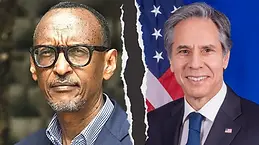
The Rwandan government under President Paul Kagame has long claimed it champions decentralization, development, and equity for all. But a deep look at the Multi-Year Budget Framework (2023–2026) reveals a very different picture, one that raises serious questions about fiscal fairness, local autonomy, and national priorities.
Instead of empowering districts, the budget system exposes a reality of low tax collection, heavy reliance on foreign aid, and tight top-down control. Most local governments raise less than 5% of their own budget and depend almost entirely on grants and earmarked transfers from Kigali.
Is this budget truly a tool for uplifting Rwandans, or just another way for Kagame’s regime to tighten its grip on power? Reality check: Kagame’s Budget = Centralized Control + Local Deception
1. Kigali City: The Real Winner, and Proof of Inequality
Kigali alone gets:
2023–24: 109.1 Billion RWF
2025–26: 124.5 Billion RWF
That’s over 10% of the national district budget for just one city.
Red Flag: Kigali is being overfunded while rural districts like Ngororero, Rutsiro, and Nyaruguru barely touch 30–35 billion RWF. This exposes how Kagame’s regime prioritizes elite urban optics over village development.
Across almost all of Rwanda’s 30 districts, Earmarked Transfers (Code 02) dominate. In many cases, over 75% of district budgets are dictated from the top, meaning local leaders can only spend money the way the central government tells them to.
Understand Rwanda’s Budget 2023–2026: Growth or Control

23 juin 2025
15 mai 2026
6 min read

Publié
Mis à jour:
The Rwandan government under President Paul Kagame has long claimed it champions decentralization, development, and equity for all. But a deep look at the Multi-Year Budget Framework (2023–2026) reveals a very different picture, one that raises serious questions about fiscal fairness, local autonomy, and national priorities.
Instead of empowering districts, the budget system exposes a reality of low tax collection, heavy reliance on foreign aid, and tight top-down control. Most local governments raise less than 5% of their own budget and depend almost entirely on grants and earmarked transfers from Kigali.
Is this budget truly a tool for uplifting Rwandans, or just another way for Kagame’s regime to tighten its grip on power? Reality check: Kagame’s Budget = Centralized Control + Local Deception
1. Kigali City: The Real Winner, and Proof of Inequality
Kigali alone gets:
2023–24: 109.1 Billion RWF
2025–26: 124.5 Billion RWF
That’s over 10% of the national district budget for just one city.
Red Flag: Kigali is being overfunded while rural districts like Ngororero, Rutsiro, and Nyaruguru barely touch 30–35 billion RWF. This exposes how Kagame’s regime prioritizes elite urban optics over village development.
Across almost all of Rwanda’s 30 districts, Earmarked Transfers (Code 02) dominate. In many cases, over 75% of district budgets are dictated from the top, meaning local leaders can only spend money the way the central government tells them to.
Example: Rutsiro District (2023–24):
Earmarked: RWF 21.7B
Total Budget: RWF 26.9B
→ Over 80% were decided by Kigali.
This model does not encourage local innovation or grassroots needs; it enforces a “command-and-comply” structure. While the government calls it “decentralization,” it acts more like fiscal micromanagement.
Own Revenue: The Numbers Don't Lie
Across districts, own-source revenues are shockingly low. Despite the RWF 1.1 trillion national district budget projected for 2026, most districts raise under RWF 2B themselves.
PUBLICITÉ
Examples:
Nyaruguru: 1.2B
Gisagara: 790M
Kamonyi: 2.2B
Rubavu (despite growth): under 2.3B
This shows a dangerous overdependence on Kigali. Districts are essentially budget consumers, not economic engines.
Kagame’s fiscal model gives local leaders the title of “mayor,” but treats them like budget managers with no real authority.
2. Districts Used as Shells for Earmarked Transfers
Across most districts:
Earmarked Transfers = 75–85% of the budget
That means: the central government controls almost all the money, telling districts what to do, where to spend, and how to report.
For example:
Ngoma District (2025–26):
80% of 34.6B comes from earmarked transfers
Own revenue? Barely 1.6B RWF
This isn’t decentralization, it’s central dictatorship in disguise, where local leaders are budget clerks, not decision-makers.
3. District “Own Revenue” is Insultingly Low
Many districts can’t generate even 5% of their total budget.
PUBLICITÉ
Examples:
Gisagara (2025–26): Own Revenue = 790M RWF
Nyaruguru (2025–26): Own Revenue = 1.2B RWF
Rutsiro (2025–26): Own Revenue = 1.1B RWF
These are districts with land, youth, and potential. Why so broke?
Answer: Kagame’s regime overcentralizes taxes, leaving districts broke and dependent, then uses that dependence to control mayors, silence dissent, and manipulate development narratives.
4. Massive Mysterious “Transfers from Other Agencies”
In some districts, this code (05) shoots up mysteriously.
Rubavu District:
10B RWF in transfers every year, no explanation.
Musanze:
8B RWF flat each year. Again, not explained.
Where is this money coming from? Which agency? What for?
This smells like ghost allocations, used to shift large sums for political programs, military logistics, or regime interests without local oversight.
5. Some Districts Just Inflate for Political Optics
Rutsiro District:
Block Grant jumps from 2.7B ➜ 5.2B ➜ 7.4B in 3 years
Meanwhile, earmarked funds shrink year by year
Is this an inflation trick? Or padding numbers for donor optics?
Tendances actuelles


Populaire aujourd'hui


PUBLICITÉ
Same in Musanze and Nyamasheke, where grants randomly spike, but without matching growth in infrastructure, jobs, or production on the ground.
Budgeting for Control, Not Citizens
From this analysis, one thing becomes clear: The Rwandan district budget is not just a development plan, it’s a tool of political engineering.
What the budget really does:
Centralizes power in Kigali
Rewards political loyalty over actual needs
Starves local economic freedom through fiscal dependence
Masks donor reports with shiny but hollow stats
While the Rwandan government promotes the image of a well-managed economy, the foundation remains fragile. Rwanda collects very low taxes from its citizens and businesses. In many districts, “own revenue” makes up less than 5% of the entire budget. This shows how weak local economic activity is, or how little room they’re given to grow.
Instead of empowering communities, the system survives on grants, foreign aid, and highly controlled earmarked transfers. That’s not financial independence, it’s aid-funded governance dressed in modern branding.
Download the full Budget from a verified source obtained by Xtrafrica Media group
PUBLICITÉ
Articles connexes