PHNOM PENH, Cambodia — 14 November 2026. Rwanda has rejected a request from French President Emmanuel Macron to remove Louise Mushikiwabo from the race to lead the Organisation internationale de la Francophonie (OIF), setting up a high-stakes diplomatic confrontation with Rwanda's President Paul Kagame ahead of the organisation's 16 November election.
The dispute escalated on Saturday as the Democratic Republic of Congo announced the withdrawal of its own candidate, Juliana Amato Lumumba, and backed Romanian former prime minister Dacian Cioloș in a bid to produce a compromise.
What happened between Macron, Kagame and Mushikiwabo at the OIF?
Rwanda's foreign minister confirmed that Macron asked Kagame to withdraw Mushikiwabo's bid for a third term, and said Kigali rejected the request. Mushikiwabo insists she remains a candidate. Congo has publicly shifted its support to Romania's Dacian Cioloș, but the final choice rests with OIF members on 16 November.
What Macron asked Kagame to do and what is actually confirmed
The immediate flashpoint was a reported private message from Macron to Kagame during the night of 12–13 November. Jeune Afrique first reported that the French president wanted Rwanda to withdraw Mushikiwabo's candidacy and help build agreement around Cioloș.
The full private communication has not been made publicly available for independent examination; its reported wording, suggested concessions and precise delivery time should not be treated as an authenticated public document.
There is, however, stronger evidence for the central request than an anonymous account of a diplomatic exchange. On 14 November, TV5MONDE reported that Rwandan Foreign Minister Olivier Nduhungirehe had confirmed the French request to AFP. The minister said Kigali had rejected it. That establishes Rwanda's publicly stated position; it does not establish that Kagame personally issued a separate, public response or that the French presidency released the alleged letter.
A day earlier, Nduhungirehe told The New Times that Rwanda would not withdraw Mushikiwabo's candidacy. The message was consistent across the two appearances: Rwanda intends to let its candidate stand rather than accept a pre-election bargain negotiated above her head.
France's publicly reported position is narrower than a declared endorsement. According to Associated Press reporting from Phnom Penh, Macron's office said on Saturday evening that most members favoured consensus and that the president would discuss the matter with African counterparts. That statement supports the account of a French effort to prevent a divisive vote, but it does not by itself authenticate every detail attributed to the private message or constitute an official declaration that France will vote for Cioloș.
GEOPOLITICS AFRICA
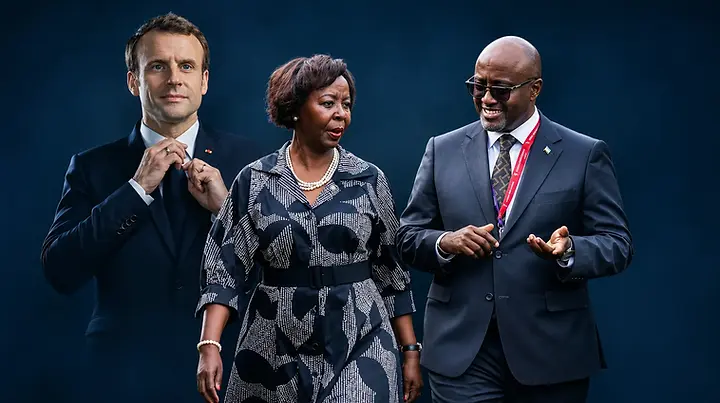
Macron, Kagame and Mushikiwabo: Inside the OIF Crisis

14 nov. 2026
14 nov. 2026
20 min read
Publié
Mis à jour:
PHNOM PENH, Cambodia — 14 November 2026. Rwanda has rejected a request from French President Emmanuel Macron to remove Louise Mushikiwabo from the race to lead the Organisation internationale de la Francophonie (OIF), setting up a high-stakes diplomatic confrontation with Rwanda's President Paul Kagame ahead of the organisation's 16 November election.
The dispute escalated on Saturday as the Democratic Republic of Congo announced the withdrawal of its own candidate, Juliana Amato Lumumba, and backed Romanian former prime minister Dacian Cioloș in a bid to produce a compromise.
What happened between Macron, Kagame and Mushikiwabo at the OIF?
Rwanda's foreign minister confirmed that Macron asked Kagame to withdraw Mushikiwabo's bid for a third term, and said Kigali rejected the request. Mushikiwabo insists she remains a candidate. Congo has publicly shifted its support to Romania's Dacian Cioloș, but the final choice rests with OIF members on 16 November.
What Macron asked Kagame to do and what is actually confirmed
The immediate flashpoint was a reported private message from Macron to Kagame during the night of 12–13 November. Jeune Afrique first reported that the French president wanted Rwanda to withdraw Mushikiwabo's candidacy and help build agreement around Cioloș.
The full private communication has not been made publicly available for independent examination; its reported wording, suggested concessions and precise delivery time should not be treated as an authenticated public document.
There is, however, stronger evidence for the central request than an anonymous account of a diplomatic exchange. On 14 November, TV5MONDE reported that Rwandan Foreign Minister Olivier Nduhungirehe had confirmed the French request to AFP. The minister said Kigali had rejected it. That establishes Rwanda's publicly stated position; it does not establish that Kagame personally issued a separate, public response or that the French presidency released the alleged letter.
A day earlier, Nduhungirehe told The New Times that Rwanda would not withdraw Mushikiwabo's candidacy. The message was consistent across the two appearances: Rwanda intends to let its candidate stand rather than accept a pre-election bargain negotiated above her head.
France's publicly reported position is narrower than a declared endorsement. According to Associated Press reporting from Phnom Penh, Macron's office said on Saturday evening that most members favoured consensus and that the president would discuss the matter with African counterparts. That statement supports the account of a French effort to prevent a divisive vote, but it does not by itself authenticate every detail attributed to the private message or constitute an official declaration that France will vote for Cioloș.
This distinction matters because the political argument has quickly outrun the documentary record. The central fact is a withdrawal request that Rwanda acknowledges and rejects. The disputed material is the exact text of the communication and the full range of understandings, if any, reached with other governments.
Mushikiwabo refuses to leave the race
Mushikiwabo's response was unambiguous. Speaking to TV5MONDE in an interview published on 14 November, the incumbent insisted she was a candidate to the end, rejected outside interference in the process and presented her candidacy as a decision for Rwanda. Her position turns the question from whether Macron can broker a withdrawal into whether a divided institution will ultimately use its written election rules.
Mushikiwabo has led the OIF since 2018, when she was elected after serving as Rwanda's foreign minister. She was re-elected in 2022 and is seeking another four-year mandate covering 2027–2030. The OIF's official secretary-general profile confirms her tenure and the organisation's political and cooperation responsibilities. A third term is controversial politically, but the published 2026 election guide describes the four-year mandate as renewable; it does not state a two-term cap.
Kigali's argument is therefore partly procedural. A candidate who has completed the formal nomination and hearing stages is entitled to seek members' votes under the framework established by the OIF. A government can request a withdrawal, but the public rules do not give France a unilateral veto over an eligible candidate. Equally, those rules do not guarantee Mushikiwabo re-election. It is the participating full members, not the foreign minister of one country, who decide.
Congo's strategic withdrawal changes the contest
The DRC had put forward Juliana Amato Lumumba, a former minister and the daughter of independence leader Patrice Lumumba. Her candidacy carried obvious national symbolism, and its presence gave Kinshasa a direct electoral alternative to Rwanda's incumbent. On 14 November, the Congolese government changed course in a way that could fundamentally alter the vote.
A Congolese foreign ministry communiqué dated in Phnom Penh on 14 November and reproduced by Topdirect states that the country announced Lumumba's withdrawal and, after consultations with Romania, backed Cioloș. The statement describes the move as a contribution to consensus, while explicitly urging other candidates and their supporting governments to show comparable flexibility. Crucially, it links the Congolese concession to an expectation of reciprocity; Kinshasa is not saying all competing candidacies have been withdrawn.
The sequence of reporting explains why some headlines initially seemed contradictory. Earlier on Saturday, Actualite.cd described Congo as ready to withdraw rather than recording a formal completed withdrawal. Later, the same outlet reported Cioloș publicly thanking Congo for its support and treating Lumumba's withdrawal as accomplished.
PUBLICITÉ
Associated Press likewise reported that Congo had announced the withdrawal. The most defensible formulation at this stage is that Kinshasa has publicly announced Lumumba's withdrawal and thrown its support behind Cioloș; a final certified ballot list from the summit presidency was not established in the reviewed material.
That is a meaningful development, not just a change of language. Instead of asking members to choose directly between two candidates associated with opposing governments in the Great Lakes crisis, Congo is now urging agreement around a candidate from outside the region. Whether that produces consensus depends on Rwanda, Mauritania and the wider membership; the mere existence of a proposed compromise does not prove there is one.
Can Macron force an OIF candidate to withdraw?
No publicly available OIF rule grants the French president that power. France can negotiate, persuade and influence the process, but it cannot single-handedly remove Rwanda's nominee. The organisation's own 2026 summit press dossier explains who can vote and how: consensus is preferred, and if none emerges, the election goes to a secret ballot among the full members present.
The OIF has 90 members and participating governments in total, but they do not all have identical electoral rights. The organisation lists 53 full members, five associate members and 32 observers.
The decisive leadership ballot belongs to the heads of state or government, or heads of delegation, of the 53 full members who are present. Observers and associates should not be counted as additional leadership votes.
The dossier defines a simple-majority procedure for this election as victory for the candidate who receives the greatest number of votes. That is especially important when more than two candidates remain: it should not be casually rewritten as a requirement to win over half of all 90 members. If two contenders tie, further rounds are held. Voting is secret, and the Cambodian presidency of the summit alone proclaims the result.
The procedure matters beyond this confrontation. The OIF formally heard all four candidates on 30 June 2026, after an application process established by the 2022 reform. The Phnom Penh election is the first to apply that revised framework in full. A political demand for consensus remains compatible with the rules, but so does the use of a ballot when consensus fails. Neither side can honestly present the voting option as illegitimate merely because it is inconvenient.
The African Union decision that complicates Congo's choice
Another layer of the dispute lies in an African Union document adopted months before the summit. At its 49th ordinary session in Addis Ababa on 28–29 July, the AU Executive Council adopted Decision EX.CL/Dec.1361(XLIX) on African candidacies in international institutions. Paragraph 9 called on AU member states to consult at the highest level and agree on one African candidate for the OIF leadership election.
The same decision listed three African contenders: Mushikiwabo of Rwanda, Lumumba of the DRC and Coumba Bâ of Mauritania. This was not a declaration that Mushikiwabo alone had secured the continent's endorsement, nor was it an announcement that every African country had agreed on a single candidate. It was an appeal for unity despite the simultaneous candidacies.
By switching its support to Cioloș, Kinshasa has taken a course that sits uneasily beside that AU call for a common African nominee. Rwanda can invoke that inconsistency, but the AU's political appeal should not be confused with an OIF eligibility rule forbidding members to support a European candidate.
The two institutions govern different decisions. Equally, Congo can argue that it is offering a concession to preserve the OIF, while critics may ask why a European candidate became the preferred compromise rather than another African nominee.
This produces a genuine strategic dilemma for African governments: support an African-led Francophonie but risk deepening a Rwanda–Congo confrontation, or rally behind a European candidate in the name of consensus while setting aside a continental political objective. The public record does not establish that African members have chosen either course collectively.
Why Macron's role looks different from 2018
The most revealing historical contrast is Macron's earlier role in Mushikiwabo's rise. In 2018, France publicly supported the former Rwandan foreign minister's bid for the OIF leadership. The choice formed part of an improving relationship between Paris and Kigali after years of tension linked to the history of the 1994 genocide against the Tutsi and competing interpretations of France's earlier policies in Rwanda. Le Monde's report from the Phnom Penh summit explicitly recalls Macron's 2018 support as an element of the rapprochement.
Eight years later, the reported request asks Kagame to facilitate the opposite outcome: a departure from the candidacy France once championed. That reversal is the politically significant comparison. It does not prove that Macron has abandoned relations with Rwanda or personally decided the election in favour of Congo. It shows that French efforts to preserve an international organisation now have to account for an increasingly costly rivalry between two African members.
France's leverage is real but should be described precisely. AP identifies France as the largest financial contributor and reports an OIF budget of approximately €71.7 million for 2026. The amount is the organisation's reported total budget, not France's individual payment. Its financial position and diplomatic standing make Paris influential; they do not supersede a collectively agreed voting procedure.
PUBLICITÉ


The French presidency's preference for a compromise can also be understood in institutional terms. If a secret ballot produces a winner whom a major member government refuses to accept, the OIF could emerge procedurally intact but politically weaker. That is a plausible risk, not a proven prediction. If negotiations instead remove every African contender in favour of a Romanian politician, they could produce an entirely different legitimacy debate about who has the power to define consensus.
The war in eastern Congo is now inside the Francophonie debate
This dispute cannot be separated from the crisis in eastern DRC. Congo and other governments, as well as UN experts, have accused Rwanda of supporting the M23-led armed movement in the country's east.
Kigali has offered shifting accounts of its involvement with rebel groups, at times acknowledging support and at others denying such ties, while consistently citing security threats posed by armed actors operating near Rwanda’s border.
The connection is more than rhetorical. Congo has opposed another term for Mushikiwabo against the backdrop of its dispute with Rwanda, and its leaders have questioned whether remaining in the OIF would be tenable if she were re-elected.
For the underlying conflict evidence, XTRAfrica previously examined the UN Group of Experts' 2026 reporting on Rwanda and M23, and separately analysed the taxation and mineral economy in areas affected by the rebellion. Those reports concern the conflict itself; they should not be mistaken for proof of how individual OIF delegations intend to vote.
The danger for the OIF is that an election ostensibly about language cooperation, education, development and peace becomes a proxy judgement on one member country's conduct in a separate regional crisis.
Rwanda's supporters may see pressure to remove its candidate as selective politicisation. Congo's supporters may see re-election of a former senior Rwandan official as incompatible with the values the organisation says it promotes. Neither interpretation eliminates the need for the OIF to address the substantive eastern Congo conflict independently of the ballot.
Those regional disputes already have a longer diplomatic history. XTRAfrica has covered Tshisekedi's approach to rebel integration and the Washington peace process. The new election confrontation is a different arena, but one in which unresolved security accusations and failed trust-building efforts are shaping an ostensibly multilateral choice.
Congo is also leaving its membership on the table
Kinshasa's statements on 14 November contained a second important warning. Congolese Foreign Minister Thérèse Kayikwamba Wagner said the DRC could reassess its relationship with the OIF depending on the positions adopted by members and the eventual outcome, as reported by Actualite.cd after the ministerial discussions. She also made clear that Congo could not force another government to withdraw its candidate.
A possible future reassessment is not a completed withdrawal from the organisation. Congo remains a member as the summit proceeds. That distinction matters because the threat itself can affect negotiation calculations, while an actual departure would have different diplomatic, cultural and programmatic consequences. The country is a particularly important part of the French-speaking world, and its absence would diminish the OIF's reach across central Africa.
It would not be the first major membership fracture. Mali, Burkina Faso and Niger announced their departures in 2025 amid disputes over suspensions and changing relations with France, according to AP. The three exits did not cause the current Rwanda–Congo conflict, but they help explain why the OIF's leaders appear determined to avoid another highly visible rupture.
An institution that promotes dialogue cannot automatically guarantee political harmony among its members. Its credibility instead depends on whether it can manage disagreements through clear rules and consistent standards, rather than by appearing to reward the loudest ultimatum or to insulate incumbents from challenge.
Why Dacian Cioloș has emerged as the compromise candidate
Cioloș is a Romanian former prime minister and the only non-African candidate among the four originally presented to OIF members. His appeal in the current negotiations is not that he resolves the Rwanda–DRC conflict, but that he is not a candidate nominated by either of those two countries. That makes him a possible third option for delegations wanting to avoid choosing sides directly.
According to Le Monde's reporting on the candidates' platforms, Cioloș has discussed giving the Francophonie a stronger economic role and building partnerships with the European Union for education and development. The proposal is relevant because the OIF is judged not only on diplomatic ceremony but also on whether it can translate its language network into practical opportunities.
Still, a compromise candidate is not necessarily a consensus candidate. A proposal supported by France and the DRC would require sufficiently broad acceptance elsewhere, including from governments concerned that a European successor would weaken African representation. Nor should Romania's candidacy be confused with an EU appointment: the decision belongs to OIF members acting under OIF rules.
PUBLICITÉ
Cioloș's public thanks to Kinshasa reinforce the reality of Congo's political shift. They do not disclose the full balance of votes, secure the support of Rwanda, or resolve what the Mauritanian delegation will do. The arithmetic remains hidden until members either reach agreement or hold a secret ballot.
Coumba Bâ and the African alternative still matter
Mauritania's Coumba Bâ risks disappearing from a story increasingly told as a duel between Mushikiwabo and Cioloș. Yet she was one of the four candidates included in the OIF's formal June hearings and in the African Union's July list. Her candidacy is a reminder that the dispute is not a binary choice between keeping the Rwandan incumbent and accepting a European contender.
The OIF's official list of candidates and election calendar provided a legitimate basis for each nomination. As of this review, no authoritative notice establishing that Mauritania had formally withdrawn Bâ's candidacy was located. Reports about prospective diplomatic bargains should therefore not be presented as evidence that the remaining African alternative has already disappeared.
A Bâ candidacy could matter if members attempt to satisfy both the AU's aspiration for one African nominee and the OIF's search for broad agreement. But that is a potential negotiating path, not an announced agreement. Until a formal change or official outcome is disclosed, speculation about her support should remain speculation.
The institutional stakes go beyond one office
The secretary-general of the Francophonie represents an organisation that spans five continents, with programs addressing language, education, governance, culture, economic cooperation and conflict prevention.
The OIF's June 2026 institutional announcement describes a community of 90 member governments and states and approximately 396 million French speakers worldwide. Those figures capture the scale of the constituency, but they do not by themselves measure the effectiveness of OIF programs.
Africa is central to the institution's present and future. As Le Monde notes, a large share of the world's French speakers live on the continent. A debate about whether the leadership should remain African therefore concerns representation, funding priorities and how the organisation responds to African crises not simply the nationality of the next officeholder.
The Phnom Penh summit is being held under the theme of reinvesting in peace for shared prosperity and lasting stability. That message makes the leadership dispute especially conspicuous. Yet it also offers a concrete test: will the organisation apply its rules consistently while allowing disagreement, and will it emerge capable of addressing the kinds of conflicts among members that have brought this election to a breaking point?
Timeline: how the OIF dispute reached Phnom Penh
2018: Mushikiwabo, then Rwanda's former foreign minister, becomes OIF secretary-general with France's support.
March 2022: OIF ministers adopt a revised framework that formalises nominations, candidate hearings and a leadership election.
November 2022: Mushikiwabo is re-elected for a second term.
30 June 2026: Four candidates Bâ, Cioloș, Lumumba and Mushikiwabo present their programs at a formal ministerial hearing in Paris.
28–29 July 2026: The African Union Executive Council calls for agreement on one African candidate for the 2027–2030 OIF term.
Overnight 12–13 November 2026: Macron reportedly sends a private request to Kagame seeking Mushikiwabo's withdrawal. The exact text and hour remain unverified publicly.
13–14 November 2026: Rwanda's foreign minister rejects the prospect of withdrawal; Mushikiwabo reiterates that she remains in the race.
14 November 2026: Congo issues a statement announcing Lumumba's withdrawal and support for Cioloș; the Romanian candidate publicly welcomes the backing. The French presidency publicly stresses consensus.
16 November 2026: The full-member delegations are scheduled to select a secretary-general in Phnom Penh for the 2027–2030 mandate.
Four questions the 16 November vote must settle
Has Mushikiwabo already been removed?
No. Her third-term candidacy remains publicly supported by Rwanda, and Mushikiwabo has said she is staying in the race. A French request is not an OIF disqualification.
Did Kagame personally announce that he was defying Macron?
The verified public rejection came through Rwandan Foreign Minister Olivier Nduhungirehe. The source material reviewed does not establish a separate authenticated public statement from Kagame setting out his response to the alleged letter.
Did Congo abandon Juliana Lumumba?
Its foreign ministry communiqué says that it announced her withdrawal and endorsed Cioloș. The Romanian candidate subsequently acknowledged Congo's support. Earlier statements only expressed readiness to withdraw, and the final official candidate list should be checked against the summit's electoral records.
Who is most likely to win?
No verified ballot count or consensus agreement is public. Assertions that Mushikiwabo, Cioloș or Bâ has already won would be premature. The Cambodian summit presidency is responsible for proclaiming the result after the 16 November procedure.
For now, the significant change is not a declared winner but the collapse of an easy consensus. Macron has pushed for a diplomatic solution; Rwanda refuses to withdraw its incumbent; Congo has moved behind a European challenger while retaining the option of reassessing its OIF membership.
The next decisive evidence will be an authoritative withdrawal notice, a joint compromise announcement or the result formally declared by the Cambodian summit presidency on 16 November.
