1. An Exceptional Site
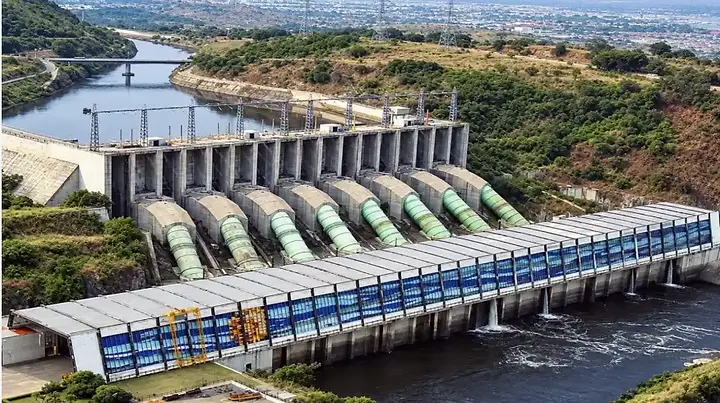
The Inga site lies on the Congo River in Kongo Central province, between Kinshasa and the Atlantic Ocean. It is situated near the Inga Rapids, where the river combines an exceptional flow with a substantial natural drop in elevation. This combination explains why the location is considered one of Africa's major hydroelectric sites.
According to the World Bank, the site benefits from a particularly high average river flow — the second highest in the world after the Amazon — and a natural drop of approximately 97 meters. The site's overall theoretical potential is estimated at around 42,000 MW.
Key Facts
Inga is therefore more than a power station: it is a vast hydraulic and energy complex whose development can have national, regional and international effects.
2. History: From an Idea to a Hydroelectric Complex
Inga's modern history began with the ambition to harness the immense natural energy of the Congo Rapids. The principle involves diverting part of the river's water toward the N'Kokolo valley to use the difference in elevation created by the terrain and the river's course.
The first major works resulted in Inga I, commissioned in 1972. With an installed capacity of approximately 351 MW, the station was a major addition to the country's electricity system.
Development continued with Inga II. Civil works began in the early 1970s, and its electromechanical generating units were progressively commissioned between 1977 and 1982. With 1,424 MW installed, Inga II greatly increased available generating capacity.
Together, Inga I and Inga II now represent 1,775 MW of installed capacity. SNEL describes them as the country's main hydroelectric complex.
INFRASTRUCTURE
Inga: Inside the DRC Hydropower Site With 42,000 MW Potential

7 oct. 2026
7 oct. 2026
11 min read
Publié
Mis à jour:
1. An Exceptional Site
The Inga site lies on the Congo River in Kongo Central province, between Kinshasa and the Atlantic Ocean. It is situated near the Inga Rapids, where the river combines an exceptional flow with a substantial natural drop in elevation. This combination explains why the location is considered one of Africa's major hydroelectric sites.
According to the World Bank, the site benefits from a particularly high average river flow — the second highest in the world after the Amazon — and a natural drop of approximately 97 meters. The site's overall theoretical potential is estimated at around 42,000 MW.
Key Facts
River | Location | Potential |
Congo | Kongo Central | Approximately 42,000 MW |
Inga is therefore more than a power station: it is a vast hydraulic and energy complex whose development can have national, regional and international effects.
2. History: From an Idea to a Hydroelectric Complex
Inga's modern history began with the ambition to harness the immense natural energy of the Congo Rapids. The principle involves diverting part of the river's water toward the N'Kokolo valley to use the difference in elevation created by the terrain and the river's course.
The first major works resulted in Inga I, commissioned in 1972. With an installed capacity of approximately 351 MW, the station was a major addition to the country's electricity system.
Development continued with Inga II. Civil works began in the early 1970s, and its electromechanical generating units were progressively commissioned between 1977 and 1982. With 1,424 MW installed, Inga II greatly increased available generating capacity.
Together, Inga I and Inga II now represent 1,775 MW of installed capacity. SNEL describes them as the country's main hydroelectric complex.
PUBLICITÉ
Timeline: 1972 — Inga I commissioned • 1977–1982 — Inga II generating units progressively commissioned • 2025 — First phase of the Inga 3 Development Program launched.
3. How Does Inga Work?
A hydroelectric development operates on a simple principle: converting the potential and kinetic energy of water into mechanical energy, then into electricity. At Inga, the river's geography allows a substantial elevation difference to be harnessed without relying on a conventional, very high dam and reservoir.
Water intake and diversion: Part of the water is directed into the site's hydraulic system.
Water drop: The elevation difference accelerates the water through pipes and water conveyance structures.
Turbines: The force of the water turns the turbines in the hydroelectric generating units.
Generators: Rotation is converted into electrical energy.
Transmission: Electricity is then carried through high-voltage networks.
4. Inga I: The First Major Step
Inga I marked a decisive stage in the DRC's energy history. Commissioned in 1972, the station was designed to convert the energy of the Congo River into large-scale electricity production. Its installed capacity is approximately 351 MW.
The facility helped shape the electricity network around Kinshasa and support the needs of economic activity. Its existence also demonstrates that Inga's power rests on an enduring geographical advantage: the combination of a very high river flow and a natural drop in elevation.
Over time, the station has faced the familiar challenges of aging infrastructure: maintenance, equipment renewal, generating-unit availability and the quality of the transmission network. A power station's actual performance depends as much on the availability of its equipment and the lines carrying its electricity as on its theoretical capacity. 351 MW — Inga I's installed capacity.
PUBLICITÉ
Tendances actuelles


Populaire aujourd'hui


5. Inga II: Moving to a Larger Scale
Inga II considerably increased the site's generating capacity. The station has eight units rated at 178 MW each, giving a total installed capacity of 1,424 MW. The units were progressively commissioned in the late 1970s and early 1980s.
This second phase reflected the ambition to supply a developing economy, particularly major urban and industrial centers. Inga's electricity has therefore been associated with mining, industrial and commercial activity while also contributing to household electricity supply.
Today, Inga I and Inga II total 1,775 MW of installed capacity. SNEL states that the two stations supply, among other areas, Kinshasa and the major mining regions of Katanga.
Station | Installed capacity |
Inga I | 351 MW |
Inga II | 1,424 MW |
Inga I + Inga II | 1,775 MW |
6. Why Inga Is Strategic for the DRC
Inga's role extends far beyond electricity generation. The site is central to a national question: how can the supply of reliable energy be increased to support economic growth and improve access to electricity?
Generation: Inga I and II account for an essential share of national hydroelectric capacity.
Economy: More abundant and reliable energy can support industry, mining, businesses and services.
Population: Development of the electricity sector can help improve household access to energy.
Renewable energy: Hydroelectricity harnesses energy from the water cycle and can reduce dependence on fossil fuels.
Sovereignty: Substantial domestic generating capacity strengthens the country's energy security and planning capabilities.
Regional role: Interconnections create opportunities for electricity exchanges with neighboring networks.
Inga's potential can become an economic benefit only if generation, maintenance, transmission and distribution advance together. A powerful station alone is not enough to guarantee universal access to electricity.
7. Infrastructure with a Regional Role
The DRC's geographical position gives Inga a regional role. The country belongs to Central and Southern African power systems, making electricity exchanges beyond the domestic market possible. Historically, the DRC has concluded export agreements with several neighboring countries and regional partners.
Countries and Markets Involved
Country | Role or prospect |
DRC | Main market: the national network, households, businesses and industries. |
South Africa | Major regional partner; Inga 3 is envisaged with a substantial focus on exports to Southern Africa. |
Zimbabwe | The DRC has historically exported electricity to Zimbabwe. |
Republic of the Congo | Electricity exchanges between the two Congos form part of the sector's history. |
Zambia | The DRC and Zambian networks are interconnected, facilitating regional exchanges. |
Botswana | Mentioned in transmission-corridor scenarios associated with the regional development of Inga 3. |
8. Inga 3: The Next Major Step
The Inga 3 project represents the next major step envisaged in developing the site's potential. Its ambition is to harness more of the Congo River's immense water resources while strengthening infrastructure and economic benefits for local communities.
PUBLICITÉ
On June 3, 2025, the World Bank announced approval of $250 million in financing for the first phase of the Inga 3 Development Program. This phase forms part of a $1 billion multiyear program and focuses particularly on laying the project's foundations, infrastructure, employment and local community development.
The World Bank also notes that five territories near the Inga Rapids — Seke-Banza, Lukula, Tshela, Songololo and Luozi — have been identified as potential beneficiaries of community development activities.
Conditions for Success
Sustainable development of Inga requires sound planning, transparent governance, robust environmental and social studies, long-term maintenance, adequate transmission networks and meaningful community participation. The challenge is therefore more than building additional turbines: it is about turning the river's power into lasting, shared benefits.
9. Conclusion — Turning Inga's Power into a Future
Since Inga I was commissioned in 1972, followed by the development of Inga II, the site has become one of the symbols of the Democratic Republic of the Congo's energy capacity. Its strength rests on exceptional geography: at this location, the Congo River offers a considerable flow and a natural elevation difference favorable to hydroelectricity.
The real challenge of the coming decades will be to align this potential with the needs of Congolese people: more available electricity, reliable networks, productive investment, local jobs and stronger regional integration. Inga 3 could become an important stage in this transformation, provided its technical, financial, environmental and social dimensions are addressed together.
Key Takeaways
Inga I: Approximately 351 MW; commissioned in 1972.
Inga II: 1,424 MW; progressively commissioned between 1977 and 1982.
Inga I + Inga II: 1,775 MW of installed capacity.
Estimated overall site potential: Approximately 42,000 MW.
Inga 3: A development program launched with a first phase supported by $250 million from the World Bank in 2025.
Documentary Sources
World Bank, “Factsheet on World Bank support for the Democratic Republic of Congo's Inga Project,” 2024.
World Bank, “New Inga 3 Development Program to Start with Investments in Local Congolese Communities,” June 3, 2025.
World Bank, “In the DRC, community consultations lay the groundwork for local citizens to benefit from the Inga 3 Development Program,” June 3, 2025.
SNEL SA, “La Production” section: information on Inga I and Inga II.
Additional data and historical details drawn from World Bank documents.
PUBLICITÉ
Articles connexes


