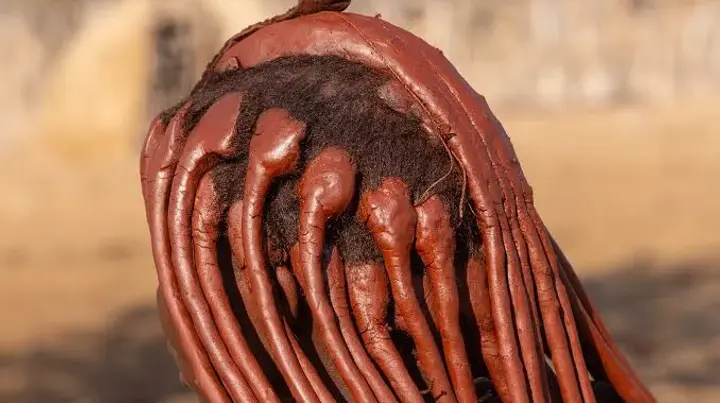
Almost every himba woman you see the first thing you notice is the red colour on their skin and hair. This color is obtained from Otjize, a red ochre paste closely connected to Himba beauty, body care , and cultural identity.
Their use of red ochre is not just a visual style. Its a practice that belongs to a wider pastoral culture characterised by land, livestock, family, and adaptation to to a dry environment.
Understanding Otjize
This paste is made from red ochre and animal fat , often described in research as goat butterfat. A peer-reviewed study in scientific reports decribes Otjize as a Himba formulation made from natural Namibian red ochre and fat, used on the skin and hair as both a cosmetic and protective paste.
The red pigment is mainly linked to hematite, an iron-rich mineral that give the paste its deep red color. Some sources also note that Otjize may be perfumed with aromatic resin from the Omuzumba shrub.
Otjize as a symbol of beauty
In the scientific Reports study on himba Otjize the scientists descibe it as beauty cosmetic as well as a skin protective formulation.
This matters Otjize should not be reduced to survival alone. It is not only about sun, dust or water scarcity but also about appearance , self-presentation and what beauty means inside Himba society.
For many Himba women , red ochre is part of looking complete , dignified and recognizable culturally.
A marker of identity
CULTURE
Why Himba Women Use Red Ochre "otjize"

Jun 12, 2026
Jun 12, 2026
9 min read
Published
Updated:
Almost every himba woman you see the first thing you notice is the red colour on their skin and hair. This color is obtained from Otjize, a red ochre paste closely connected to Himba beauty, body care , and cultural identity.
Their use of red ochre is not just a visual style. Its a practice that belongs to a wider pastoral culture characterised by land, livestock, family, and adaptation to to a dry environment.
Understanding Otjize

This paste is made from red ochre and animal fat , often described in research as goat butterfat. A peer-reviewed study in scientific reports decribes Otjize as a Himba formulation made from natural Namibian red ochre and fat, used on the skin and hair as both a cosmetic and protective paste.
The red pigment is mainly linked to hematite, an iron-rich mineral that give the paste its deep red color. Some sources also note that Otjize may be perfumed with aromatic resin from the Omuzumba shrub.
Otjize as a symbol of beauty

In the scientific Reports study on himba Otjize the scientists descibe it as beauty cosmetic as well as a skin protective formulation.
This matters Otjize should not be reduced to survival alone. It is not only about sun, dust or water scarcity but also about appearance , self-presentation and what beauty means inside Himba society.
For many Himba women , red ochre is part of looking complete , dignified and recognizable culturally.
A marker of identity

Otjize also works as a visible marker of identity. It connects the body to Himba dress, hair, jewelry, and wider cultural belonging.
ADVERTISEMENT
Research on Himba dress and cultural change shows that clothing and appearance are not small details. Austin Sterling Cameron’s BYU thesis, The Influence of Media on Himba Conceptions of Dress, Ancestral and Cattle Worship, and the Implications for Culture Change, treats dress as one of the major cultural symbols through which Himba people understand continuity and change.
This means otjize is part of a visual language. It helps communicate belonging, womanhood, and connection to Himba ways of life. It is also linked to hair styling and adornment, which can carry social meaning.
Red earth, life, and symbolism
Some academic descriptions connect otjize with symbolic meanings of red earth and life. The Scientific Reports article notes that otjize is associated with the rich red color of the earth and blood as the essence of life.
This symbolism should be handled carefully. Not every claim about red ochre, fertility, ancestors, or spirituality is equally well sourced. But the evidence does support saying that otjize is more than makeup. It carries cultural meaning connected to beauty, land, life, and identity.
Protection from sun and heat
Otjize also has practical benefits. The Himba live in a hot, dry region with strong sun exposure. The Scientific Reports study found that Himba red ochre showed strong UVA and UVB filtering properties. The study also reported infrared reflection, meaning the ochre may help reduce heat absorbed by the skin.
This does not mean otjize should be described as a modern sunscreen in a simple commercial sense. It means scientific testing supports the idea that the red ochre has protective physical properties.
In this way, otjize joins beauty and adaptation. It makes the body look culturally beautiful while also helping the skin face a difficult environment.
Body care and hygiene

Otjize is also connected to body care. In dry areas where water can be limited, daily washing may not look the same as it does in wetter environments. The scientific study notes that otjize has been described as helping cleanse the skin over time and protect against the hot, dry climate.
ADVERTISEMENT
The same study also found some antibacterial activity in the red ochre sample tested. This supports a cautious claim that otjize may have useful skin-care properties. However, it is better not to exaggerate this into a medical claim.
A safe way to describe it is this: otjize is part of Himba body care, and scientific testing has found protective and antibacterial properties in the red ochre used in the formulation.
Hair, adornment, and social meaning
Otjize is applied not only to the skin but also to hair. Himba women are known for carefully shaped hairstyles coated with red ochre paste. These hairstyles form part of a wider system of dress and adornment.
Borg and Jacobsohn’s book chapter on Himba red pigment explains that Himba women use red hematite pigment as a full-body cosmetic called otjize. See Borg & Jacobsohn, “Ladies in Red,” in Rot: Die Archäologie bekennt Farbe, 2013, pp. 43–51.(ResearchGate PDF page for “Ladies in Red”)
The general African art-history source Smarthistory’s “Art, Adornment, and Identity in Africa” explains that adornment can communicate identity, status, and belonging across African visual cultures. For the Himba, otjize belongs to this kind of visual communication, although Himba-specific claims should still be grounded in Himba-specific sources.
Otjize, hair, leather clothing, and jewelry work together. They create a complete public appearance that is both personal and cultural.
Is the tradition changing?
Yes, but change does not mean disappearance.
The 2024 peer-reviewed study “There Are No True Himbas Anymore” reports changes in Himba dress, hairstyles, education, religion, gender roles, marriage practices, and use of modern items. It also shows that Himba culture is under pressure from modernization, schooling, environmental change, and wider social contact.
This means it would be wrong to say all Himba women use otjize in exactly the same way today. Some women continue the practice strongly, especially in more rural settings. Others may change how they dress or groom because of school, town life, religion, work, or personal choice.Otjize remains an important cultural symbol, but Himba life is not frozen in the past.
Common misconceptions about Himba red ochre
It is only because they do not bathe
This is too simple. Otjize has body-care functions, but it is also about beauty, identity, and cultural meaning.


POPULAR TODAY


ADVERTISEMENT
It is only decoration
This is also incomplete. Scientific research supports protective properties, including UV filtering and heat reflection.
Every Himba woman uses otjize the same way
Research supports variation in modern Himba dress and grooming practices.
The red ochre tradition proves Himba culture has not changed
This is false. Himba culture is changing, and research documents shifts in dress, hairstyles, education, religion, and daily life.
Why otjize matters
Otjize matters because it brings together many parts of Himba life. It is beauty, but not only beauty. It is body care, but not only body care. It is identity, but not a fixed costume.
For Himba women, red ochre can express connection to land, social belonging, cultural pride, and daily resilience in a harsh environment. To understand it properly, we must avoid treating it as an exotic image. It is a living practice with practical, aesthetic, and cultural meanings.
This article relies mainly on academic and institutional sources: a peer-reviewed scientific article, a university thesis, a peer-reviewed modern cultural-change study, UNESCO archive material, and an art-history education source for general adornment context.
References for further reading:
Scientific Reports: From Himba indigenous knowledge to engineered Fe2O3 UV-blocking green nanocosmetics
BYU Scholars Archive: The Influence of Media on Himba Conceptions of Dress, Ancestral and Cattle Worship.
ADVERTISEMENT
RELATED ARTICLE