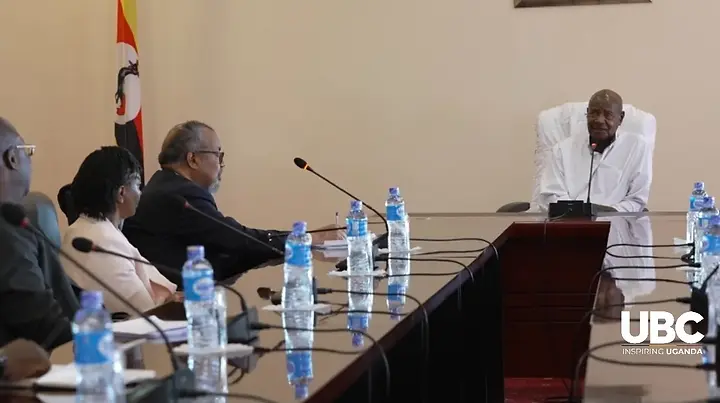
On 8 June 2026, President Yoweri Museveni welcomed World Health Organization (WHO) Director‑General Dr Tedros Adhanom Ghebreyesus to State House Entebbe. At the meeting Tedros thanked Uganda for its prompt and capable response to the Ebola outbreak that spilled over from the neighbouring Democratic Republic of the Congo (DRC).
He said Uganda’s border screening, surveillance, testing and case‑management systems were working well and expressed confidence that the epidemic could be brought under control. The WHO chief nevertheless urged Uganda to work closely with the DRC and to reconsider closing the border because such restrictions disrupt trade but do not stop the virus.
Situation in the DRC and Uganda
The current outbreak, declared on 15 May 2026, is caused by the Bundibugyo species of Ebola virus a rare strain for which no approved vaccine or specific treatment exists. By 9 June 2026, the European Centre for Disease Prevention and Control (ECDC) reported 550 confirmed cases and 101 confirmed deaths in the DRC.
Ituri province remains the epicentre, with cases also recorded in North Kivu and South Kivu. The ECDC also reported 19 confirmed cases in Uganda, including two deaths. Many of Uganda’s infections are imported; health officials note that only five of the confirmed cases appear to result from local transmission.
The situation is complicated by conflict and population movements in eastern DRC. According to a Washington Post article, more than 100 people had died by 9 June as the outbreak intensified, with more than 550 confirmed cases and a low contact‑tracing coverage rate, while attacks on health workers and armed conflict hindered the response. The humanitarian crisis in Ituri has also displaced nearly a million people, making surveillance and contact tracing difficult.
Uganda’s response and border measures
Uganda’s experience with previous Ebola outbreaks helped the country respond quickly. The Ugandan health ministry established screening at official border posts and stepped up laboratory testing and contact tracing. Tedros praised these measures as critical to early detection.
However, Uganda went further by temporarily closing its border with the DRC to general traffic, allowing only authorised humanitarian, cargo and security crossings. The Centre for Infectious Disease Research and Policy (CIDRAP) reports that entrants must undergo health screening, complete locator forms and face mandatory 21‑day isolation if they travel for non‑essential reasons.
CIDRAP notes that Uganda had eight confirmed cases and one death when the closure was announced, while the DRC had more than 1,077 suspected cases and 246 suspected deaths. The WHO chief later urged Kampala to reopen the border, arguing that restrictions harm local economies without stopping the virus.
HEALTH NEWS
UN Commends Uganda for Swift Ebola Response Measures

Jun 9, 2026
Jun 9, 2026
5 min read
Published
Updated:
On 8 June 2026, President Yoweri Museveni welcomed World Health Organization (WHO) Director‑General Dr Tedros Adhanom Ghebreyesus to State House Entebbe. At the meeting Tedros thanked Uganda for its prompt and capable response to the Ebola outbreak that spilled over from the neighbouring Democratic Republic of the Congo (DRC).
He said Uganda’s border screening, surveillance, testing and case‑management systems were working well and expressed confidence that the epidemic could be brought under control. The WHO chief nevertheless urged Uganda to work closely with the DRC and to reconsider closing the border because such restrictions disrupt trade but do not stop the virus.
Situation in the DRC and Uganda
The current outbreak, declared on 15 May 2026, is caused by the Bundibugyo species of Ebola virus a rare strain for which no approved vaccine or specific treatment exists. By 9 June 2026, the European Centre for Disease Prevention and Control (ECDC) reported 550 confirmed cases and 101 confirmed deaths in the DRC.
Ituri province remains the epicentre, with cases also recorded in North Kivu and South Kivu. The ECDC also reported 19 confirmed cases in Uganda, including two deaths. Many of Uganda’s infections are imported; health officials note that only five of the confirmed cases appear to result from local transmission.
ADVERTISEMENT
The situation is complicated by conflict and population movements in eastern DRC. According to a Washington Post article, more than 100 people had died by 9 June as the outbreak intensified, with more than 550 confirmed cases and a low contact‑tracing coverage rate, while attacks on health workers and armed conflict hindered the response. The humanitarian crisis in Ituri has also displaced nearly a million people, making surveillance and contact tracing difficult.
Uganda’s response and border measures
Uganda’s experience with previous Ebola outbreaks helped the country respond quickly. The Ugandan health ministry established screening at official border posts and stepped up laboratory testing and contact tracing. Tedros praised these measures as critical to early detection.
However, Uganda went further by temporarily closing its border with the DRC to general traffic, allowing only authorised humanitarian, cargo and security crossings. The Centre for Infectious Disease Research and Policy (CIDRAP) reports that entrants must undergo health screening, complete locator forms and face mandatory 21‑day isolation if they travel for non‑essential reasons.
CIDRAP notes that Uganda had eight confirmed cases and one death when the closure was announced, while the DRC had more than 1,077 suspected cases and 246 suspected deaths. The WHO chief later urged Kampala to reopen the border, arguing that restrictions harm local economies without stopping the virus.
ADVERTISEMENT
A continental plan to contain Bundibugyo Ebola
On 5 June 2026, the WHO and the Africa Centres for Disease Control and Prevention (Africa CDC) launched a joint continental preparedness and response plan. The plan, covering June–November 2026, aims to raise US$ 518 million to support governments and partners in strengthening emergency coordination, disease surveillance, laboratory testing, infection prevention and control, clinical care, community engagement and logistics.
WHO Director‑General Tedros stressed that the only way to beat the outbreak is through close partnership under a “one response” approach. The plan complements national response plans in the DRC and Uganda and focuses on protecting vulnerable populations and enhancing cross‑border collaboration.
Al Jazeera reported that the WHO–Africa CDC plan was unveiled in response to a surge of 71 new cases in 24 hours and that authorities warn the current Bundibugyo outbreak could become one of the largest ever Ebola crises without robust public‑health interventions. The plan emphasises stopping the outbreak at its source, supporting affected countries and ensuring neighbours are ready to detect and act quickly.
Encouraging signs from Uganda
Despite the challenges, Uganda has reported promising signs. On 5 June 2026, the Ugandan Ministry of Health announced that four Ebola patients had recovered and been discharged, leaving 15 confirmed cases (11 imported) under monitoring. Health officials attributed these recoveries to improved laboratory testing, contact tracing and emergency response systems built during past outbreaks.
TRENDING NOW


POPULAR TODAY


ADVERTISEMENT
The news was highlighted in a report that 4 Patients Recover from Ebola in Uganda as Monitoring Continues, which noted that the World Health Organization and Africa CDC continue to monitor the situation and that regional cooperation remains essential.
The same site has also reported on the wider regional response. For example, an earlier article described how DR Congo activated emergency measures in Ituri and North Kivu, deployed rapid‑response teams and set up treatment centres, while international partners such as WHO, Africa CDC, UNICEF and Médecins sans Frontières provided supplies, experts and logistics support. The report highlighted that insecurity and attacks on health facilities hamper surveillance and contact tracing, but that previous Ebola experience gives DRC a trained workforce and networks to build upon.
Outlook
The UN’s praise underscores that Uganda’s swift actions rigorous border screening, expanded surveillance, and rapid case management have so far limited local transmission of the Bundibugyo Ebola virus. However, the outbreak remains a serious regional threat.
Hundreds of cases and deaths in eastern DRC, coupled with insecurity and cross‑border movement, mean that robust international cooperation and adequate funding are essential to prevent a wider catastrophe. The WHO–Africa CDC plan and Uganda’s early successes provide hope, but officials warn that the response must be sustained until the outbreak is declared over.
ADVERTISEMENT
RELATED ARTICLE


