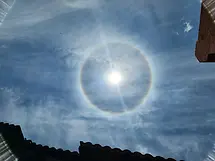
PRETORIA, South Africa — 16 November 2026. A bright ring appeared around the sun over parts of Gauteng on Monday, drawing photographs, public discussion and questions about what caused the spectacle. Scientists identify the optical effect as a 22-degree sun halo, produced when sunlight bends as it passes through ice crystals in high-altitude clouds.
The sight can appear dramatic, sometimes with faint rainbow-like colours, but it is a natural atmospheric phenomenon. It is not an astronomical emergency, and the halo alone is not a reliable forecast of rain.
What caused the ring around the sun in South Africa on 16 November?
The bright circle visible in parts of Gauteng was a solar halo. Sunlight passing through six-sided ice crystals in thin, high clouds bends into a ring roughly 22 degrees from the sun. Observers should never look directly at the sun to see it.
What people saw in Gauteng
A luminous circle surrounded the sun on Monday, with a pale glow and sometimes subtle colour along the ring. The Citizen's account, published at 12:07 PM SAST, documented the phenomenon and included a photograph credited to one of its journalists. The report says people noticed the effect shortly before midday.
Separate photographs shared in an open Johannesburg discussion and a South African public photo thread illustrated how the sight caught attention beyond a single reporter. Posts and comments are useful evidence of public interest; they do not themselves explain the physics or establish that the halo was visible everywhere in South Africa.
A local Pretoria report in Rekord also published a reader-supplied photograph, showing a clear circle with a slightly reddish inner edge. Different viewpoints, cloud cover and camera exposures can change how bright the ring appears to each observer.
The science behind a 22-degree halo
Professor Jennifer Fitchett, an atmospheric scientist at the University of the Witwatersrand, told Rekord that the display was a 22-degree halo. Sunlight moves through tiny hexagonal ice crystals suspended in cirrus clouds, often eight to ten kilometres high. As the light is refracted, an observer sees a circle around the sun.
SOUTH AFRICA NEWS
South Africa Sun Halo: Why a Bright Ring Appeared

Nov 16, 2026
Nov 16, 2026
6 min read
Published
Updated:
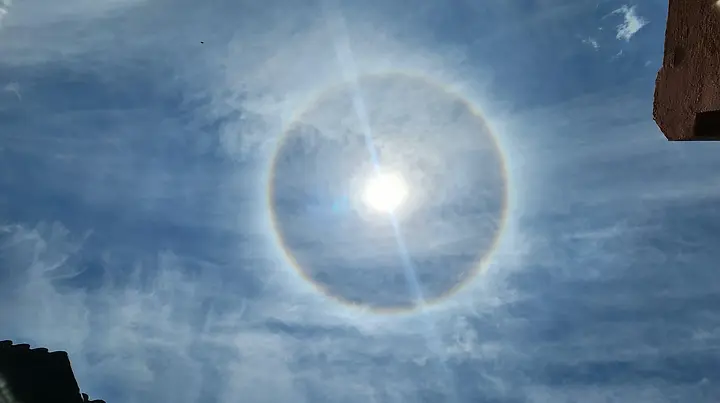
PRETORIA, South Africa — 16 November 2026. A bright ring appeared around the sun over parts of Gauteng on Monday, drawing photographs, public discussion and questions about what caused the spectacle. Scientists identify the optical effect as a 22-degree sun halo, produced when sunlight bends as it passes through ice crystals in high-altitude clouds.
The sight can appear dramatic, sometimes with faint rainbow-like colours, but it is a natural atmospheric phenomenon. It is not an astronomical emergency, and the halo alone is not a reliable forecast of rain.
What caused the ring around the sun in South Africa on 16 November?
The bright circle visible in parts of Gauteng was a solar halo. Sunlight passing through six-sided ice crystals in thin, high clouds bends into a ring roughly 22 degrees from the sun. Observers should never look directly at the sun to see it.
What people saw in Gauteng
A luminous circle surrounded the sun on Monday, with a pale glow and sometimes subtle colour along the ring. The Citizen's account, published at 12:07 PM SAST, documented the phenomenon and included a photograph credited to one of its journalists. The report says people noticed the effect shortly before midday.
Separate photographs shared in an open Johannesburg discussion and a South African public photo thread illustrated how the sight caught attention beyond a single reporter. Posts and comments are useful evidence of public interest; they do not themselves explain the physics or establish that the halo was visible everywhere in South Africa.
ADVERTISEMENT
A local Pretoria report in Rekord also published a reader-supplied photograph, showing a clear circle with a slightly reddish inner edge. Different viewpoints, cloud cover and camera exposures can change how bright the ring appears to each observer.
The science behind a 22-degree halo
Professor Jennifer Fitchett, an atmospheric scientist at the University of the Witwatersrand, told Rekord that the display was a 22-degree halo. Sunlight moves through tiny hexagonal ice crystals suspended in cirrus clouds, often eight to ten kilometres high. As the light is refracted, an observer sees a circle around the sun.
The number describes the approximate angular distance of the ring from the sun, not the temperature or the diameter of the clouds. It is called a halo rather than an ordinary rainbow because the optical geometry and the crystals producing the display are different from sunlight passing through raindrops.
The United Kingdom Met Office's explanation of atmospheric optical effects likewise describes halos as consequences of sunlight passing through ice crystals high in the sky. Even when conditions are warm near the ground, the upper atmosphere can be cold enough for these crystals to form.
ADVERTISEMENT


What the South African Weather Service said
The scientific interpretation was also supported by the South African Weather Service. In an interview reported by IOL, spokesperson Lehlogonolo Thobela described the sun's light bending through ice crystals in high cirrus clouds. That produces the bright ring, with faint colours visible under some conditions.
Halos occur in many parts of the world and at different times of year. They are not uniquely South African, and their appearance should not be portrayed as evidence of a rare planetary alignment or an imminent disaster. The relevant ingredients are sunlight, the observer's position and the structure of icy clouds above.
Does a sun halo mean rain is coming?
A halo can occur when high cirrus clouds move ahead of changing weather systems, and some traditional weather sayings associate rings with approaching rain. But the halo itself is a visual effect, not a guarantee of rainfall at a specific place or time.
Fitchett told Rekord that the ring alone offered little predictive value. On the day of the Gauteng sighting, other visible cloud developments were more useful clues to possible rain. The South African Weather Service account in IOL likewise identifies the phenomenon as optical rather than a stand-alone forecast.
For an actual prediction, residents should consult up-to-date local forecasts and any official weather alerts. A striking photo of a halo is not a substitute for information about thunderstorms, flooding, heat or travel conditions.
ADVERTISEMENT
The most important safety advice is simple: do not stare into the sun. Looking directly at it can damage eyesight even if a bright ring makes the surrounding sky tempting to examine.
Fitchett suggested using the edge of a building to block the solar disc while viewing the surrounding halo. A viewer can also appreciate photographs taken safely by experienced observers, rather than trying to photograph the sun through an optical instrument. Do not use binoculars or a telescope pointed at the sun without specialised, approved solar safety equipment.
Because the ring occupies a large area of sky, ordinary cloud cover may hide parts of it or obscure it completely. The same observer may see the halo only briefly even when high-altitude ice clouds remain overhead.
The Gauteng halo shows how a familiar sun can produce an unfamiliar image when atmospheric conditions are right. Public photographs record the appearance, while the independent explanations from a university scientist, a national weather-service spokesperson and a meteorological agency establish the physics.
The next time a circle appears around the sun, the key questions are whether high icy clouds are present and whether other weather observations support a forecast. The ring itself is best understood as light refracted through ice crystals and admired without looking straight at the sun.