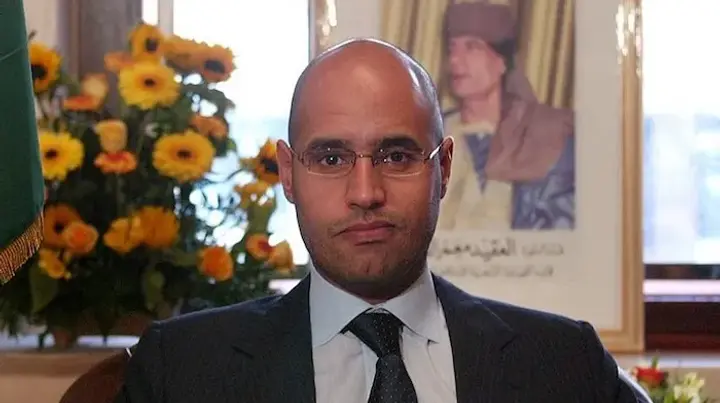
Libyan prosecutors have opened an investigation into the killing of Saif al-Islam Gaddafi, the 53-year-old son of former leader Muammar Gaddafi an event that lands in the middle of Libya’s long-running political deadlock and could intensify competition among rival power centers and armed groups based on initial reporting by the BBC .
Authorities said Saif al-Islam died from gunshot wounds and that efforts were under way to identify the attackers. His office described a “direct confrontation” after four unknown gunmen broke into his home in Zintan, a city in north-west Libya long associated with militia influence since 2011. Forensic experts were dispatched to Zintan as part of the inquiry.
Saif al-Islam’s significance in today’s Libya lies less in formal office than in symbolism and unfinished politics. Once positioned as an heir apparent, he remained a contentious national figure after the fall of his father’s regime in 2011, viewed by some as a potential political alternative and by others as inseparable from the abuses of the old state. The persistence of those competing narratives has helped keep him politically relevant in a country where legitimacy is often contested, not consolidated.
That relevance had practical implications. Libya’s attempted transition has repeatedly stalled, with elections postponed and institutions split. In that environment, any figure with name recognition, networks, and a constituency however divisive can become a pressure point.
Saif al-Islam’s stated intention to run for president in 2021, before elections were postponed indefinitely, placed him back into the national equation and reminded rivals that “old regime” politics still had an audience.
Conflicting accounts raise the political temperature
Even the basic details of his death have been reported differently. While his office said the killing occurred in Zintan, another account cited in the report said he died near Libya’s border with Algeria. In fragile political systems, contradictions like these can become fuel driving suspicion, competing blame narratives, and mobilization by factions seeking advantage.
For Libya’s rival authorities and armed formations, perception often matters as much as proof. A high-profile killing can be interpreted as a message: a warning to would-be challengers, a settling of scores, or a signal of shifting alliances. Without a clear, credible account something Libya’s fragmented institutions have struggled to provide public debate can harden along factional lines.
The militia factor: security and authority are inseparable
AFRICAN POLITICS
Saif al-Islam Gaddafi killing: why Libya’s politics may shift

Feb 4, 2026
May 15, 2026
4 min read
Published
Updated:
Libyan prosecutors have opened an investigation into the killing of Saif al-Islam Gaddafi, the 53-year-old son of former leader Muammar Gaddafi an event that lands in the middle of Libya’s long-running political deadlock and could intensify competition among rival power centers and armed groups based on initial reporting by the BBC .
Authorities said Saif al-Islam died from gunshot wounds and that efforts were under way to identify the attackers. His office described a “direct confrontation” after four unknown gunmen broke into his home in Zintan, a city in north-west Libya long associated with militia influence since 2011. Forensic experts were dispatched to Zintan as part of the inquiry.
Saif al-Islam’s significance in today’s Libya lies less in formal office than in symbolism and unfinished politics. Once positioned as an heir apparent, he remained a contentious national figure after the fall of his father’s regime in 2011, viewed by some as a potential political alternative and by others as inseparable from the abuses of the old state. The persistence of those competing narratives has helped keep him politically relevant in a country where legitimacy is often contested, not consolidated.
That relevance had practical implications. Libya’s attempted transition has repeatedly stalled, with elections postponed and institutions split. In that environment, any figure with name recognition, networks, and a constituency however divisive can become a pressure point.
ADVERTISEMENT
Saif al-Islam’s stated intention to run for president in 2021, before elections were postponed indefinitely, placed him back into the national equation and reminded rivals that “old regime” politics still had an audience.
Conflicting accounts raise the political temperature
Even the basic details of his death have been reported differently. While his office said the killing occurred in Zintan, another account cited in the report said he died near Libya’s border with Algeria. In fragile political systems, contradictions like these can become fuel driving suspicion, competing blame narratives, and mobilization by factions seeking advantage.
For Libya’s rival authorities and armed formations, perception often matters as much as proof. A high-profile killing can be interpreted as a message: a warning to would-be challengers, a settling of scores, or a signal of shifting alliances. Without a clear, credible account something Libya’s fragmented institutions have struggled to provide public debate can harden along factional lines.
ADVERTISEMENT
The militia factor: security and authority are inseparable
Libya has, for years, been split among competing centers of power and local armed groups. That reality turns any major political event into a security question. Saif al-Islam was previously held by a militia in Zintan for years after 2011 and later released under an amnesty law, underscoring how coercive power has frequently rested outside unified state command.
His killing therefore tests more than criminal accountability; it tests authority itself. If prosecutors cannot credibly establish what happened and who is responsible it reinforces the perception that violence can reshape the political landscape without consequence. That perception can embolden spoilers, weaken already-strained public trust, and complicate any future election roadmap.
Legal shadow and international pressure
Saif al-Islam also carried a long legal and diplomatic burden. The International Criminal Court has sought him for alleged crimes against humanity connected to the 2011 crackdown, and the ICC case has remained tied to broader questions about accountability in post-Gaddafi Libya.
His death may reshape those accountability debates in two ways. First, it closes off any possibility however remote of a trial that could establish an authoritative record. Second, it may intensify scrutiny of Libya’s security environment and judicial capacity, particularly if the investigation falters or becomes politicized. International actors watching Libya’s trajectory may read the killing as another indicator that the state remains unable to guarantee security for high-profile figures, let alone manage national elections.


POPULAR TODAY


ADVERTISEMENT
What happens next and why it matters
For now, prosecutors say the investigation is ongoing and focused on identifying the gunmen. The key political question is whether the inquiry produces results that are accepted across Libya’s divided landscape or whether it becomes another disputed process that deepens mistrust.
Either way, Saif al-Islam’s death removes one potential pole from Libya’s fragmented political map, but it does not remove the forces that made him relevant: a stalled transition, divided institutions, and a security order shaped by armed groups. In that context, the aftermath could be destabilizing not only because of who he was, but because of what the killing reveals about who holds power and how it is exercised.
ADVERTISEMENT
RELATED ARTICLE