A finished scarification pattern can look remarkably precise. Small raised marks follow one another across the shoulder, chest, arm or face, turning the skin into a permanent design. From a distance, the scars may resemble beads arranged beneath the surface of the body.
But every raised mark begins as an open wound.
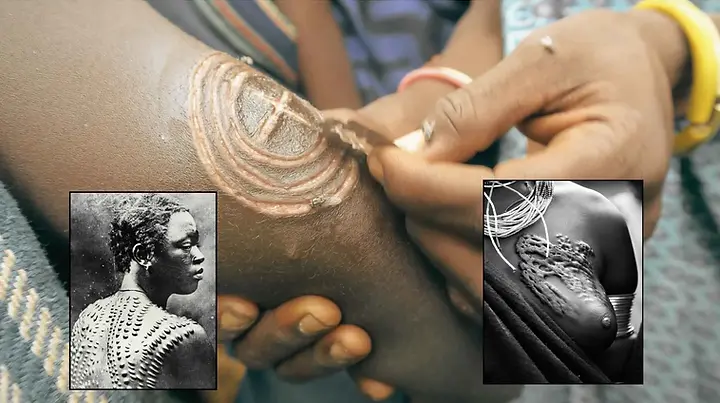
Among some Suri communities in southwestern Ethiopia, scarification is created by deliberately lifting, cutting and removing small sections of skin. The procedure may be repeated for hours as blood flows from the wounds. Materials such as ash or mud may then be placed on the injured skin, influencing how it heals and helping the scars become more visible.
It is a painful process, but describing it only through pain misses much of its meaning. Scarification can also involve beauty, courage, endurance, attraction and public identity. The scars remain long after the wounds have closed, becoming part of how a person’s body is seen by others.
At the same time, not every Suri scar carries the same message. Some are deliberately created as decoration. Others may be connected to fighting, personal history or social recognition. Reliable research does not support the popular claim that every pattern has one fixed meaning.
Understanding Suri scarification therefore requires looking beyond the striking photographs. The real story lies in the cutting, the bleeding, the difficult healing and the social world in which those scars become meaningful.
Who Are the Suri?
The Suri live mainly in southwestern Ethiopia, close to the border with South Sudan. They are agro-pastoralists whose lives have traditionally depended on cattle, seasonal cultivation and access to land and water.
Different publications use names such as Suri, Surma, Chai and Tirmaga, sometimes as if they describe exactly the same group. The reality is more complicated. Suri-speaking communities are related, but customs and interpretations may vary between places, generations and individuals.
AFRICAN CULTURE
The Painful Process Behind Suri Scarification

Jul 14, 2026
Jul 14, 2026
18 min read
Published
Updated:
A finished scarification pattern can look remarkably precise. Small raised marks follow one another across the shoulder, chest, arm or face, turning the skin into a permanent design. From a distance, the scars may resemble beads arranged beneath the surface of the body.
But every raised mark begins as an open wound.
Among some Suri communities in southwestern Ethiopia, scarification is created by deliberately lifting, cutting and removing small sections of skin. The procedure may be repeated for hours as blood flows from the wounds. Materials such as ash or mud may then be placed on the injured skin, influencing how it heals and helping the scars become more visible.

It is a painful process, but describing it only through pain misses much of its meaning. Scarification can also involve beauty, courage, endurance, attraction and public identity. The scars remain long after the wounds have closed, becoming part of how a person’s body is seen by others.
At the same time, not every Suri scar carries the same message. Some are deliberately created as decoration. Others may be connected to fighting, personal history or social recognition. Reliable research does not support the popular claim that every pattern has one fixed meaning.
Understanding Suri scarification therefore requires looking beyond the striking photographs. The real story lies in the cutting, the bleeding, the difficult healing and the social world in which those scars become meaningful.
Who Are the Suri?

The Suri live mainly in southwestern Ethiopia, close to the border with South Sudan. They are agro-pastoralists whose lives have traditionally depended on cattle, seasonal cultivation and access to land and water.
Different publications use names such as Suri, Surma, Chai and Tirmaga, sometimes as if they describe exactly the same group. The reality is more complicated. Suri-speaking communities are related, but customs and interpretations may vary between places, generations and individuals.
This distinction matters when discussing scarification. An observation recorded in one Suri or Surma community cannot automatically be treated as a rule followed by everyone.
It is safer to say that scarification has been documented among the Suri, including on the bodies of women, men and young people, but the design, purpose and social meaning of a mark may depend on its location and the circumstances in which it was created.
Scarification also exists alongside other forms of Suri bodily expression. These include temporary body painting, hairstyles, beads, stretched earlobes and, among some women, lip plates. Together, these practices shape how people present themselves during daily life, ceremonies, courtship, fighting and encounters with outsiders.
What Is Scarification?
Scarification is the intentional creation of permanent marks by cutting, removing, burning or otherwise injuring the skin. Unlike tattooing, which introduces pigment beneath the skin, scarification changes the texture of the skin itself.
The Pitt Rivers Museum at the University of Oxford describes it as an invasive form of permanent body marking in which cutting and the healing process are manipulated to produce scars.
Different techniques create different results. A cut drawn along the surface may leave a relatively flat line. Small sections of skin can also be lifted with a thorn or hook and sliced away, producing round wounds. When many wounds are arranged together, they can heal into rows, curves or more complicated patterns.
The raised marks are often casually described as keloids, but that term is not always medically accurate. A true keloid grows beyond the boundaries of the original wound. Some scarification marks may instead be hypertrophic scars raised tissue that remains within the injured area.Unless the scars have been medically examined, raised scarification is usually the safer description.
How the Suri Scarification Process Begins
When Does the Scarification Process Begin?
Reliable sources do not establish one universal age at which all Suri people begin scarification. The clearest age-related account comes from the neighbouring Mursi, whose body-marking traditions share regional similarities with those of the Suri but should not be treated as identical.
According to Mursi Online, boys and girls traditionally begin making decorative scars called kitchoga as they approach their full adult height. For girls, the preferred period begins after the breasts have developed. People explain that scars made earlier may fade as the body continues growing, while beginning the process after childbirth is uncommon. Older boys and young men may continue adding scars even after becoming fathers.
The process may also remain unfinished. Mursi Online reports that some married women said they had stopped because the cutting was too painful, while others said they had simply forgotten to complete their patterns. This shows that scarification is not necessarily performed in one session or completed by everyone.

ADVERTISEMENT
One of the clearest published descriptions of the physical process appears in a 2017 study by Roland Garve and his colleagues. Their article, Scarification in Sub-Saharan Africa: Social Skin, Remedy and Medical Import, includes an observed scarification procedure involving a Surma woman in southwestern Ethiopia.
In that documented case, the intended design was not first drawn or painted on the woman’s skin. The person performing the procedure worked directly on the selected area.
A small portion of skin was lifted using a wooden hook or a sharp thorn. Once raised, the skin was sliced or removed with a razor blade. The action created a small wound that would later become one part of the finished pattern.
The same process was then repeated.
Each wound may look minor when seen separately, but a complete design can require dozens or even hundreds of individual cuts. The scarifier must control the distance and arrangement of the wounds while the person receiving the scars remains still.
Garve and his colleagues reported that the procedure continued for hours despite ongoing bleeding (Garve et al., 2017, pp. 709–710). That detail reveals the physical reality hidden beneath the healed patterns seen in photographs.
This was not a single quick incision. It was the repeated lifting and cutting of living skin.
Hours of Cutting and Bleeding
Bleeding at initial cutting Bleeding at initial cutting Bleeding at initial cutting
Calling Suri scarification painful is not simply an attempt to create a dramatic headline. Cutting through the skin activates pain receptors and damages blood vessels. Repeating the process over a wide area increases both the injury and the physical strain.
The person must endure the initial cuts, the repeated contact around fresh wounds and the continued bleeding. Areas such as the chest and shoulder also move as the person breathes, walks or uses an arm, making the period after the procedure uncomfortable.
In the case observed by Garve and his colleagues, coagulated blood was occasionally removed using water that was not sterile. The wounds were then treated with ash and mud (Garve et al., 2017, p. 710).
The study does not record the woman’s personal description of the pain. It would therefore be irresponsible to invent scenes of screaming, fainting or forced endurance. Nevertheless, the documented procedure lifting skin, cutting it away and repeating that action for hours provides enough evidence to recognize its painful nature.
The discomfort may also continue after the cutting ends. Fresh wounds can sting, swell and become sensitive to touch. Clothing, sleeping positions and ordinary movement may irritate the area. If inflammation or infection develops, healing can become even more painful.
A young man displays fresh cuts and healed raised scars across her chest, showing different stages
The finished scars may be admired for years, but they are produced through a difficult period in which the body must repair numerous injuries at once.
Why Ash and Mud May Be Placed in the Wounds
Materials introduced into scarification wounds can affect how the skin heals. According to the broader scarification research, substances such as ash, clay or other materials may irritate the wounds, slow natural closure or encourage the formation of more prominent scar tissue.
Garve and his colleagues specifically observed ash and mud being applied during the Surma procedure. However, their account should not be expanded into a universal rule. It does not prove that all Suri scarification uses the same substances or follows the same method.
Popular articles sometimes claim that particular plants, animal products or secret medicines are always rubbed into Suri wounds. Such statements require direct evidence. Without a reliable Suri source identifying the ingredients, they should not be repeated as fact.
It is also misleading to say that the purpose is simply to “infect” the wound. Manipulating healing may help create a raised result, but infection is a dangerous medical complication, not merely a normal artistic stage.
The difference is important. A wound can become irritated and develop prominent scar tissue without deliberately being infected.
How the Raised Patterns Develop
The final design does not appear immediately after the procedure. At first, the skin contains a collection of open wounds arranged in a planned formation.
The body responds by stopping the bleeding, producing inflammation and creating new tissue. Fibroblast cells help manufacture collagen, a structural protein used to repair damaged skin. As collagen accumulates, the wounds gradually close and scar tissue forms.
ADVERTISEMENT
Some bodies produce more raised tissue than others. The final appearance may depend on genetics, the depth of each cut, its position, the substances applied and how the wounds are treated during healing.

Marks on areas of skin under tension, including the chest and shoulders, may heal differently from those on other parts of the body. Infection or repeated irritation can also change the outcome.
As the swelling settles and the surface closes, the design becomes more recognizable. Rows of small raised scars can form curves, dots and geometric arrangements that remain visible for life.
The scar is therefore both the intended result and the body’s biological response to injury. The scarifier creates the wounds, but the individual body completes the pattern through healing.
What Do Suri Scars Mean?
There is no single meaning that explains every Suri scar.Some raised patterns are clearly arranged with visual appearance in mind. They decorate the body in a permanent way and may be admired as expressions of beauty. The placement of the marks across the chest, shoulders, arms or face can draw attention to the shape and movement of the body.

But beauty does not exclude other meanings. The process itself can demonstrate endurance. A person who completes hours of cutting and then passes through the healing period carries visible evidence of that experience.
Scars may also contribute to identity and belonging. Permanent body marks can be recognized by people who understand the social environment in which they were created, even when an outsider sees only decoration.
The Pitt Rivers Museum reports that some Suri men’s scars have been interpreted as records of killing an enemy. It describes particular arm placements associated with male and female victims. That claim must be attributed carefully. It does not mean every scar on a Suri man records a killing, nor does it establish that the interpretation applies across all Suri communities and periods.
A responsible explanation leaves space for variation. A scar may be beautiful, personal and socially meaningful at the same time.
Women’s Scarification and the Limits of the Evidence
Women with elaborate raised patterns are among the most widely circulated images of the Suri. Scars may appear on the arms, shoulders, chest, abdomen or face, often arranged in repeated dotted or curved designs.

Online descriptions frequently state that these marks prove adulthood, fertility, readiness for marriage or the ability to survive childbirth. Those explanations may sound believable because similar meanings have been documented in other African societies.
However, customs from one community should not be transferred automatically to another.
The strongest sources used for this article document the appearance and physical production of Suri women’s scarification more clearly than they document a fixed meaning for every pattern. Beauty, bodily presentation and social identity are relevant themes, but broader claims require direct testimony from Suri women or detailed community-specific research.
This evidence gap should not be hidden. Admitting what is not yet firmly established produces a more honest article than presenting a dramatic but unsupported explanation.
Suri women are not simply subjects in photographs. Their choices, circumstances and interpretations should be central to any complete account of what their scars mean.
Intentional Scarification Is Not the Same as a Fighting Scar
Suri men are also known for donga, a highly organized form of stick fighting in which young men demonstrate strength, courage and fighting ability before spectators.
Donga can leave permanent injuries. A man may carry scars on his head or body after being struck during a fight. These marks are different from designs created through deliberate cutting, even though both can become socially meaningful.
Trending Now


Popular Today


ADVERTISEMENT
Anthropologist Debra L. Martin reports that scars acquired through Suri stick fighting were displayed with pride and connected to masculinity and virility. She also explains that fighters demonstrated that they were strong, resistant to pain and skilled in combat (Martin, 2021, p. S173).
A donga scar can therefore become evidence of participation in a respected masculine arena. But it should not automatically be labelled scarification.
The distinction is simple: intentional scarification begins with planned wounds arranged into a pattern, while fighting scars begin as injuries. Both may later carry pride, memory or recognition, but they reach the body through different processes.
The Risk of Infection and Other Complications
Traditional scarification involves opening the body’s natural protective barrier. Once the skin is cut, bacteria and other organisms have a possible route into the tissue.
Medical risk increases when instruments are not sterilized, when the same blade is used on several people or when unclean substances are introduced into the wounds. Garve and his colleagues identify both local and systemic infections as possible complications of scarification (2017, pp. 712–713).

The risks include delayed healing, bacterial infection, tetanus and, in severe cases, sepsis. Reused contaminated instruments may also create a route for blood-borne infections such as hepatitis B, hepatitis C or HIV.
The researchers caution that studies do not always prove that a particular infection was transmitted directly through scarification. The accurate conclusion is therefore that unsafe scarification creates a risk of transmission, not that everyone who undergoes it becomes infected.
Modern medical knowledge does not erase the cultural value people may place on scarification. It does, however, support the use of sterile blades, clean water, hygienic wound care and informed adult consent.Cultural respect should never require ignoring preventable harm.
When Suri Bodies Become Tourist Spectacles
Suri scarification is now seen far beyond southwestern Ethiopia. Photographs of raised scars, lip plates and painted bodies circulate through travel magazines, documentaries, social media and tourism advertising.
Anthropologist Jon Abbink warns that outsiders have often approached the Suri through an expectation of discovering a remote and visually spectacular “tribe.” In this process, Suri people can be reduced to exotic images while their modern lives and individual interests disappear (Abbink, 2009, pp. 893–924).
Scarification is especially vulnerable to this kind of treatment. A photographer may isolate a patterned shoulder or chest without explaining the person, the process or the uncertainty surrounding the scars’ meaning.
The resulting image can be beautiful, but it can also turn pain into entertainment.
Beautiful result on a suri person Beautiful result on a suri person Beautiful result on a suri person
A better approach recognizes that the Suri are living people responding to tourism, education, healthcare, religion, markets, state policies and changing personal preferences. Scarification should not be presented as a practice frozen in an untouched past.
Some people may value it deeply. Others may choose fewer marks or none at all. Traditions can remain meaningful while also changing.
Looking Beyond the Pain
Suri scarification begins with injury. Skin is lifted, sliced and sometimes removed. The cutting may continue for hours. Blood is cleared away, substances may be placed in the wounds, and the body is left to transform those injuries into permanent raised patterns.
That process is undeniably painful.
But pain is not the complete story. The scars can become part of beauty, memory, endurance and public identity. They may communicate something about a person’s experiences, or they may simply be admired as deliberate adornment. In other cases, their precise meaning may remain personal or uncertain.
The most responsible way to write about Suri scarification is therefore to resist two easy extremes. It should not be romanticized as harmless decoration, but it should not be presented as meaningless brutality either.
Each finished pattern carries evidence of cutting and healing. Yet behind the scar is a person not a tourist attraction, not a symbol of a supposedly frozen culture and not merely a body that endured pain.The scars are permanent, but their meanings are human, varied and still changing.
Reference:
Garve, R. et al. (2017), “Scarification in Sub-Saharan Africa: Social Skin, Remedy and Medical Import”, Tropical Medicine & International Health, 22(6), pp. 708–715.
Martin, D. L. (2021), “Violence and Masculinity in Small-Scale Societies”, Current Anthropology, 62(S23), pp. S169–S181.
Pitt Rivers Museum, “Scarification”, University of Oxford.
Abbink, J. (2009), “Suri Images: The Return of Exoticism and the Commodification of an Ethiopian ‘Tribe’”, Cahiers d’Études Africaines, 49(196), pp. 893–924.
ADVERTISEMENT
Related Articles


