A major investigation by Global Witness reveals how conflict coltan from Rubaya’s mines in eastern Democratic Republic of Congo (DRC) is being smuggled through Rwanda and laundered into the world’s electronics supply chains.
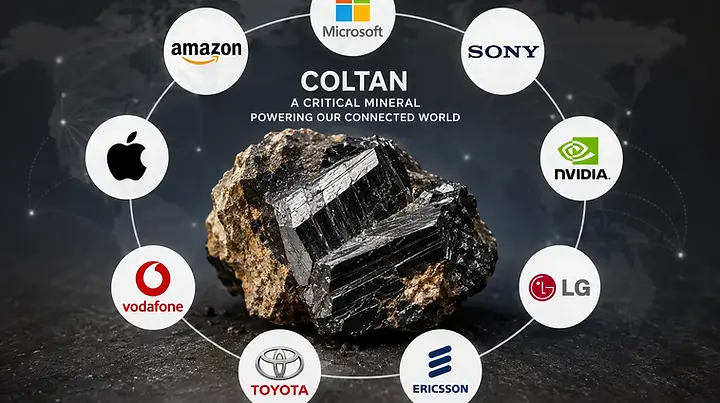
The report traces more than 2,000 tonnes of this smuggled mineral which originates from Rubaya, a site that supplies roughly 15 % of global tantalum into the supply chains of brands such as Microsoft, Apple, Amazon, Sony, Nvidia, Toyota, Vodafone, LG Display, Ericsson and Honda. A detailed breakdown of the smuggling network is provided in Global Witness’s investigative report.
The smuggled ore is sold to international traders and processed at smelters in China (e.g., Jiujiang Tanbre, Jiujiang Jinxin, Ningxia Orient, Ximei Resources) and Kazakhstan’s Ulba Metallurgical Plant. These smelters refine coltan into tantalum, which is used to manufacture capacitors.
Capacitor makers such as Kemet, Kyocera AVX, Vishay and Panasonic source from the implicated smelters, meaning the conflict mineral can end up in everyday devices. Downstream brands that reported these smelters in their supply chains include Microsoft, Amazon, Vodafone, Sony, Nvidia, LG Display, Ericsson, Toyota and Honda as cited by Okapi.
Conflict coltan mined and taxed in Rubaya
The Rubaya mines in North Kivu province are among the world’s richest coltan deposits. Since April 2024 the M23 rebel group backed by thousands of Rwandan troops has controlled these mines, turning them into a major revenue source.
M23’s parallel administration selects friendly traders, levies taxes of about US$4 per kilogram for M23 and US$3 per kilogram for Rwanda, and uses violence to enforce compliance. UN experts estimate that the group earns roughly US$800 000 per month from these taxes, while the conflict has killed and displaced thousands.
Smuggling across the border and booming exports
Most of the coltan is smuggled directly into Rwanda, often via M23‑controlled Goma, where Rwandan officials allegedly record incoming loads. Once in Kigali, smugglers mix the ore with Rwandan production to obscure its origin.
UN experts estimate that since April 2024 more than 120 tonnes of coltan per month have been trafficked from Rubaya to Rwanda. Within a year of M23’s takeover, at least 1 400 tonnes of coltan had been smuggled into Rwanda. Rwandan official figures show coltan exports more than doubling between 2021 and 2025, despite Rwanda’s own modest production.
WAR IN DR CONGO
Multinational Companies Cited in Rubaya–Rwanda Coltan Smuggling Chain

Jun 12, 2026
Jun 12, 2026
4 min read
Published
Updated:
A major investigation by Global Witness reveals how conflict coltan from Rubaya’s mines in eastern Democratic Republic of Congo (DRC) is being smuggled through Rwanda and laundered into the world’s electronics supply chains.
The report traces more than 2,000 tonnes of this smuggled mineral which originates from Rubaya, a site that supplies roughly 15 % of global tantalum into the supply chains of brands such as Microsoft, Apple, Amazon, Sony, Nvidia, Toyota, Vodafone, LG Display, Ericsson and Honda. A detailed breakdown of the smuggling network is provided in Global Witness’s investigative report.
The smuggled ore is sold to international traders and processed at smelters in China (e.g., Jiujiang Tanbre, Jiujiang Jinxin, Ningxia Orient, Ximei Resources) and Kazakhstan’s Ulba Metallurgical Plant. These smelters refine coltan into tantalum, which is used to manufacture capacitors.
Capacitor makers such as Kemet, Kyocera AVX, Vishay and Panasonic source from the implicated smelters, meaning the conflict mineral can end up in everyday devices. Downstream brands that reported these smelters in their supply chains include Microsoft, Amazon, Vodafone, Sony, Nvidia, LG Display, Ericsson, Toyota and Honda as cited by Okapi.
ADVERTISEMENT
Conflict coltan mined and taxed in Rubaya
The Rubaya mines in North Kivu province are among the world’s richest coltan deposits. Since April 2024 the M23 rebel group backed by thousands of Rwandan troops has controlled these mines, turning them into a major revenue source.
M23’s parallel administration selects friendly traders, levies taxes of about US$4 per kilogram for M23 and US$3 per kilogram for Rwanda, and uses violence to enforce compliance. UN experts estimate that the group earns roughly US$800 000 per month from these taxes, while the conflict has killed and displaced thousands.
Smuggling across the border and booming exports
Most of the coltan is smuggled directly into Rwanda, often via M23‑controlled Goma, where Rwandan officials allegedly record incoming loads. Once in Kigali, smugglers mix the ore with Rwandan production to obscure its origin.
ADVERTISEMENT
UN experts estimate that since April 2024 more than 120 tonnes of coltan per month have been trafficked from Rubaya to Rwanda. Within a year of M23’s takeover, at least 1 400 tonnes of coltan had been smuggled into Rwanda. Rwandan official figures show coltan exports more than doubling between 2021 and 2025, despite Rwanda’s own modest production.
Rwandan exporters and international traders
Global Witness identifies seven Rwandan exporters responsible for about 85 % of Rwanda’s coltan exports between January 2023 and September 2025, including East Group Minerals, Sunrise Metal Company, African Panther Resources, Tawotin, Kanzamin, Boss Mining Solution and Philbert Trading Minerals.
Evidence suggests that at least five of these companies routinely buy conflict coltan from Rubaya. Traders ship the ore through Tanzania or Kenya to smelters in China and Kazakhstan.


POPULAR TODAY


ADVERTISEMENT
Laundering through traceability schemes
Although Rwanda has legal requirements for mineral traceability, the dominant system ITSCI has been exploited to launder smuggled coltan. Smugglers told investigators that exporters simply apply ITSCI tags in Kigali or even at the border, turning DRC coltan into “Rwandan” coltan. An alternative system, Better Mining, has taken on some suspended ITSCI companies, but critics argue that both schemes fail to detect smuggled ore.
Recommendations and accountability
Global Witness argues that due diligence and traceability systems in the Great Lakes region have been gamed, allowing conflict minerals to enter global supply chains. The organisation recommends that companies stop buying Rwandan coltan until M23 withdraws from the Rubaya mines or until suppliers can rigorously verify origin. It calls on the international community to suspend military exports to Rwanda, condition aid on ending support for M23, and sanction responsible companies and officials.
ADVERTISEMENT
RELATED ARTICLE