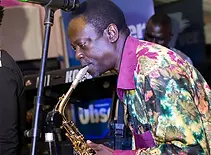
The singer and saxophonist guided Uganda’s longest-running band for five decades before his death in Kampala on 24 September 2026.
Moses Matovu was a Ugandan singer, saxophonist, composer and co-founder of Afrigo Band. Known to fans as Papa Moi, he helped build the group in 1975 and remained its defining leader for five decades. He died aged 77 on 24 September 2026 after a fatal confrontation in Kampala.
Early life and formative years in Kampala
Moses Matovu was born in Kawempe, Kampala, on 19 June 1949. He grew up largely with his mother after his parents separated and spent part of his childhood in Mengo. A Uganda Radio Network career profile records that he attended Namirembe Primary School and Pillai’s Secondary School, with part of his education supported by a Buganda Kingdom scholarship.
Music entered his life through church before it became his profession. As a child, Matovu sang in the Namirembe Cathedral choir. That background gave him an early ear for melody and ensemble performance, but football was initially just as important. He played for clubs including Nakivubo Boys, Lint Marketing Board, Express and Fiat, and later said football helped lead him into the Uganda Police Force.
Political upheaval disrupted his education in the 1960s. Instead of following a conventional academic route, he moved toward performance at a moment when Kampala’s clubs and hotel bands were becoming important spaces for modern Ugandan music.
Breakthrough from Thunderbirds to Afrigo Band
Matovu entered professional music in 1967 as a vocalist with the Thunderbirds Band. He joined the Police Band in 1968 and moved to the Cranes Band in 1969. Those groups developed his skills as a singer and instrumentalist; the police ensemble also exposed him to disciplined brass-band performance.
The decisive turning point came after the Cranes Band split. Matovu and fellow musicians formed Afrigo Band in the mid-1970s, with the group treating 31 August 1975 as its founding date. The name expressed an outward-looking idea: Africa moving forward through music.
Afrigo’s early home was Kampala’s live circuit. It combined Congolese rumba with Ugandan rhythms, melodic horn lines and songs in Luganda, Kiswahili and other languages. Matovu became its bandleader, vocalist, composer and saxophonist, a combination of musical and organisational roles that proved essential to the group’s survival.
BIOGRAPHY
Moses Matovu Biography: Afrigo Band Leader’s Life and Legacy

Sep 24, 2026
Sep 24, 2026
11 min read

Published
Updated:
The singer and saxophonist guided Uganda’s longest-running band for five decades before his death in Kampala on 24 September 2026.
Moses Matovu was a Ugandan singer, saxophonist, composer and co-founder of Afrigo Band. Known to fans as Papa Moi, he helped build the group in 1975 and remained its defining leader for five decades. He died aged 77 on 24 September 2026 after a fatal confrontation in Kampala.
Early life and formative years in Kampala
Moses Matovu was born in Kawempe, Kampala, on 19 June 1949. He grew up largely with his mother after his parents separated and spent part of his childhood in Mengo. A Uganda Radio Network career profile records that he attended Namirembe Primary School and Pillai’s Secondary School, with part of his education supported by a Buganda Kingdom scholarship.
Music entered his life through church before it became his profession. As a child, Matovu sang in the Namirembe Cathedral choir. That background gave him an early ear for melody and ensemble performance, but football was initially just as important. He played for clubs including Nakivubo Boys, Lint Marketing Board, Express and Fiat, and later said football helped lead him into the Uganda Police Force.
Political upheaval disrupted his education in the 1960s. Instead of following a conventional academic route, he moved toward performance at a moment when Kampala’s clubs and hotel bands were becoming important spaces for modern Ugandan music.
Breakthrough from Thunderbirds to Afrigo Band
Matovu entered professional music in 1967 as a vocalist with the Thunderbirds Band. He joined the Police Band in 1968 and moved to the Cranes Band in 1969. Those groups developed his skills as a singer and instrumentalist; the police ensemble also exposed him to disciplined brass-band performance.
The decisive turning point came after the Cranes Band split. Matovu and fellow musicians formed Afrigo Band in the mid-1970s, with the group treating 31 August 1975 as its founding date. The name expressed an outward-looking idea: Africa moving forward through music.
Afrigo’s early home was Kampala’s live circuit. It combined Congolese rumba with Ugandan rhythms, melodic horn lines and songs in Luganda, Kiswahili and other languages. Matovu became its bandleader, vocalist, composer and saxophonist, a combination of musical and organisational roles that proved essential to the group’s survival.
XTRAfrica’s Moses Matovu artist page records him separately from the wider Afrigo Band catalogue, reflecting how closely his individual identity and the band’s history became linked.
Sound, catalogue and artistic craft
Afrigo Band’s catalogue turned everyday Ugandan experiences into durable popular music. Songs associated with the group include “Afrigo Batuuse,” “Jim,” “Amazzi Genyama,” “Rose Guma,” “Speed,” “Obangaina,” “Tondeka Awaka” and “Olimujjawa.” Not every well-known Afrigo song was written by Matovu, but his singing, saxophone work and leadership helped give the catalogue its recognisable continuity.
Matovu’s playing was never built around virtuosity for its own sake. His horn lines served the song; his vocals carried narrative and emotion; and his arrangements left room for dancers and other musicians. That restraint helped Afrigo work equally well at weddings, hotel residencies, national celebrations and concert stages.
ADVERTISEMENT
In a late interview republished on the morning of his death, Matovu explained that experience changed how he heard his earliest recordings. He could laugh at the simplicity of his first tenor-saxophone work because decades of practice had refined his ear. He also resisted the assumption that every love song was autobiographical, describing songwriting as observation, adaptation and imagination.
The group’s longevity depended on rebuilding. Equipment was looted after the fall of Idi Amin, and Afrigo had to acquire instruments again piece by piece. Personnel also changed across the decades. Rather than freezing the band in one era, Matovu brought younger performers into an institution that could outlive individual members.
Heritage and Ugandan identity
Afrigo’s importance extends beyond a list of songs. The band remained active through governments, conflict, curfews, changing venues and the shift from vinyl and cassettes to digital distribution. Uganda’s official Afrigo-at-50 profile described its history as one of rhythm, resilience and relevance.
Matovu’s work connected Kampala’s cosmopolitan nightlife to local language and memory.
Afrigo borrowed from regional rumba but did not simply imitate Congolese stars. Its musicians placed Ugandan stories, humour, romance and social observation inside a sophisticated live-band sound.
The group also became a training ground. Performers associated with Afrigo over the years include Joanita Kawalya, Rachael Magoola, Frank Mbalire, Sammy Kasule and Herman Ssewanyana. Matovu’s willingness to share the stage made mentorship part of his cultural legacy.
Achievements, awards and professional leadership
Matovu received several lifetime-achievement honours. The Janzi Awards selected him as the first recipient of its music lifetime-achievement prize in 2021. Contemporary coverage of the Janzi recognition cited his long contribution to Uganda’s creative and performing arts.
He also received a HiPipo Music Awards Lifetime Achievement Award and earlier industry recognition. These honours acknowledged more than celebrity: Matovu had helped preserve a professional band structure in an industry often organised around individual stars and short release cycles.
He served in music-sector leadership positions, including work connected to musicians’ and performing-rights organisations. His record showed that creative longevity also requires administration, rehearsal discipline, rights awareness and the patient management of people.
Afrigo celebrated 50 years in 2025. Reaching that anniversary while still performing placed Matovu among a small group of African bandleaders who sustained one institution across several generations.
Personal journey and family status
Matovu kept much of his family life away from the centre of his public career. Older profiles contain family claims, but current authoritative documentation is too limited to publish them as settled facts in this obituary biography.
ADVERTISEMENT
His public identity instead remained tied to performance, football, mentorship and civic fellowship. He was associated with Rotary and continued discussing football long after music became his full-time life. Those interests present a fuller picture of a man whose authority came from consistency rather than constant self-promotion.
Final hours and the police investigation
Matovu died at Kibuli Hospital on Thursday, 24 September 2026, after suffering serious injuries in Kibuli, Kampala. He was 77. Uganda Police opened a suspected-murder investigation through Kabalagala Police Station.
The first reports described an attack by unidentified assailants. Later that morning, police supplied a more specific but still preliminary account. Nile Post reported the updated police statement, which said a physical confrontation followed a personal dispute outside a residence at about 5:30 AM. A woman who had been with Matovu was taken into custody to assist investigators, while police said a male suspect had been identified and was being pursued.
Those details are allegations under investigation, not a final account of motive or responsibility. Police said the exact circumstances remained unestablished. No court had determined guilt by the time this profile was completed.
The confirmed core is narrower: Matovu was injured during a confrontation, was taken to hospital and died; a homicide inquiry is continuing. Daily Monitor’s initial report and The Observer’s police-sourced account independently confirmed his death and the opening of the case.
Career timeline and key events
Year | Event | Significance |
1949 | Born in Kawempe, Kampala | Began a life rooted in Uganda’s capital and its changing cultural scene |
1967 | Joined Thunderbirds Band | Entered professional music as a vocalist |
1968 | Joined the Police Band | Developed brass and ensemble experience |
1969 | Moved to the Cranes Band | Expanded as a singer and instrumentalist |
1975 | Co-founded Afrigo Band | Created the institution that defined his career |
1980s–2000s | Rebuilt and sustained Afrigo through political and industry changes | Established the band’s unusual longevity |
2021 | Received major lifetime-achievement honours | Won recognition for decades of cultural work |
2025 | Afrigo Band marked 50 years | Celebrated one of Africa’s longest-running active bands |
2026 | Died after a confrontation in Kibuli | Ended a nearly six-decade career; police investigation continues |
Legacy and impact on African music
Matovu’s strongest achievement was institutional. Afrigo Band did not survive for 50 years simply because audiences remembered old hits. It survived because musicians rehearsed, recruited, adapted and kept performing. Matovu gave that continuity a face and a working method.
His death creates a leadership question for Afrigo, but it does not erase the structure he helped build. The catalogue remains, younger members carry experience gained beside him, and the band’s place in Uganda’s national story is secure.
For East African music, his career is evidence that a live band can absorb outside influences without losing local identity. It can also age without becoming a museum piece. Afrigo’s best work continued to circulate because it spoke to weddings, grief, courtship, social frustration and communal celebration the subjects through which popular music becomes memory.
His career also shows why cultural preservation cannot depend on nostalgia alone. The recordings, arrangements, photographs and oral histories around Afrigo deserve systematic archiving, with songwriters and performers properly credited. Matovu’s story spans the analogue, cassette, CD and streaming eras; preserving that record would let younger Ugandans understand not only the hits but the discipline behind them. It would also protect a history that remains scattered across interviews, private collections and memories of live performances.
Looking ahead for Afrigo Band
The immediate next steps belong to Matovu’s family, Afrigo Band and the police investigation. Funeral arrangements and any formal succession decisions should come from those authorities, not speculation.
For the band, the practical challenge is to preserve Matovu’s standards while allowing the next generation to lead. Archives, master recordings, song credits and performance histories also deserve careful documentation. A five-decade institution needs more than tribute concerts; it needs a protected record.


POPULAR TODAY


ADVERTISEMENT
The most credible honour will be continued performance and accurate preservation. Matovu spent his career keeping Ugandan live music moving. Afrigo’s future will show how deeply that lesson was learned.
Frequently asked questions
Who was Moses Matovu?
He was a Ugandan singer, saxophonist, composer and co-founder of Afrigo Band, serving as its best-known leader for five decades.
How old was Moses Matovu when he died?
He was 77, having been born on 19 June 1949 and died on 24 September 2026.
What was Moses Matovu’s nickname?
Fans and media often called him Papa Moi.
When was Afrigo Band formed?
Afrigo Band was formed in 1975 and marked its 50th anniversary in 2025.
Which instruments did Moses Matovu play?
He was best known as a saxophonist and vocalist and was also described as a flautist and composer.
What songs are associated with Afrigo Band?
Well-known titles include “Afrigo Batuuse,” “Jim,” “Amazzi Genyama,” “Speed,” “Rose Guma” and “Obangaina.”
How did Moses Matovu die?
He died after suffering injuries during a confrontation in Kibuli. Police are investigating the exact circumstances and pursuing an identified male suspect.
Was anyone arrested over Moses Matovu’s death?
Police said a woman who had been with him was in custody assisting investigators. That did not amount to a finding of criminal responsibility.
What happens to Afrigo Band after Moses Matovu’s death?
The band had not announced a permanent leadership arrangement when this profile was completed. Its long-standing members and younger performers retain the musical institution Matovu helped create.
ADVERTISEMENT
RELATED ARTICLE