Introduction
Southwest of Kinshasa, in the municipality of Mont-Ngafula, lies one of the best-known tourist sites in the capital of the Democratic Republic of the Congo: Lake Ma Vallée. Surrounded by abundant vegetation and situated in the Lukaya River valley, this artificial lake is a distinctive place where nature, history, recreation and tourism meet.
Away from the bustle of the city center, Ma Vallée offers visitors a landscape of water, hills, trees and forest. The site is particularly appreciated for walks, water activities and relaxing in nature. Its development dates back to the colonial period.
Lake Ma Vallée is therefore more than a tourist attraction. It also forms part of Kinshasa's historical and natural heritage. Its evolution over the decades reflects the city's transformation and the way some natural spaces have gradually become places for leisure.
1. Location and Address
Lake Ma Vallée Kimwenza neighborhood, Mont-Ngafula municipality Kinshasa, Democratic Republic of the Congo
The site is in the Lukaya River valley, not far from Kimwenza railway station. From Kinshasa, the route follows the Matadi road toward Kongo Central before turning toward Kimwenza and continuing to the lake area.
2. Why the Name “Ma Vallée”?
According to available historical information, the name is believed to relate to the site's location in the Lukaya River valley. “Ma,” meaning “my,” is said to refer to the private property on which the lake was developed, while “Vallée,” meaning “valley,” refers to the Lukaya valley. The name gradually became associated with the site.
The Lukaya River plays an important role in the area's geographical identity. The valley is also connected to the historic Matadi–Kinshasa railway, whose track passes through the area. The lake's history is therefore linked to water, forest and Kinshasa's older transport infrastructure.
VISIT DR CONGO
Lake Ma Vallée: Kinshasa's Historic Nature Escape

Oct 5, 2026
Oct 7, 2026
11 min read

Published
Updated:
Introduction
Southwest of Kinshasa, in the municipality of Mont-Ngafula, lies one of the best-known tourist sites in the capital of the Democratic Republic of the Congo: Lake Ma Vallée. Surrounded by abundant vegetation and situated in the Lukaya River valley, this artificial lake is a distinctive place where nature, history, recreation and tourism meet.
Away from the bustle of the city center, Ma Vallée offers visitors a landscape of water, hills, trees and forest. The site is particularly appreciated for walks, water activities and relaxing in nature. Its development dates back to the colonial period.
Lake Ma Vallée is therefore more than a tourist attraction. It also forms part of Kinshasa's historical and natural heritage. Its evolution over the decades reflects the city's transformation and the way some natural spaces have gradually become places for leisure.

1. Location and Address
Lake Ma Vallée Kimwenza neighborhood, Mont-Ngafula municipality Kinshasa, Democratic Republic of the Congo
The site is in the Lukaya River valley, not far from Kimwenza railway station. From Kinshasa, the route follows the Matadi road toward Kongo Central before turning toward Kimwenza and continuing to the lake area.
2. Why the Name “Ma Vallée”?
According to available historical information, the name is believed to relate to the site's location in the Lukaya River valley. “Ma,” meaning “my,” is said to refer to the private property on which the lake was developed, while “Vallée,” meaning “valley,” refers to the Lukaya valley. The name gradually became associated with the site.
The Lukaya River plays an important role in the area's geographical identity. The valley is also connected to the historic Matadi–Kinshasa railway, whose track passes through the area. The lake's history is therefore linked to water, forest and Kinshasa's older transport infrastructure.
3. An Artificial Lake Surrounded by Nature
Unlike some of Central Africa's large natural lakes, Lake Ma Vallée is artificial. Available information gives it a surface area of approximately 1 km², a length of about three kilometers and a width reaching approximately 300 meters. Its maximum depth is estimated at around 22 meters, with an average depth of approximately 15 meters.
The lake is surrounded by extensive vegetation. The forest and green spaces give the site its peaceful character, making it a kind of natural refuge close to a major metropolis such as Kinshasa.

This vegetation also gives the landscape considerable visual appeal. Visitors can observe trees, plants, birds and other elements of the local ecosystem while enjoying views of the lake.
ADVERTISEMENT
4. The History of Lake Ma Vallée
The history of Lake Ma Vallée dates back to the colonial period. Available historical sources indicate that an expatriate acquired the land in 1939 and that the lake was subsequently excavated and developed during the Second World War. By the 1950s, the site had become a leisure destination visited particularly by Europeans living in Congo and by tourists.
This period marked an important stage in the site's transformation. The lake was no longer simply a developed area within a natural setting: it was gradually becoming an established place for relaxation.
The 1950s
During the 1950s, Lake Ma Vallée enjoyed a degree of popularity. Visitors came to enjoy its natural surroundings and tranquility. Historical documents and studies of the site also mention development during that decade, including the construction of an embankment and the installation of facilities for visitors. One academic document on the lake specifically gives 1958 as the year it officially opened to the public.
However, available sources do not fully agree on some precise dates. Some give 1939 as the year the land was acquired, while a thesis available online mentions “1995,” which appears difficult to reconcile with the events it describes from the 1950s. Precise dates should therefore be checked whenever necessary.

5. A History Marked by Tragic Events
Lake Ma Vallée's history extends beyond tourism. The 1960s were marked by tragic events involving the family then operating the site. According to available historical accounts, the lake's owner was murdered in the early 1960s. His son subsequently took over management of the site but was also murdered a few months later, according to the account given by the sources consulted.
These events left a deep mark on the site's history. The concession later changed management. Available information indicates that the property eventually came under the responsibility of the National Episcopal Conference of Congo (CENCO). The site then went through different periods of operation and closure before gradually becoming a tourist destination again.
A thesis on Lake Ma Vallée states that CENCO acquired the site in the 1980s and that it experienced a period of closure during the 1990s before reopening to the public toward the end of that decade.
6. Lake Ma Vallée as a Tourist Destination
Over the years, Lake Ma Vallée has become one of the leisure destinations associated with Kinshasa. Its main advantage lies in its surroundings: visitors can enjoy a setting relatively removed from the bustle of the city center without completely leaving the capital.
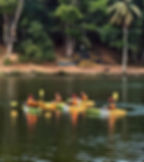
Tourism and Recreational Activities
The site offers opportunities to take part in or observe various nature-based tourism activities. The main activities mentioned include:
Walks around the lake.
Kayaking.
Pedal boating.
Fishing.
Outdoor activities.
Certain adventure activities.
Dining.
Photography and enjoying the scenery.
Tourism sources also mention activities such as zip-lining, aerial obstacle courses and archery during certain periods of the site's operation. These activities can turn a simple lake visit into a fuller tourism experience.
ADVERTISEMENT
7. The Site's Natural Beauty
One of Lake Ma Vallée's main attractions is its landscape. Trees and vegetation surround the lake, creating a striking contrast with Kinshasa's densely urbanized neighborhoods. This makes the site an appealing place for people who want to spend a few hours in quieter surroundings.

The water's surface reflects the trees surrounding the lake and offers different photographic opportunities, particularly as the light changes throughout the day.
8. Environmental Significance
Lake Ma Vallée's importance extends beyond tourism. The vegetation around the lake helps protect the soil, maintain biodiversity and regulate the local microclimate.
In a city as extensive as Kinshasa, conserving such green spaces is an important concern. The gradual loss of forests around the capital can have several consequences, including soil erosion, declining biodiversity and deteriorating landscapes.
Some sources also report that the forest around Lake Ma Vallée faces pressures linked particularly to tree cutting and charcoal production. Protecting this environment is therefore essential to safeguarding the site's future.
The lake can thus be seen as a place where tourism and environmental protection must go hand in hand.

9. The Question of Water Quality
Protecting the lake also means protecting its water quality. Scientific studies cited in sources about the site have reported bacteria such as Escherichia coli in certain parts of the lake. These findings highlight the importance of regular water-quality monitoring and help explain why swimming is not presented as an authorized activity at the site.
10. Lake Ma Vallée and Kinshasa's Tourism Culture
Lake Ma Vallée holds a distinctive place in Kinshasa's image as a tourism destination. For several decades, it has been a well-known destination for residents of the capital and international visitors.
Its proximity to other tourist sites, particularly the Lola ya Bonobo sanctuary, also makes it possible to consider itineraries combining several attractions in southwestern Kinshasa. The site therefore forms part of the capital's tourism history.
It also shows that Kinshasa is more than large buildings, markets, roads and urban neighborhoods. The city has natural spaces that can contribute to its appeal as a tourism destination.
11. Heritage Worth Preserving
Conserving Lake Ma Vallée is important for future generations. Several elements need protection:
The forest: Vegetation around the lake should be protected against excessive cutting and other forms of degradation.
The water: Water quality should be monitored to preserve the ecosystem and ensure visitor safety.
The landscape: Construction and tourism activities should be organized in ways that preserve the site's natural character.
Biodiversity: Plant and animal species in the area should be considered in tourism management.
Historical heritage: The lake's history should be more thoroughly documented and presented to visitors so they can understand the site's historical importance.
Tourism can become a means of financing conservation when activities are organized sustainably.
12. Future Prospects
Lake Ma Vallée has several possibilities for development. Giving greater attention to its historical heritage could help tell visitors the lake's story, from its creation to the present.
Information panels, educational trails and guided tours could also strengthen the site's educational value.
Ecotourism could be another important avenue. Activities could be developed around nature observation, learning about trees, environmental education and raising awareness of forest protection.
TRENDING NOW


POPULAR TODAY


ADVERTISEMENT
The site could also be more fully integrated into Kinshasa's tourism itineraries, particularly alongside other attractions in Mont-Ngafula and Kimwenza.
The aim would be to allow tourism to generate income while protecting the natural resources that make Lake Ma Vallée attractive in the first place.
Conclusion
Lake Ma Vallée is much more than a body of water on the outskirts of Kinshasa. It is a historical, tourism and environmental site that forms part of the Congolese capital's heritage.
Located in the Kimwenza neighborhood of Mont-Ngafula municipality, in the Lukaya valley, the lake stands out for its forest surroundings, its history dating to the colonial period and its many recreational activities.
Its history has passed through several stages: the lake's creation and development, the growth of tourism in the 1950s, tragic events in the 1960s, changes in management, periods of closure and the gradual resumption of tourism activities.
Today, Lake Ma Vallée offers an important opportunity for the development of nature-based tourism in Kinshasa. But its future also depends on the ability to preserve its forest, water quality, biodiversity and historical heritage.
Preserving Ma Vallée means preserving part of Kinshasa's history and natural heritage..
Sources and Documentary Note
This article was structured using the documentary information supplied for this feature: geographical and historical information on Lake Ma Vallée, mapping data, academic studies of the site, and tourism information relating to activities and visitor attendance.
Main Sources Mentioned in the Original Feature
Geographical and historical information on Lake Ma Vallée.
Mapping data and the site's location.
Academic studies of the history and management of Lake Ma Vallée.
Tourism information and activities at the site.
LAKE MA VALLÉE
Mont-Ngafula • Kimwenza • Kinshasa • Democratic Republic of the Congo
ADVERTISEMENT
RELATED ARTICLE


