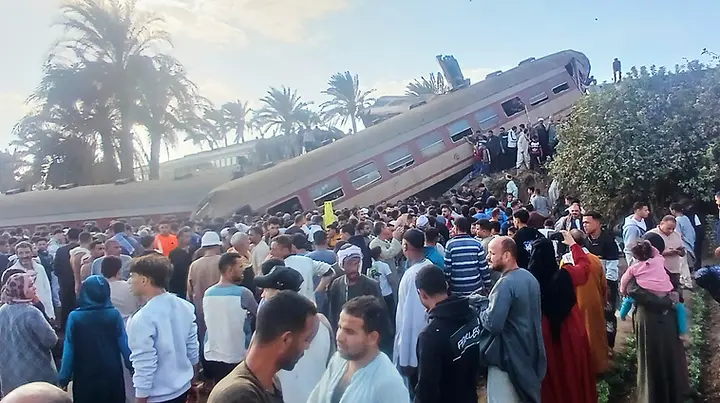
AL-AYYAT, Egypt — 9 November 2026. Egypt's Health Ministry has confirmed seven deaths and 125 injuries after two passenger trains collided on Sunday, 8 November, in Al-Ayyat district, Giza Governorate, south of Cairo. The ministry's late-Sunday update supersedes lower figures circulated during rescue operations. Authorities have opened a formal investigation into why one train struck another that was stopped on the same track.
The ministry said 71 injured people had been discharged after treatment by Sunday night. The accident also interrupted trains serving Upper Egypt, while railway and transport authorities arranged alternative journeys for affected passengers.
How many people died in the Egypt train collision?
Egypt's Health Ministry reported seven deaths and 125 injuries following the collision on 8 November 2026 in Al-Ayyat, Giza. The government said 71 injured people had left hospital by Sunday night. Prosecutors are investigating how the trains came to occupy the same track; no final cause has been announced.
How two trains collided south of Cairo
The Egyptian National Railways statement reproduced by the railway workers' union identified the services involved as train No. 134, a Tahya Misr passenger train travelling from Giza to Fayoum, and train No. 2010, which was operating from Cairo to Aswan.
The collision occurred between the Kafr Ammar and Al-Raqqa stations in the Al-Ayyat district. Several railway carriages derailed, and emergency crews were sent to remove damaged vehicles and clear the line.
The Public Prosecution's initial findings, published by Ahram Gate, describe the front of train 134 striking the last carriage of train 2010 while the latter was stationary on the same track, facing in the same direction. That describes the reported sequence, but it does not establish why the second train was stopped, how signalling was operating or whether any individual failed to follow a procedure.
Associated Press reporting from Al-Ayyat described nearby residents rushing toward the collision and helping people get out before and during the emergency response. Survivors recounted confusion inside damaged carriages as ambulances carried people to hospitals. Those accounts are evidence of the immediate human impact, not a technical explanation of the crash.
What Egypt's verified casualty figures show
ACCIDENT NEWS
Egypt Train Collision: 7 Dead, 125 Injured in Al-Ayyat

Nov 8, 2026
Nov 8, 2026
7 min read
Published
Updated:
AL-AYYAT, Egypt — 9 November 2026. Egypt's Health Ministry has confirmed seven deaths and 125 injuries after two passenger trains collided on Sunday, 8 November, in Al-Ayyat district, Giza Governorate, south of Cairo. The ministry's late-Sunday update supersedes lower figures circulated during rescue operations. Authorities have opened a formal investigation into why one train struck another that was stopped on the same track.
The ministry said 71 injured people had been discharged after treatment by Sunday night. The accident also interrupted trains serving Upper Egypt, while railway and transport authorities arranged alternative journeys for affected passengers.
How many people died in the Egypt train collision?
Egypt's Health Ministry reported seven deaths and 125 injuries following the collision on 8 November 2026 in Al-Ayyat, Giza. The government said 71 injured people had left hospital by Sunday night. Prosecutors are investigating how the trains came to occupy the same track; no final cause has been announced.
How two trains collided south of Cairo
The Egyptian National Railways statement reproduced by the railway workers' union identified the services involved as train No. 134, a Tahya Misr passenger train travelling from Giza to Fayoum, and train No. 2010, which was operating from Cairo to Aswan.
The collision occurred between the Kafr Ammar and Al-Raqqa stations in the Al-Ayyat district. Several railway carriages derailed, and emergency crews were sent to remove damaged vehicles and clear the line.
The Public Prosecution's initial findings, published by Ahram Gate, describe the front of train 134 striking the last carriage of train 2010 while the latter was stationary on the same track, facing in the same direction. That describes the reported sequence, but it does not establish why the second train was stopped, how signalling was operating or whether any individual failed to follow a procedure.
ADVERTISEMENT
Associated Press reporting from Al-Ayyat described nearby residents rushing toward the collision and helping people get out before and during the emergency response. Survivors recounted confusion inside damaged carriages as ambulances carried people to hospitals. Those accounts are evidence of the immediate human impact, not a technical explanation of the crash.
What Egypt's verified casualty figures show
Early ministry statements gave smaller totals while ambulances were still transporting casualties and hospitals were recording admissions. A earlier ministry figures reported by Ahram Online reported four deaths and 88 injuries. Prosecutors separately cited an initial estimate of seven deaths and 114 injured people. These were interim figures, not competing final findings.
By late Sunday, the Health Ministry's fuller figures carried by Ahram Online stood at seven people dead and 125 injured, or 132 hospital-received casualties in total. The ministry said 72 ambulances had supported evacuation and patient transfers. Reported injuries included cuts, bruises and fractures affecting the limbs, pelvis and spine.
The distribution of cases explains why medical teams were working across more than one governorate:
Al-Wasta Central Hospital: 87 casualties received, including three fatalities.
Al-Ayyat Central Hospital: 34 injured patients received.
Atfih Central Hospital: 11 casualties received, including four fatalities.
The same ministry update said 71 injured patients had been discharged after their conditions improved. Eleven other patients were moved to Beni Suef University Hospital or Beni Suef Specialist Hospital for continued care. A further 43 remained under observation at Al-Ayyat, Al-Wasta and Atfih hospitals at the time of the update. These figures reflect the ministry's Sunday-night snapshot, not a claim that every patient's status remained unchanged on Monday.
ADVERTISEMENT
The seven deaths were referred to the Public Prosecution's oversight. Names of victims should not be circulated without confirmation from the responsible authorities or their families.
Egypt's Public Prosecution opened an investigation and sent investigators to the site and nearby hospitals. According to the prosecutors' account published on 8 November, a specialist technical committee was ordered to examine the tracks, damaged rolling stock and circumstances in which several carriages left the rails.
The committee is also to examine railway operating procedures and safety requirements. The inquiry could establish whether technical problems, operating decisions or other factors contributed, but none of those possibilities should be presented as the confirmed cause before the investigation reports its findings.
President Abdel Fattah El-Sisi, in an official presidential statement on Sunday, directed government agencies to ensure medical care, accelerate the inquiry and pursue accountability where negligence is established. The directive is not itself a finding that a particular employee, operator or official caused the collision.
Train disruption, replacement buses and refunds
The collision affected the route linking Cairo with Upper Egypt. The national railway authority deployed emergency teams and cranes to remove wreckage, while service arrangements were adjusted during clearance work.
As Ahram Online reported from the rail authority's announcement, Egyptian National Railways offered refunds through station ticket offices to passengers who chose not to travel because of the disruption. The transport authorities also arranged buses on affected sections, including between Al-Wasta and Al-Ayyat and between El-Moneib and Al-Ayyat.
These were emergency arrangements announced on Sunday. They do not establish that every affected service had returned to its normal timetable by Monday. Travellers should check current departure information directly with Egyptian National Railways or their departure station before making connections.


ADVERTISEMENT
What compensation has been announced?
Egypt's Financial Regulatory Authority has issued separate instructions on support for those affected. In its 8 November statement, the regulator directed the Railway and Metro Accident Insurance Pool to accelerate procedures for victims and their families. It announced an exceptional increase in the insurance payment for a death or permanent total disability from EGP 30,000 to EGP 50,000.
The authority said other injuries would be treated according to the applicable rules and medical documentation. The instruction is an announced compensation measure, not proof that all payments have already reached beneficiaries. Families should rely on the responsible insurance and public authorities for documentation requirements and confirmed payment arrangements, rather than unofficial intermediaries.
The accident has brought renewed attention to rail operations in Al-Ayyat. AP's account of Egypt's railway history notes that the country has pursued railway modernisation while continuing to experience serious accidents. Two freight trains also collided in Al-Ayyat in September 2026, injuring two railway workers. That earlier case is separate and does not establish a common cause.
The immediate questions are specific: what did the technical inspection show, why was the Cairo–Aswan service stationary, what operating protection was in place, and when were normal services independently confirmed as restored? Answers depend on verified findings rather than speculation about driver behaviour or equipment failure.
For families, the near-term priorities remain medical updates, identifying the deceased through official channels and receiving the assistance already announced. For passengers, the priority is reliable train-service information. For railway safety, the next decisive milestone will be the prosecution's findings and any documented corrective action that follows.
