A Youth Transformed in Service of the Nation
In Kinshasa, blue uniforms and yellow boots have become a familiar sight. Behind the sanitation operations lies a broader policy: to supervise, train and reintegrate young people in order to steer them toward productive work and service to the community.
Destroy Yesterday, Build Tomorrow
1. When a Former Threat Becomes a Workforce
Early in the morning, as Kinshasa begins to come alive, groups of young people in uniform take up positions along the city's main roads. Brooms, shovels, rakes and wheelbarrows become their working tools. They clean drains, collect waste and help maintain public spaces. These young people are commonly known as the builders (bâtisseurs).
Their presence has become one of the most visible features of sanitation operations in the capital. But their story goes beyond simply cleaning the streets. Some of the young people directed to the National Service come from backgrounds marked by urban delinquency, particularly the phenomenon known as "Kuluna." The stated objective is to provide them with supervision, discipline and training so that they can gradually regain a productive place in society.
2. The National Service: Beyond the Image of the Uniforms
The National Service combines civic education, discipline, vocational training and productive activities, among other things. The Kaniama-Kasese centre in Haut-Lomami plays an important role in this system. It is presented as a place where young people can learn respect for rules, the value of work, responsibility, civic-mindedness and useful skills.
It is essential to distinguish the National Service from a prison. The supervision and training programme is not, in itself, a prison sentence. Some young people may be directed there after being arrested for acts of delinquency, but the intended approach is one of supervision and reintegration.
3. From the Street to Kaniama-Kasese: The Principle of a Second Chance
JUSTICE & CRIME
National Service in the DRC: From "Kuluna" to Builders

Sep 23, 2026
Sep 23, 2026
9 min read

Published
Updated:
A Youth Transformed in Service of the Nation
In Kinshasa, blue uniforms and yellow boots have become a familiar sight. Behind the sanitation operations lies a broader policy: to supervise, train and reintegrate young people in order to steer them toward productive work and service to the community.
Destroy Yesterday, Build Tomorrow

1. When a Former Threat Becomes a Workforce
Early in the morning, as Kinshasa begins to come alive, groups of young people in uniform take up positions along the city's main roads. Brooms, shovels, rakes and wheelbarrows become their working tools. They clean drains, collect waste and help maintain public spaces. These young people are commonly known as the builders (bâtisseurs).
Their presence has become one of the most visible features of sanitation operations in the capital. But their story goes beyond simply cleaning the streets. Some of the young people directed to the National Service come from backgrounds marked by urban delinquency, particularly the phenomenon known as "Kuluna." The stated objective is to provide them with supervision, discipline and training so that they can gradually regain a productive place in society.
2. The National Service: Beyond the Image of the Uniforms
The National Service combines civic education, discipline, vocational training and productive activities, among other things. The Kaniama-Kasese centre in Haut-Lomami plays an important role in this system. It is presented as a place where young people can learn respect for rules, the value of work, responsibility, civic-mindedness and useful skills.
It is essential to distinguish the National Service from a prison. The supervision and training programme is not, in itself, a prison sentence. Some young people may be directed there after being arrested for acts of delinquency, but the intended approach is one of supervision and reintegration.
3. From the Street to Kaniama-Kasese: The Principle of a Second Chance
The path of a young person without training, employment or prospects can become fragile. A lack of activity can increase exposure to delinquent networks and make it difficult to rebuild a life plan. The National Service seeks to interrupt this cycle by providing a structured environment.
Vocational training and productive activities are therefore a central component. Agriculture, in particular, plays an important role at Kaniama-Kasese. The principle is simple: learn to work, acquire skills and develop the ability to earn a living legally.
ADVERTISEMENT
The transformation being sought is therefore both professional and social. A young person is no longer defined solely by their past; they can gradually be recognized for what they learn and what they accomplish.
4. The Builders on the Streets of Kinshasa
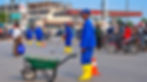
In Kinshasa, the most visible dimension of the programme today is sanitation. The builders work on roads, drains, public rights-of-way and certain heavily used public spaces.
Action With Immediate Effects
Cleaning major roads and public spaces.
Clearing and cleaning certain drains.
Collecting and removing waste from roadways.
Participating in community and productive work.
Contributing to a more orderly appearance along certain routes in the capital.
Boulevard Lumumba is particularly symbolic. As a major road connecting different parts of Kinshasa and an important route to N'Djili International Airport, it serves as a showcase for the capital. Its maintenance is therefore not only about cleanliness; it also affects the city's image and perceptions of how well it is organized.
5. A Clean City Cannot Be Built Through Cleaning Alone
Sanitation teams can clear a road or a drain, but the durability of the result depends on what happens afterward. If waste is thrown back into the same place, the problem quickly returns. Sanitation must therefore become a collective responsibility.
Cleaning must be combined with regular waste collection, the availability of trash bins, public awareness, proper organization of markets and respect for rules. The behaviour of residents, traders and road users is decisive.
6. Work as a Tool for Rebuilding Lives
Work also has an educational dimension. Respecting schedules, following instructions, working as a team and completing a task that benefits the community can help create new habits. Collective activity can also encourage solidarity, responsibility and team spirit.
This is where the term "builder" takes on its full meaning: the idea is no longer simply to correct behaviour, but to channel the energy of young people toward production, maintenance and development.
ADVERTISEMENT
7. Expected Benefits and the Conditions for Reintegration

The programme pursues several objectives at once. For young people, it can provide structure, training and work experience. For the city, it provides teams capable of intervening quickly in certain areas. For society, it carries the idea that a difficult past does not necessarily prevent someone from having a second chance.
For Young People
Civic education and learning discipline.
Acquisition of professional and practical skills.
Experience in collective work.
An opportunity to prepare for social and economic reintegration.
Temporary removal from certain high-risk environments.
For Kinshasa and the Community
Temporary improvements in the cleanliness of certain major roads.
Maintenance of drains and public rights-of-way.
Recognition of the value of community work.
Reinforcement of the message that young people can contribute to development.
8. The Major Challenge: What Happens Afterwards?
The real test of a reintegration policy does not lie only in the period of supervision. It comes after the young person returns to society. Do they reunite with their family? Can they practise the trade they learned? Can they find employment or an economic activity? Can they permanently distance themselves from their former networks? These questions determine how durable the change will be.
Families, businesses and training institutions can play complementary roles. Training that leads to employment, an apprenticeship or an income-generating activity has a greater chance of producing lasting change.
9. Agriculture and Production: Building Instead of Destroying
Agriculture occupies a special place in this vision. Producing food, learning to work the land and developing agricultural skills make it possible to combine discipline with economic activity. The approach therefore goes beyond simple supervision: it seeks to turn a young person into a producer and, eventually, someone capable of creating value.
This approach connects with a broader question: How can the potential of Congolese youth be transformed into a force for development? The National Service obviously cannot, on its own, address every challenge related to employment, training and reintegration. It is part of a much broader challenge.
10. The Programme's Limits, Questions and Future
An article about the builders must also examine the difficulties. The first concerns the sustainability of sanitation. A road can be cleaned today and covered with waste again tomorrow. The result therefore depends on a permanent system of collection, awareness and accountability.
The second challenge concerns commercial activities in public spaces. Clearing certain public rights-of-way can improve traffic flow and urban order, but it can also affect the livelihoods of people who sell their products there. A sustainable policy must therefore seek a balance between sanitation, urban organization and opportunities to work.


POPULAR TODAY


ADVERTISEMENT
The third issue concerns the quality of supervision. The success of a reintegration policy depends on living conditions, the quality of training received, respect for procedures and the ability to handle incidents properly. Transparency and regular evaluation are essential for measuring results.
11. Measuring Success Through Results
Images of young people in uniform and street-cleaning operations are visible, but they are not enough on their own to measure the programme's effectiveness. The most meaningful indicators are those that make it possible to follow the young people's progress over time.
Number of young people actually trained and skills acquired.
Number of young people reintegrated into professional or productive activities.
Changes in the circumstances of young people after they return to society.
Quality and regularity of training.
Conditions of supervision and care.
Sustainability of the results achieved through sanitation operations.
12. Conclusion - Building a New Life to Build the Country
Today, the National Service represents much more than a group of young people tasked with sweeping the streets. Behind every uniform is a different story. Some have experienced delinquency; others joined the programme through different pathways. All are now presented as builders.
The most visible part of their work is on the streets of Kinshasa. The most important part, however, lies elsewhere: in training, in the fields, in learning a trade and, above all, in the lives of the young people after they return to society.
The real challenge is therefore twofold: to make public spaces cleaner while enabling young people to rebuild their futures.
A clean road improves a city. A trained, responsible and reintegrated generation of young people can help build an entire country.
ADVERTISEMENT
RELATED ARTICLE


