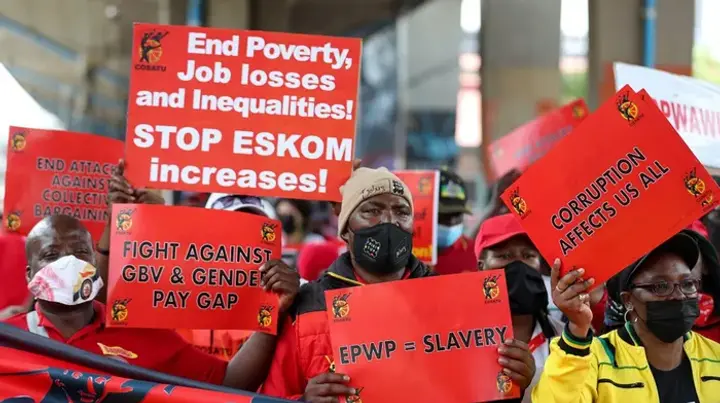
JOHANNESBURG, South Africa - 7 October 2026: The Congress of South African Trade Unions has called nationwide marches and pickets for Wednesday to press demands over job losses, wages and workplace protections, according to morning reporting by SABC News.
The programme coincides with World Day for Decent Work. COSATU spokesperson Zanele Sabela said the federation was raising concerns about retrenchments, employers failing to comply with the minimum wage and the replacement of secure jobs with less stable employment.
The announcement sets out a protest programme, not evidence that every workplace or public service has stopped operating. Attendance, road restrictions and service interruptions need to be assessed locally rather than inferred from the national call.
Why has COSATU called protests for 7 October?
The federation says workers face job cuts, weak minimum-wage enforcement and insecure employment. Its announced programme combines marches and pickets with demands for stronger workplace protections. A nationwide protest call does not, by itself, establish a nationwide shutdown or the scale of participation.
Minimum-wage enforcement is a central demand
COSATU wants stronger enforcement of labour protections rather than relying on wage announcements alone. Jacaranda FM's report attributes to Sabela a call for the government to accelerate recruitment of 10,000 additional labour inspectors.
The federation also identifies collective bargaining, social protection and retirement provision among its concerns. These demands cover both what workers earn and the conditions under which they keep their jobs.
A statutory wage floor and the amount reaching a worker's pay packet are not the same thing. COSATU's argument is that enforcement capacity must accompany wage policy so that employees can benefit from the protections government announces.
Government promised additional inspectors in February
POLICY AND REFORMS
COSATU Calls Nationwide Protests Over Jobs, Wages and Workers' Rights

Oct 7, 2026
Oct 7, 2026
5 min read
Published
Updated:
JOHANNESBURG, South Africa - 7 October 2026: The Congress of South African Trade Unions has called nationwide marches and pickets for Wednesday to press demands over job losses, wages and workplace protections, according to morning reporting by SABC News.
The programme coincides with World Day for Decent Work. COSATU spokesperson Zanele Sabela said the federation was raising concerns about retrenchments, employers failing to comply with the minimum wage and the replacement of secure jobs with less stable employment.
The announcement sets out a protest programme, not evidence that every workplace or public service has stopped operating. Attendance, road restrictions and service interruptions need to be assessed locally rather than inferred from the national call.
Why has COSATU called protests for 7 October?
The federation says workers face job cuts, weak minimum-wage enforcement and insecure employment. Its announced programme combines marches and pickets with demands for stronger workplace protections. A nationwide protest call does not, by itself, establish a nationwide shutdown or the scale of participation.
Minimum-wage enforcement is a central demand
COSATU wants stronger enforcement of labour protections rather than relying on wage announcements alone. Jacaranda FM's report attributes to Sabela a call for the government to accelerate recruitment of 10,000 additional labour inspectors.
The federation also identifies collective bargaining, social protection and retirement provision among its concerns. These demands cover both what workers earn and the conditions under which they keep their jobs.
ADVERTISEMENT
A statutory wage floor and the amount reaching a worker's pay packet are not the same thing. COSATU's argument is that enforcement capacity must accompany wage policy so that employees can benefit from the protections government announces.
Government promised additional inspectors in February
The recruitment proposal predates this week's protests. In his 12 February 2026 State of the Nation Address, President Cyril Ramaphosa announced an additional 10,000 labour inspectors. The pledge appeared in a section addressing enforcement of immigration, labour and other laws.
Eight days later, Employment and Labour Minister Nomakhosazana Meth described the proposed appointments as permanent posts during a Gauteng Labour Activation Programme speech. She separately referred to a labour-inspector internship programme and said more than 3,000 young recruits had begun deployment at that stage.
Those were different categories: planned permanent appointments and an internship initiative. The February statements do not establish that all 10,000 permanent inspectors were subsequently recruited, trained or deployed.
For the current dispute, the relevant question is progress against that commitment: how many additional inspectors are in workplaces, what authority they exercise and whether enforcement is reaching vulnerable employees. The earlier speeches provide government policy context, not a response to Wednesday's demonstrations.
ADVERTISEMENT
The announced programme includes local workplace actions
COSATU's 1 October programme statement linked activities around the World Federation of Trade Unions anniversary with World Day for Decent Work.
It specifically described marches in Johannesburg and Tshwane for 7 October. For KwaZulu-Natal, it identified a planned DENOSA march in Durban and workplace activity around Richards Bay Minerals. The programme also listed activities in other provinces across the commemorative period.
The distinction between those dates is important: an activity in the wider programme should not automatically be described as taking place on Wednesday. Nor does a listed destination establish that a memorandum has already been delivered or that the institution concerned has accepted its demands.
Global Business Solutions' notice summary describes an announced national action period of 09:00 to 16:30 South African time. That is an overall window, not a verified start time for every local march.
NUM links the campaign to secure employment
In its 5 October mobilisation statement, the National Union of Mineworkers called on workers in mining, energy, construction and metalworking to join the COSATU programme.
NUM argues that permanent employment is being weakened by restructuring and insecure subcontracted work. It also says training programmes should lead to sustainable careers rather than substitute for permanent positions.
TRENDING NOW


POPULAR TODAY


ADVERTISEMENT
These are the union's stated concerns, not findings against every employer in those industries. Its demands include living wages, safe workplaces, social protection and respect for collective bargaining.
The emphasis on security extends beyond a single payday. A worker may retain some paid hours while losing predictable income, benefits or the ability to plan household spending. That is why the campaign combines demands about wages with demands about the quality and stability of employment.
What workers and commuters need next
For commuters, the relevant updates are confirmed local routes, restrictions and transport arrangements. A national announcement is not a substitute for a municipal traffic advisory or an operator's service notice.
Workers considering participation should obtain guidance from their union and employer about the notice applicable to their workplace, attendance and pay. A protest announcement should not be treated as an automatic entitlement to paid absence or as an instruction that every service must close.
The next developments to track are actual memorandum handovers, responses from employers and government, and dated progress on inspector recruitment. Those outcomes will show whether the programme produces specific commitments beyond the demands announced before the marches.
ADVERTISEMENT
RELATED ARTICLE